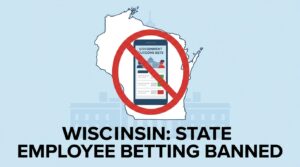
Wisconsin’s Ethics Commission has enacted new rules prohibiting state executive branch employees from placing wagers on prediction markets tied to government decisions, policy outcomes, or elections they may influence. The move makes Wisconsin one of the first states to directly address the growing intersection of public-sector ethics and the rapidly expanding prediction market industry. These rules, which took effect in 2025, target platforms where users can bet on everything from regulatory rulings to legislative votes. For a state workforce numbering in the tens of thousands, the implications reach well beyond symbolic governance.
What Wisconsin’s New Ethics Framework Actually Targets
Before unpacking the strategic consequences, it helps to understand the specific prohibitions now in place and what they signal about the regulatory direction for prediction markets at the state level.
- Executive branch employees are barred from wagering on prediction markets where the outcome could be influenced by their official duties or access to nonpublic information
- The rules extend to platforms like Kalshi and Polymarket, which have seen surging volumes on political and policy-related contracts
- Wisconsin’s Ethics Commission framed the prohibition as a natural extension of existing conflict-of-interest statutes, not an entirely new regulatory category
- Violations could trigger disciplinary action under the state’s ethics code, though criminal penalties were not explicitly outlined in the initial guidance
- The rules do not appear to restrict prediction market participation on topics unrelated to an employee’s governmental role
Why Prediction Markets Forced the Issue
Prediction markets have existed in various forms for decades. What changed is scale. Platforms like Kalshi’s regulated prediction exchange now process millions of dollars in contracts pegged to Federal Reserve decisions, election results, and agency rulings. Polymarket, operating largely outside U.S. regulatory perimeters, saw extraordinary volume during the 2024 presidential election cycle.
That growth created a problem Wisconsin apparently decided it could no longer ignore.
A state employee with advance knowledge of a pending regulatory decision, budget allocation, or policy shift could, at least in theory, profit from that information on a prediction market. The analogy to insider trading in securities markets is imperfect but instructive. Securities law has decades of case law defining material nonpublic information. Prediction markets, by contrast, sit in a gray zone where federal oversight remains fragmented between the CFTC and state gambling regulators (a distinction regulators have been slow to enforce). Wisconsin’s move sidesteps that federal ambiguity by anchoring its prohibition in state-level ethics law rather than financial regulation.
A Template for Other States?
Whether other states follow Wisconsin’s lead depends on several factors that remain unresolved. Most state ethics codes already contain broad conflict-of-interest provisions. But few have been tested against the specific mechanics of prediction market contracts. The question is whether existing language is sufficient or whether explicit rulemaking, like Wisconsin’s, becomes necessary to create enforceable boundaries.
States with large executive branch workforces and active prediction market user bases are the most likely candidates. New York, California, and Illinois all have robust ethics commissions and significant state employee populations. Yet none have publicly signaled similar action as of mid-2025.
Still, the precedent matters. Wisconsin’s Ethics Commission did not need new legislation to act. It interpreted existing authority to cover a novel market structure. That interpretive flexibility gives other state ethics bodies a roadmap that doesn’t require legislative calendars or partisan negotiation.
How This Reshapes Risk for Prediction Market Platforms
For platforms themselves, fragmented state-by-state ethics rules add a compliance layer that didn’t exist twelve months ago. Consider the operational challenge: a platform would need to determine whether a user holds a government position, assess whether a given contract intersects with that user’s official responsibilities, and potentially restrict access accordingly. None of that is straightforward at scale.
Kalshi, which holds CFTC approval for certain event contracts, has built its business model around regulatory legitimacy. State ethics rules that effectively limit its addressable market among government employees represent a different kind of risk than an outright federal ban. It’s subtler. And arguably harder to manage.
| Factor | Impact on Prediction Platforms | Impact on State Employees |
|---|---|---|
| Scope of prohibition | Requires new user-screening protocols for government-linked accounts | Must evaluate whether any contract touches their official duties |
| Enforcement mechanism | Platforms face reputational risk if employees are caught using them improperly | Disciplinary action under state ethics code |
| Federal regulatory overlap | CFTC jurisdiction doesn’t preempt state ethics rules | Employees face dual compliance obligations |
| Precedent effect | Other states may adopt similar frameworks, compounding compliance costs | Broader chilling effect on government workers’ market participation even in permitted categories |
The Behavioral Dimension: Trust, Transparency, and Public Perception
Beyond the legal mechanics, Wisconsin’s decision taps into something deeper about how citizens perceive government integrity. When public employees can profit from outcomes they help shape, the appearance of corruption erodes institutional trust regardless of whether actual misconduct occurs. Behavioral research consistently shows that perceived conflicts of interest damage credibility nearly as much as proven ones. The mere existence of a financial incentive tied to a policy outcome shifts how the public interprets that outcome.
This is where framing matters enormously. Wisconsin positioned its rules not as a crackdown on gambling but as a safeguard for public confidence. That distinction carries weight. Employees who understand the “why” behind a prohibition are more likely to internalize it than those who see it as arbitrary restriction. And for the broader public, knowing that state workers cannot bet on the decisions they influence provides a concrete anchor for trust in government processes.
Effective communication of these rules will likely determine their real-world impact. An ethics rule that exists only in a compliance manual achieves far less than one embedded in onboarding, training, and institutional culture. The psychological contract between government and citizen depends on visible accountability structures, not just legal ones.
Frequently Asked Questions
Can Wisconsin state employees still use prediction markets for non-government topics?
Based on the current guidance, the prohibition targets contracts where outcomes intersect with an employee’s official duties or access to nonpublic government information. Betting on, say, weather events or sports outcomes would not appear to fall within the restriction, though employees should verify with the Ethics Commission.
Does this affect federal employees working in Wisconsin?
No. Wisconsin’s rules apply to state executive branch employees. Federal employees are governed by separate ethics frameworks administered by the U.S. Office of Government Ethics, which has not yet issued specific guidance on prediction markets.
Are other states expected to follow?
No formal announcements have been made, but the interpretive approach Wisconsin used could be replicated by any state with comparable ethics statutes. The timeline for adoption elsewhere remains uncertain.
What penalties do employees face for violations?
Disciplinary action under Wisconsin’s ethics code. The initial rules did not specify criminal penalties, though repeated or egregious violations could theoretically trigger broader legal scrutiny.



