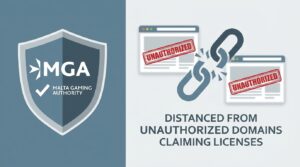
The Malta Gaming Authority (MGA) has publicly disavowed any connection to two online gambling platforms operating under the domains dragonia-de.de and dragonia-casino.at. In a formal notice, the regulator confirmed that neither site holds a valid Maltese gaming licence, and that any such claims appearing on these platforms are false and unauthorised. The move underscores a sharpening enforcement posture from one of Europe’s most prominent iGaming regulators, and it carries direct implications for operators, affiliates, and B2B service providers across the sector.
What the MGA’s Disavowal Signals for the Industry
This is not the first time the MGA has flagged unauthorised use of its licensing credentials, but each instance reinforces a pattern that compliance teams should be tracking closely. The two domains in question appear to target German and Austrian markets, jurisdictions where regulatory scrutiny has intensified considerably over the past two years. Before unpacking the broader consequences, here are the core takeaways from this enforcement notice:
- No valid licence exists: The MGA has confirmed it holds no legal or commercial relationship with either dragonia-de.de or dragonia-casino.at. Any licensing claims on these sites are fabricated.
- Counterparty risk is rising: B2B providers, payment processors, and affiliate networks that onboard partners without verifying licence authenticity face growing regulatory and reputational exposure.
- Operators targeting DACH markets with false Maltese credentials may trigger enforcement actions not only from the MGA but from Germany’s GGL and Austria’s own regulatory bodies.
- Trust infrastructure matters more than ever: Players and partners alike rely on licence seals as trust signals. Each fraudulent use erodes that trust system for legitimate MGA licensees.
How Licence Misrepresentation Actually Works
The mechanics are deceptively simple. An unauthorised operator places an MGA logo or licence number on its website, sometimes copying details from a legitimate licensee. Visitors, particularly players unfamiliar with verification procedures, assume the platform operates under Maltese regulatory oversight. That assumption carries weight. Malta’s single-licence framework, established under the Gaming Act of 2018, is widely regarded as one of the more rigorous in Europe (a distinction regulators have been slow to enforce uniformly across all licensees).
Yet the gap between perception and reality can be wide. Players depositing funds on platforms like dragonia-de.de may believe they have recourse through the MGA’s player support mechanisms. They do not. And affiliates driving traffic to such domains risk facilitating unlicensed gambling, which in several European jurisdictions now carries direct legal consequences for intermediaries.
Verification Is Not Optional
The MGA maintains a public registry of all authorised operators and licences. Checking it takes minutes. Still, the frequency of these notices suggests that many market participants skip this step entirely, whether out of negligence or commercial pressure to onboard quickly. That shortcut is becoming costlier.
| Domain | Claimed Licence | MGA Status | Target Market |
|---|---|---|---|
| dragonia-de.de | Maltese gaming licence (unspecified) | No connection confirmed; licence claim is false | Germany |
| dragonia-casino.at | Maltese gaming licence (unspecified) | No connection confirmed; licence claim is false | Austria |
Regulatory Ripple Effects Across the DACH Region
Germany’s Gemeinsame Glücksspielbehörde der Länder (GGL) has been actively pursuing unlicensed operators since gaining enforcement powers in mid-2023, including ISP blocking orders and payment disruption measures. Austria, while slower to modernise its gambling framework, has nonetheless seen courts and regulators take a harder line on offshore operators claiming European credentials.
The MGA’s notice, then, does not exist in isolation. It feeds into a broader enforcement ecosystem where regulators increasingly share intelligence and coordinate actions. An operator flagged by the MGA today could face payment processing blocks in Germany within weeks. That chain reaction is precisely what makes licence misrepresentation a higher-stakes gamble than it was even three years ago.
Building a Compliance-First Mindset: Lessons Beyond the Notice
For executives navigating this landscape, the instinct might be to treat each MGA notice as a discrete event. That framing misses the structural shift underway. Regulatory bodies across Europe are moving from reactive enforcement toward proactive surveillance, leveraging automated monitoring tools and cross-border data sharing agreements. What this means in practice is that the window for operating in grey areas is narrowing, arguably faster than many mid-tier operators have anticipated.
Consider the compliance function not as a cost centre but as a competitive moat. Operators and B2B providers with robust due diligence frameworks are better positioned to retain banking relationships, secure affiliate partnerships, and maintain player trust. The reputational damage from being associated with a platform like dragonia-casino.at, even indirectly through an affiliate link, can take months to unwind.
Reframing risk perception is essential here. Behavioural research consistently shows that organisations underestimate low-probability, high-impact events until they experience one directly. The MGA’s public notices serve as external pattern interrupts, forcing stakeholders to reassess assumptions about counterparty legitimacy. Anchoring compliance decisions to concrete, recent enforcement actions rather than abstract policy documents tends to produce faster organisational change. Teams that regularly review regulatory bulletins and integrate them into onboarding workflows build what might be called institutional vigilance, a quality that compounds over time.
Frequently Asked Questions
How can I verify whether an online casino holds a legitimate MGA licence?
The MGA publishes a searchable register of all authorised operators on its official website. Any platform claiming a Maltese licence should appear in that register with matching details. If it doesn’t, treat the claim as fraudulent.
What should B2B providers do if a partner is flagged by the MGA?
Terminate or suspend the commercial relationship immediately pending review. Continuing to provide services to an entity the MGA has publicly disavowed creates both regulatory exposure and reputational risk that far outweighs any short-term revenue.
Are players protected if they deposited funds on these sites?
No. Because neither domain holds a valid MGA licence, the MGA’s player support and dispute resolution mechanisms do not apply. Players would need to pursue remedies through other channels, which in practice are extremely limited for unlicensed platforms.
Could affiliates face penalties for promoting these domains?
Increasingly, yes. Several European jurisdictions now hold intermediaries accountable for facilitating access to unlicensed gambling services, and enforcement precedents are building.



