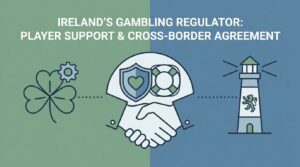
The Gambling Regulatory Authority of Ireland (GRAI) has hit two milestones in quick succession, unveiling a national player support platform and formalising a regulatory cooperation agreement with the Alderney Gambling Control Commission. Both moves arrive as the GRAI works to build out Ireland’s first comprehensive gambling oversight framework, a process that has drawn scrutiny from operators, public health advocates, and neighbouring jurisdictions alike. The timing is deliberate: with full licensing operations still ahead, the regulator is laying groundwork on harm prevention and international credibility before the heaviest compliance demands take effect.
What the GRAI’s Latest Moves Signal for Operators and Players
These two announcements, while distinct in scope, share a common thread. They position the GRAI as a regulator that intends to operate on two fronts simultaneously: public protection and cross-jurisdictional alignment. For an authority still in its establishment phase, that’s an unusually assertive posture.
- The launch of TheGamePlanHub.ie creates a single national entry point for gambling harm education and support, filling a gap that advocacy groups had flagged for years
- A Memorandum of Understanding with the AGCC opens a formal channel for sharing regulatory intelligence, enforcement approaches, and compliance frameworks across borders
- Ireland’s regulatory trajectory now mirrors patterns seen in other recently regulated European markets, where harm-reduction infrastructure preceded full licensing rollouts
- Operators targeting the Irish market should expect the GRAI to benchmark its standards against jurisdictions like Alderney, which has decades of enforcement precedent
- The MoU could serve as a template for future bilateral agreements, particularly with the UK Gambling Commission and Malta Gaming Authority
TheGamePlanHub.ie: More Than a Website
On the surface, launching a website might seem like a modest step. But Ireland’s centralised gambling support resource addresses a structural problem that persisted for years under the country’s outdated regulatory patchwork. Previously, individuals seeking help for gambling-related harm had to navigate a fragmented landscape of charities, health services, and informal referral networks. No single government-backed platform existed.
TheGamePlanHub.ie consolidates educational content on gambling risks, self-assessment tools, and pathways to professional support. It targets not just individuals who gamble, but also their families and wider social networks (a distinction regulators have been slow to enforce in other jurisdictions). The platform’s design reflects a public health framing of gambling harm, rather than treating it purely as a consumer protection issue.
Whether this resource will be adequately promoted remains an open question. Similar platforms in other markets have struggled with visibility, particularly among demographics most at risk.
Cross-Border Cooperation with Alderney
The MoU with the Alderney Gambling Control Commission carries a different kind of weight. Alderney, a small Crown Dependency in the English Channel, has operated as a licensed gambling jurisdiction since 2000. Its regulatory framework, while governing a far smaller market, is considered rigorous and well-documented. For the GRAI, this partnership offers something money can’t easily buy: institutional knowledge from a regulator that has already navigated the challenges Ireland is about to face.
Under the agreement, both authorities can exchange information related to licensees, enforcement actions, and emerging risks. In practice, this means the GRAI could receive early warnings about operators flagged by Alderney, and vice versa. The arrangement also allows for joint discussions on regulatory methodology, which could shape how the GRAI designs its own licensing conditions.
Still, a bilateral MoU is only as useful as the willingness to act on shared intelligence. Regulatory cooperation agreements exist across dozens of gambling jurisdictions globally, yet enforcement gaps persist where political will or resource constraints intervene.
How Ireland’s Approach Compares to Other Emerging Frameworks
| Jurisdiction | Regulatory Stage | Harm Prevention Platform | International MoUs |
|---|---|---|---|
| Ireland (GRAI) | Establishment phase; licensing pending | TheGamePlanHub.ie launched | AGCC (signed) |
| Netherlands (KSA) | Fully operational since 2021 | Loket Kansspel (operational) | Multiple EU and non-EU agreements |
| Germany (GGL) | Operational since 2023 | Regional counselling network | Limited bilateral agreements to date |
| Brazil | Licensing framework under development | No centralised platform yet | None publicly confirmed |
Ireland’s sequencing, prioritising harm infrastructure before licensing, arguably puts it ahead of Brazil and on par with the Netherlands at a comparable stage. Germany’s GGL, by contrast, launched licensing first and built out player protection tools afterward, a decision that drew criticism from public health researchers.
The Strategic Psychology Behind Early Harm Prevention
There’s a reason the GRAI chose to launch a harm-reduction platform before issuing its first licence. Regulatory bodies that establish credibility on player protection early tend to face less political resistance when they later introduce commercially significant decisions around licensing fees, advertising restrictions, or stake limits. This sequencing works on a perceptual level: it frames the regulator as a public guardian first and a market architect second.
From a behavioural standpoint, early visibility of support resources can also shape how operators position their own responsible gambling messaging. When a national platform exists, operators lose the ability to claim they are the primary source of harm-prevention information. That shift in framing matters. It moves the locus of trust from commercial entities to a public authority, which in turn strengthens the regulator’s hand in future negotiations over compliance standards.
And for players themselves, the existence of a government-endorsed resource creates what behavioural economists call a “default anchor.” Even individuals who never visit the site may adjust their perception of gambling risk simply by knowing such a platform exists. The GRAI appears to understand that regulation is not just a legal exercise; it is, at least in part, a communication strategy aimed at reshaping public norms around gambling behaviour.
Yet none of this works without sustained investment. Platforms launched with fanfare and then left to stagnate have undermined regulator credibility in other markets. The GRAI will need to demonstrate ongoing commitment through content updates, user engagement metrics, and integration with frontline health services.
Frequently Asked Questions
What is TheGamePlanHub.ie?
It is a centralised, government-backed platform launched by the GRAI to provide education on gambling risks, self-assessment tools, and referral pathways for individuals and families affected by gambling-related harm in Ireland.
What does the MoU between the GRAI and AGCC cover?
The agreement enables both regulators to share information about licensed operators, enforcement actions, and emerging market risks. It also facilitates discussions on regulatory best practices and compliance design.
Is the GRAI currently issuing gambling licences?
Not yet. The authority remains in its establishment phase, building regulatory infrastructure and stakeholder relationships ahead of a full licensing regime. The timeline for licence applications has not been publicly confirmed by the GRAI.
Why does the Alderney partnership matter?
Alderney has operated as a regulated gambling jurisdiction for over two decades. Its experience with operator oversight, enforcement, and cross-border cooperation gives the GRAI access to institutional expertise that would otherwise take years to develop independently. Whether the GRAI leverages that access effectively will depend on resourcing and political commitment.



