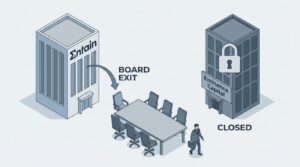
Ricky Sandler has stepped down from Entain’s board of directors, the company confirmed, following the wind-down of his hedge fund Eminence Capital. The departure removes a notable voice from the governance structure of the Ladbrokes and Coral parent group at a time when the gambling operator faces strategic questions on multiple fronts. Sandler had served as a non-executive director, a role tied directly to Eminence Capital’s investment position in the FTSE-listed firm.
What Sandler’s Departure Signals for Entain’s Board Dynamics
Board composition shifts at publicly listed gambling operators rarely happen in isolation. Before unpacking the broader implications, here are the core takeaways from this development:
- Investor-linked governance gap: Sandler’s seat was anchored to Eminence Capital’s stake in Entain. With the fund closing, the rationale for his board presence dissolved, leaving a vacancy that may reshape oversight priorities.
- No immediate replacement announced: Entain has not disclosed plans to fill the non-executive director role, which could indicate a broader board review is underway.
- The timing coincides with a period of operational restructuring and regulatory scrutiny across the UK gambling sector.
- Hedge fund withdrawal from gambling equities: Eminence Capital’s closure is part of a wider pattern of activist and institutional investors reassessing exposure to European gambling stocks amid tightening regulation.
Eminence Capital’s Closure and the Ripple Effect
Eminence Capital, the New York-based hedge fund Sandler founded, had built a meaningful position in Entain over recent years. The fund’s decision to shut down was not specific to its Entain holding, but the consequence is direct: without an active fund behind him, Sandler’s presence on the board became untenable. That much was straightforward.
What remains less clear is whether Eminence’s exit from the share register materially changes Entain’s investor base composition. Hedge fund positions in gambling operators have historically introduced both activist pressure and strategic impatience (a distinction regulators have been slow to acknowledge). With Eminence gone, the question becomes whether remaining institutional shareholders will push for similar governance engagement or adopt a more passive posture.
And while Sandler’s departure is procedural on its face, it strips the board of a director whose background in capital allocation and fund management offered a different lens from the industry veterans who typically populate gambling company boards.
Entain’s Governance at a Crossroads
The Ladbrokes and Coral parent company has navigated a turbulent stretch. Regulatory settlements, leadership transitions, and an evolving digital strategy have all demanded board-level attention. Losing a non-executive director, even one whose role was investor-linked, adds another variable to an already complex governance picture.
Entain’s board now faces a practical decision: replace Sandler with another independent voice carrying financial markets expertise, or use the vacancy to bring in a director with operational or regulatory credentials more aligned with the company’s current challenges. Neither path is without trade-offs.
| Factor | Before Sandler’s Exit | After Sandler’s Exit |
|---|---|---|
| Investor representation on board | Eminence Capital had a direct seat via Sandler | No hedge fund-linked director remains |
| Board expertise mix | Included capital markets perspective | Skews toward operational and industry backgrounds |
| Shareholder activism pressure | Moderate, with Eminence as an engaged holder | Arguably reduced in the near term, though other investors may step forward |
| Governance flexibility | Constrained by investor-linked appointment | Board has discretion over replacement profile and timeline |
How Regulatory Pressure Shapes Board Composition Decisions
UK gambling regulation has intensified considerably since the Gambling Act review process began gathering momentum. Operators like Entain face affordability checks, advertising restrictions, and enhanced compliance obligations that demand board-level fluency in regulatory risk. In practice, this means companies are increasingly prioritising directors who understand the mechanics of licensing frameworks and political stakeholder management over those whose primary value is financial market connectivity.
Still, the financial dimension cannot be ignored. Entain’s share price performance, its BetMGM joint venture economics, and capital allocation decisions all benefit from directors who think like investors. Striking that balance is the real challenge the nominations committee now confronts.
The Broader Pattern: Institutional Investors Pulling Back
Eminence Capital’s closure fits a pattern that has been quietly reshaping the shareholder registers of European gambling firms. Several hedge funds that built positions during the post-pandemic digital gambling boom have since reduced or exited those stakes entirely. Tighter regulation, compressed margins, and political uncertainty around gambling reform in multiple jurisdictions have made the sector less attractive to funds with shorter time horizons.
For Entain specifically, this raises a question about who fills the ownership gap. Long-only institutional investors tend to be less vocal on governance matters, which could give management more operational breathing room. But it also means fewer external checks on strategic direction.
Frequently Asked Questions
Why did Ricky Sandler leave Entain’s board?
Sandler’s board seat was connected to Eminence Capital’s investment in Entain. When the hedge fund announced its closure, the basis for his non-executive director role no longer existed, prompting his departure.
Will Entain appoint a replacement?
The company has not yet confirmed whether or when it will fill the vacancy. Board reviews of this nature typically take weeks to months, depending on the skills profile being sought.
Does this affect Entain’s day-to-day operations?
No. Non-executive directors provide oversight and strategic guidance rather than managing daily business activities. The operational leadership team remains unchanged.
What is Eminence Capital?
Eminence Capital was a New York-headquartered hedge fund founded by Ricky Sandler. It managed a long/short equity strategy and held positions across multiple sectors, including European gambling. The fund has now wound down its operations.



