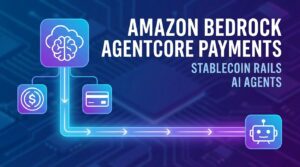
Amazon Web Services has embedded a payments layer directly into its AI agent platform, Bedrock AgentCore, enabling autonomous software agents to initiate and settle financial transactions without human intervention. Coinbase supplies the stablecoin infrastructure through its x402 protocol, while Stripe contributes wallet capabilities via its Privy acquisition. The move positions AWS at the intersection of two fast-converging markets: agentic AI and programmable money.
What AgentCore Payments Signals for Enterprise AI Infrastructure
This isn’t simply another partnership announcement dressed in buzzwords. By wiring transactional capability into the agent orchestration layer itself, Amazon is making a bet that AI agents will need to spend money, not just process information. A brief framing of the strategic implications:
- AI agents gain financial autonomy: Bedrock AgentCore Payments allows agents to authorize, execute, and reconcile payments as part of their task workflows, reducing the need for human checkpoints in procurement, licensing, and API-consumption scenarios.
- Stablecoin rails become enterprise plumbing: Coinbase’s x402 protocol, built around USDC settlement, gives agents a programmable, near-instant payment channel that sidesteps traditional card network latency and fees.
- Stripe’s wallet layer (via Privy) handles identity and custody, meaning agents can hold balances and authenticate transactions without bespoke treasury integrations.
- Competitive positioning sharpens: AWS is arguably the first major cloud provider to ship native agent-to-agent payment infrastructure at platform level, putting pressure on Microsoft Azure and Google Cloud to respond.
- The architecture implies a future where machine-initiated micropayments, metered API access, and autonomous resource provisioning become default behaviors rather than edge cases.
How the Three Layers Fit Together
Understanding the architecture matters here because each participant occupies a distinct and non-overlapping role. Amazon provides the orchestration environment where agents are built, deployed, and monitored. Coinbase handles the money movement layer. Stripe manages the wallet and identity surface.
| Component | Provider | Function |
|---|---|---|
| Agent orchestration | AWS (Bedrock AgentCore) | Task planning, tool use, memory, and execution runtime for AI agents |
| Payment protocol | Coinbase (x402) | Stablecoin-based settlement using USDC; HTTP-native payment negotiation between agents and services |
| Wallet infrastructure | Stripe (Privy) | Embedded wallets that allow agents to hold funds, authenticate, and manage keys without exposing private credentials to the orchestration layer |
The x402 protocol deserves particular attention. Named after the HTTP 402 status code (“Payment Required”), it allows a server to demand payment before granting access to a resource, and for an agent to fulfill that demand programmatically. That’s a pattern the web was technically designed for decades ago but never operationalized at scale.
Why Stablecoins, and Why Now
Traditional payment rails were never designed for machines transacting with other machines. Card networks impose minimum transaction thresholds, batch settlement windows, and fraud-detection heuristics tuned for human spending patterns. None of that maps cleanly onto an AI agent purchasing 200 milliseconds of GPU compute or licensing a dataset fragment for $0.003.
Stablecoins solve several of these friction points at once. Settlement is near-instant. Fees are marginal. And because USDC operates on public blockchain infrastructure, the transaction record is auditable by default (a distinction regulators have been slow to fully leverage but increasingly acknowledge). Coinbase’s stablecoin and crypto infrastructure already processes significant institutional volume, which gives the x402 protocol a credibility floor that a startup-built alternative would struggle to match.
Still, questions linger about regulatory treatment. The U.S. stablecoin framework remains in legislative limbo, and whether agent-initiated transactions trigger existing money transmission rules is a question no regulator has publicly addressed.
Stripe’s Quiet Expansion Into Agent-Native Finance
Stripe’s role here runs through Privy, the embedded wallet company it acquired to extend its reach beyond traditional checkout flows. Privy allows developers to spin up wallets that are programmatically controlled, which is precisely what an AI agent needs: a place to hold funds, sign transactions, and manage cryptographic keys without a human reaching for a hardware token.
For Stripe, this represents a meaningful expansion of its addressable market. The company has historically monetized human-initiated commerce. Embedding wallet infrastructure into Amazon’s Bedrock agent platform opens a channel where the “customer” is software, not a person. Whether that channel generates meaningful revenue in 2025 is debatable. But the positioning is deliberate.
Reframing How Enterprises Think About Agent Autonomy
Beyond the technical plumbing, this development reshapes how organizations might approach the delegation of financial authority to non-human actors. Enterprises already grant spending limits to employees through corporate cards and procurement systems. AgentCore Payments extends that logic to AI agents, but with tighter programmatic controls: spending caps, approval thresholds, and auditable transaction logs baked into the orchestration layer.
The psychological shift is arguably larger than the technical one. Trusting an algorithm to spend money on behalf of a business unit requires a different risk calculus than trusting it to draft an email. Organizations that adopt this early will need to build internal governance frameworks that don’t yet exist in most compliance playbooks. And the companies that build those frameworks first will likely set the norms others follow.
What makes this particularly compelling from a behavioral standpoint is the anchoring effect. Once a finance team sees an agent autonomously negotiate and settle a $50 SaaS license renewal without error, the perceived risk of delegating a $5,000 procurement decision drops considerably. That escalation curve, if it plays out, could compress enterprise adoption timelines in ways that linear forecasts underestimate.
There’s also a reframing opportunity for CFOs and treasury teams. Rather than viewing agent payments as a cost-control risk, the more productive mental model treats them as precision instruments: agents that buy only what they need, when they need it, at programmatically verified prices. The waste reduction potential in areas like cloud resource provisioning alone could justify early experimentation.
Frequently Asked Questions
What is Bedrock AgentCore Payments?
It is a transactional layer within Amazon’s Bedrock AgentCore platform that allows AI agents to initiate, authorize, and settle payments as part of their automated workflows, using stablecoin rails and embedded wallets.
How does the x402 protocol work?
Built by Coinbase, x402 uses the HTTP 402 status code to enable machine-to-machine payment negotiation. When an agent requests a paid resource, the server responds with a payment demand that the agent can fulfill programmatically using USDC, all without human involvement.
Is this available to all AWS customers today?
AWS has announced the capability as part of Bedrock AgentCore, though specific availability timelines and regional rollout details have not been fully disclosed. Enterprises interested in early access should monitor AWS’s official Bedrock documentation.
What are the regulatory risks?
Significant ambiguity remains. U.S. stablecoin legislation is still under development, and no regulator has issued specific guidance on AI agent-initiated financial transactions. Enterprises adopting this infrastructure should consult legal counsel on money transmission and custody obligations.