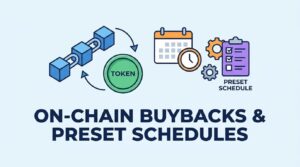
A growing number of crypto projects are shifting their token repurchase strategies onto public blockchains, committing to preset schedules and routing transactions through on-chain markets. The move marks a departure from the opaque, discretionary buyback models that have drawn scrutiny from both regulators and community participants. By anchoring repurchases to transparent, verifiable mechanisms, these protocols aim to build credibility in a market segment where trust deficits remain a persistent obstacle.
Why On-Chain Buyback Schedules Matter for Token Holders
The shift toward structured, on-chain repurchase programs carries implications that extend well beyond technical execution. For token holders, institutional observers, and competing protocols alike, the transparency embedded in this approach changes the calculus around project valuation and governance accountability.
- Verifiability replaces promises: Every repurchase transaction is recorded on-chain, eliminating the need to trust project teams’ self-reported figures. Participants can audit timing, volume, and price independently.
- Market manipulation risk drops: Preset schedules reduce the ability of insiders to time buybacks around favorable price movements or coordinated trading activity.
- Protocols adopting this model signal a willingness to bind themselves to rules that are, at least on paper, enforceable by code rather than goodwill.
- Regulatory alignment: Structured buyback programs mirror disclosure norms in traditional equity markets, where Rule 10b-18 in the United States provides a safe harbor for share repurchases conducted under specific conditions.
- Competitive pressure: Projects that continue to execute discretionary, off-chain buybacks may face growing skepticism from communities accustomed to higher transparency standards.
How the Mechanism Works in Practice
The operational framework is straightforward in concept, though the implementation details vary across protocols. A project commits a defined portion of its treasury or revenue to token repurchases. These purchases follow a predetermined cadence, whether daily, weekly, or monthly, and are executed through decentralized exchanges or other on-chain venues where the order flow is publicly visible.
Smart contracts typically govern the schedule. Once deployed, the parameters cannot be altered without a governance vote or a multisig action that itself leaves a public trail. This stands in sharp contrast to centralized buyback programs, where a project’s leadership might announce intentions without any binding commitment to follow through.
What makes this particularly interesting is the feedback loop it creates. When buybacks are visible and predictable, market participants can price them into their models. That predictability, arguably, reduces volatility around repurchase events and discourages the kind of speculative front-running that plagues less transparent systems.
The Broader Context: Trust Architecture in Decentralized Finance
Token buybacks have long occupied an awkward space in crypto markets. They borrow the language of traditional corporate finance (a signal of confidence, a mechanism for returning value) but have historically lacked the regulatory scaffolding that gives equity buybacks their credibility. In traditional markets, companies file disclosures with securities regulators, and share repurchase programs operate under well-defined legal frameworks.
Crypto projects have had no equivalent. Until recently, a project could announce a $50 million buyback program and execute $3 million of it without consequence. The community’s only recourse was social pressure, which, in a pseudonymous ecosystem, carries limited weight.
On-chain scheduling changes this dynamic. Not completely, but meaningfully. By encoding commitments into smart contracts and routing execution through decentralized exchange protocols like Uniswap, projects create a form of self-regulation that is both auditable and, in many cases, immutable once deployed.
Still, questions linger about edge cases. What happens when market conditions shift dramatically? Can a governance vote override a scheduled buyback during a liquidity crisis? And who bears the cost if a smart contract executes a large purchase into a thin order book?
What Separates Credible Programs from Performative Ones
Not all on-chain buyback programs are created equal. The difference between a credible commitment and a marketing exercise often comes down to a handful of design choices.
| Feature | Credible Program | Performative Program |
|---|---|---|
| Schedule transparency | Fixed intervals, publicly verifiable | Vague timelines, no on-chain proof |
| Funding source | Dedicated treasury allocation with on-chain tracking | Unspecified or commingled funds |
| Governance override | Requires community vote with quorum thresholds | Team can pause or cancel unilaterally |
| Execution venue | Decentralized, public order books | OTC or centralized exchanges with no visibility |
| Post-purchase handling | Tokens burned or locked with verifiable proof | Tokens recycled back into team wallets without disclosure — a pattern that erodes the entire premise of supply reduction |
Reframing Value: From Narrative to Verifiable Commitment
The psychological dimension here deserves attention. In behavioral finance, commitment devices (mechanisms that bind future behavior to present intentions) carry outsized influence on trust formation. A preset, on-chain buyback schedule functions as precisely this kind of device. It shifts the burden of proof from “trust us” to “verify it yourself,” which aligns with the foundational ethos of decentralized systems.
For institutional participants evaluating token exposure, this distinction matters enormously. Due diligence frameworks increasingly incorporate governance quality and treasury management practices as core inputs. A protocol that can demonstrate a functioning, transparent buyback mechanism scores higher on these assessments than one relying on discretionary announcements.
There is also a signaling effect worth considering. When a project locks capital into a buyback contract, it communicates confidence in its own revenue sustainability. That signal is harder to fake when the commitment is coded and public. Projects with volatile or uncertain revenue streams will hesitate to make such commitments, which itself becomes useful information for the market.
And while the crypto industry has no shortage of innovation theater, the move toward verifiable financial commitments represents something more substantive. It is, in effect, an attempt to build the institutional credibility that traditional markets take for granted, one smart contract at a time.
Frequently Asked Questions
What is an on-chain token buyback?
An on-chain token buyback is a repurchase of a project’s native token executed through decentralized, publicly visible blockchain transactions rather than through private or centralized channels. Every purchase is recorded and independently verifiable.
Why do preset schedules matter?
Preset schedules remove discretion from the process. They prevent insiders from timing buybacks to benefit from short-term price movements, and they give token holders a reliable framework for evaluating whether a project is honoring its commitments. In practice, this is the difference between a promise and a mechanism.
Can a scheduled buyback be canceled?
It depends on the smart contract design. Some programs require a governance vote to modify or halt execution, while others grant the core team override authority. The governance structure around cancellation is one of the clearest indicators of program credibility.
How does this compare to stock buybacks in traditional markets?
Traditional stock buybacks operate under regulatory frameworks like SEC Rule 10b-18, which provides safe harbor conditions for timing, price, and volume. On-chain buybacks attempt to replicate similar discipline through code rather than legal compliance, though they currently lack equivalent regulatory recognition.