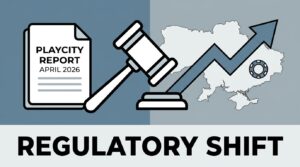
Ukraine’s gambling regulator PlayCity has published its April 2026 performance report, revealing a sharp escalation in enforcement activity against licensed operators found in breach of compliance standards. The report details significant financial penalties, new digital oversight mechanisms, and a sustained campaign against offshore operators targeting Ukrainian players. Taken together, the data suggests a regulator that has moved well beyond advisory postures into full enforcement mode.
What PlayCity’s April Numbers Tell Us About Ukraine’s Regulatory Direction
The April 2026 report is not just a routine disclosure. It captures a deliberate pivot in how Ukraine intends to govern its licensed gambling ecosystem, with consequences that extend to operators, affiliates, and technology providers across the region. Here are the strategic takeaways:
- Five-figure fines are now routine, not exceptional. PlayCity issued multiple penalties in the tens of thousands of euros range during April alone, targeting operators who failed to meet advertising, responsible gambling, or reporting obligations.
- BetKing was among the operators penalised, underscoring that even established brands face material financial consequences for compliance failures under the current framework.
- New digital reporting mechanisms went live in April, giving PlayCity near-real-time visibility into operator activity — a capability most European regulators still lack at this scale
- Offshore enforcement remains a parallel priority. PlayCity continued its campaign to block unlicensed platforms, though the persistence of the offshore market suggests that demand-side interventions (player education, payment blocking) have yet to reach full effectiveness.
- The overall posture signals that Ukraine is benchmarking itself against mature European regulatory models, arguably faster than some Western counterparts managed the same transition.
BetKing and the Cost of Non-Compliance
Among the most notable actions in the April report was the penalty imposed on BetKing’s online gambling platform. While the exact infraction details disclosed by PlayCity pointed to breaches in advertising standards and player protection protocols, the financial penalty itself landed in five-figure territory. That figure, while not catastrophic for a major operator, carries reputational weight in a market where regulatory standing increasingly determines commercial viability.
What makes this case instructive is the speed of enforcement. PlayCity identified the breach, investigated, and issued the penalty within a single reporting cycle. Compare that to jurisdictions where similar cases take months — sometimes years — to resolve. Whether this pace is sustainable across a growing number of licensees remains an open question (and one PlayCity’s staffing levels will eventually have to answer).
Digital Oversight Tools: A Quiet Revolution
Less headline-grabbing but arguably more consequential than any single fine is PlayCity’s rollout of new digital reporting infrastructure. The April report confirms that operators are now required to submit transaction-level data through standardised APIs, enabling the regulator to monitor betting volumes, bonus issuance patterns, and self-exclusion compliance in something close to real time.
This matters for three reasons.
First, it compresses the gap between violation and detection. Operators accustomed to quarterly audits now face continuous scrutiny. Second, the data infrastructure creates a foundation for algorithmic risk scoring, which PlayCity has hinted at deploying in future quarters. And third, it sets a technical barrier to entry that smaller or less sophisticated operators may struggle to meet, potentially accelerating market consolidation.
Still, technology alone doesn’t guarantee outcomes. The quality of enforcement depends on how PlayCity interprets the data it collects, and whether its analytical capacity keeps pace with the volume of information now flowing through its systems.
The Offshore Problem Hasn’t Gone Away
For all the progress on the licensed side, PlayCity’s April report acknowledges a stubborn reality: unlicensed offshore platforms continue to attract Ukrainian players. The regulator reported blocking additional domains and coordinating with internet service providers to restrict access, but these measures function more as friction than as barriers.
Players determined to access offshore sites can circumvent DNS-level blocks with minimal technical effort. Payment blocking through banks and e-wallet providers offers a more durable chokepoint, yet PlayCity’s report suggests that coordination with financial institutions is still in its early stages. The offshore market, in practice, operates as a parallel economy that regulatory action can shrink but not eliminate.
This dynamic creates an uncomfortable tension. Heavy-handed enforcement against licensed operators — while necessary for market integrity — risks pushing price-sensitive or bonus-seeking players toward the very offshore platforms PlayCity is trying to suppress.
How Ukraine’s Approach Compares Regionally
| Regulatory Dimension | Ukraine (PlayCity) | Typical EU Market |
|---|---|---|
| Penalty turnaround time | Within single reporting cycle | Often 3–12 months |
| Real-time data reporting | API-based, operational as of April 2026 | Varies widely; many still rely on periodic audits |
| Offshore enforcement | DNS blocking + early-stage payment interdiction | More mature payment blocking in markets like the Netherlands and Italy, but DNS approaches remain common elsewhere |
| Advertising enforcement | Active, with fines issued in April | Increasingly strict, particularly in Spain and Belgium |
What Operators Should Be Preparing For
The trajectory PlayCity has established through its first months of aggressive enforcement suggests that compliance costs in Ukraine will rise before they plateau. Operators currently active in the market, or considering entry, should be evaluating several dimensions simultaneously:
- Technical readiness for real-time data reporting requirements, including API integration and internal data governance
- Advertising compliance audits conducted proactively rather than reactively, given the speed at which PlayCity now identifies and penalises breaches
- Responsible gambling frameworks that go beyond minimum statutory requirements — PlayCity’s April actions suggest the regulator is interpreting its mandate broadly
- Scenario planning for potential market consolidation if smaller operators exit under the weight of compliance overhead
Frequently Asked Questions
What is PlayCity’s role in Ukraine’s gambling market?
PlayCity functions as the specialised regulatory body responsible for monitoring compliance, enforcing licensing conditions, and maintaining market integrity across Ukraine’s legal gambling sector. It has the authority to issue fines, suspend licences, and coordinate with other agencies on offshore enforcement.
Why was BetKing fined in April 2026?
According to PlayCity’s report, BetKing was penalised for breaches related to advertising standards and player protection protocols. The fine reached five-figure levels.
Can offshore gambling sites still be accessed from Ukraine?
Technically, yes. While PlayCity blocks domains and is developing payment interdiction capabilities, determined users can bypass DNS-level restrictions. The regulator’s offshore strategy remains a work in progress, with financial institution coordination still at an early stage.
How does Ukraine’s regulatory speed compare to other European markets?
Faster than most, at least on paper. PlayCity’s ability to identify, investigate, and penalise within a single reporting cycle outpaces the multi-month timelines common in many EU jurisdictions. Whether that pace holds as caseloads grow is the real test.



