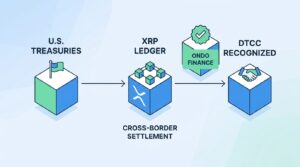
A consortium of four firms has completed what appears to be the first cross-border, cross-bank redemption of tokenized U.S. Treasuries on the XRP Ledger, a milestone that landed just as Ondo Finance secured a seat at the Depository Trust & Clearing Corporation’s tokenization table. Together, these developments signal that real-world asset (RWA) tokenization is shifting from proof-of-concept territory into something closer to institutional plumbing. The timing is not coincidental; it reflects a broader acceleration in how traditional finance infrastructure is absorbing blockchain-native settlement rails.
What the XRP Ledger Pilot Actually Demonstrated
The pilot brought together four participants to execute a redemption workflow that crossed both national borders and banking relationships. Settling tokenized Treasuries across these boundaries has long been cited as one of the harder problems in digital asset infrastructure, largely because it requires coordination between custodians, issuers, and ledger validators operating under different regulatory regimes.
That this occurred on the XRP Ledger is notable for a specific reason. Ripple’s network has historically positioned itself around payments and foreign exchange corridors, not securities settlement. A successful cross-bank Treasury redemption stretches that identity considerably. Whether this becomes a recurring settlement venue or remains a one-off demonstration depends on factors the pilot alone cannot answer: regulatory clarity, institutional appetite, and whether competing chains offer faster paths to compliance.
Still, the technical execution matters. Cross-border settlement of tokenized government debt, completed end-to-end on a public ledger, is not something the market had seen before this pilot.
Why Ondo’s DTCC Seat Changes the Calculus for RWA Tokenization
Ondo Finance joining the DTCC’s tokenization efforts is arguably the more consequential development here, at least in terms of what it signals about institutional gatekeeping. The DTCC processes trillions of dollars in securities transactions daily. Its willingness to bring a crypto-native firm into its tokenization working group suggests that the boundary between decentralized finance protocols and legacy clearing infrastructure is thinning faster than many expected.
Ondo has built its business around tokenizing yield-bearing instruments, particularly short-duration U.S. Treasuries, and packaging them for on-chain investors. Ondo Finance’s tokenized Treasury products have attracted significant capital inflows in recent months, positioning the firm as one of the more visible players in the RWA space. A DTCC collaboration gives Ondo something its competitors lack: proximity to the entity that actually settles most U.S. securities.
(Not all market participants view this as an unqualified positive; some worry that DTCC involvement could eventually centralize tokenization governance in ways that undercut the decentralized ethos these products were built on.)
Strategic Implications for Institutions and Issuers
Before unpacking the key takeaways, it is worth framing why these two events, occurring in close succession, carry outsized weight. Tokenized Treasuries are not exotic instruments. They represent the safest, most liquid asset class in global finance. When settlement infrastructure for these assets begins migrating onto distributed ledgers with institutional backing, the downstream effects touch everything from repo markets to collateral management.
- Cross-border settlement friction drops materially. The XRP Ledger pilot demonstrated that tokenized government debt can move across jurisdictions and banking counterparties without the multi-day lag typical of correspondent banking chains.
- DTCC engagement legitimizes crypto-native issuers. Ondo’s inclusion in the DTCC’s tokenization framework gives traditional asset managers a reason to evaluate on-chain Treasury products they might have previously dismissed.
- Competing Layer 1 networks now face pressure to demonstrate equivalent settlement capabilities for institutional-grade assets, or risk ceding ground to XRP Ledger and Ethereum-based alternatives.
- Regulatory attention will intensify. Cross-border redemption of tokenized securities raises jurisdictional questions that existing frameworks were not designed to address. Expect supervisory bodies to accelerate guidance on digital asset custody and cross-border transfer protocols.
- The convergence of DeFi protocols and legacy clearing houses creates a hybrid infrastructure model that, at least on paper, could reduce post-trade costs by orders of magnitude.
How RWA Tokenization Reshapes Investor Behavior
Beyond the mechanics of settlement, these developments carry implications for how investors perceive and interact with fixed-income markets. Behavioral finance research and NLP-based communication frameworks suggest that framing effects play a significant role in adoption curves for new financial instruments. When tokenized Treasuries are presented not as “crypto products” but as “U.S. government debt accessible 24/7 with near-instant settlement,” the psychological barrier to entry shifts dramatically.
Institutional allocators tend to anchor their decisions on familiarity and perceived safety. By embedding tokenized Treasuries within DTCC-recognized workflows, the framing moves from speculative to operational. This reanchoring effect, well-documented in decision science, could accelerate capital flows into tokenized RWAs far more effectively than any marketing campaign. The language used to describe these instruments matters as much as the technology underneath them.
And while retail investors may respond to narratives of innovation and disruption, institutional treasurers respond to something else entirely: reduced counterparty risk, shorter settlement windows, and compatibility with existing compliance infrastructure. The XRP Ledger pilot and Ondo’s DTCC recognition both speak directly to that second audience. Framing tokenization as an upgrade to existing processes, rather than a replacement, aligns with how large organizations process change. Resistance drops when new technology is positioned as an extension of trusted systems rather than a departure from them.
This distinction between disruption framing and integration framing will likely determine which tokenization platforms capture institutional capital over the next 18 months.
What Remains Unresolved
For all the progress these announcements represent, several structural questions persist. Cross-border settlement on a public ledger raises unresolved issues around finality, particularly in jurisdictions where blockchain-based transactions lack explicit legal recognition. The DTCC’s broader digital asset strategy remains in early stages, and Ondo’s participation does not guarantee that tokenized products will flow through DTCC’s core clearing systems anytime soon.
There is also the question of interoperability. The XRP Ledger pilot succeeded within its own ecosystem. But institutional adoption at scale will require tokenized assets to move fluidly across multiple chains and into traditional custody accounts without manual reconciliation. That bridge has not been built yet.
Frequently Asked Questions
What are tokenized U.S. Treasuries?
They are digital representations of U.S. government debt instruments issued and settled on blockchain networks, allowing holders to access Treasury yields through on-chain infrastructure rather than traditional brokerage accounts.
Why does the DTCC’s involvement matter?
The DTCC clears and settles the vast majority of U.S. securities transactions. Its engagement with tokenization projects like Ondo’s signals that legacy financial infrastructure is beginning to accommodate blockchain-based assets, which could dramatically lower barriers to institutional adoption.
Is the XRP Ledger now a securities settlement platform?
Not formally. The pilot demonstrated technical feasibility for cross-border Treasury redemption, but regulatory designation as a recognized settlement venue would require approvals that have not been granted. One successful pilot does not make a market.