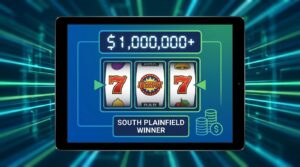
A South Plainfield, New Jersey resident has landed a massive online casino payout after a modest jackpot side bet ballooned into a seven-figure windfall. The win, recorded on a digital slot platform, underscores the outsized payouts that progressive jackpot mechanics can deliver even from minimal additional wagers. While the player’s identity has not been publicly disclosed, the event has drawn attention across the regulated New Jersey iGaming market, where online casino revenue continues to climb month over month.
What a Progressive Jackpot Add-On Means for Online Casino Economics
Progressive jackpots operate on a deceptively simple premise: a fraction of every qualifying bet feeds into a shared prize pool that grows until someone triggers it. The South Plainfield winner reportedly opted into a small jackpot add-on, a feature many players either ignore or underestimate. That decision proved transformative.
Before unpacking the broader implications, here are the strategic takeaways from this event:
- Low-cost jackpot add-ons can yield disproportionate returns, reinforcing their role as a key engagement mechanic for operators seeking to differentiate slot offerings.
- New Jersey’s regulated online casino market continues to produce headline-grabbing payouts, strengthening its position as the most mature legal iGaming jurisdiction in the U.S.
- Progressive jackpot wins generate significant organic publicity for platforms, reducing customer acquisition costs in a market where paid media expenses keep rising.
- The event highlights how digital slot design, particularly optional side features, shapes player behavior and lifetime value.
New Jersey’s iGaming Market: Still Setting the Pace
New Jersey legalized online casino gambling in 2013, a full decade before most other states even began serious legislative discussions. That head start matters. The state’s Division of Gaming Enforcement reported over $200 million in online gaming revenue for multiple consecutive months in 2024, a figure that dwarfs most competing jurisdictions.
Seven-figure wins like this one are not everyday occurrences, but they are far from anomalies in the Garden State’s digital gambling ecosystem. The combination of a large, active player base and well-funded progressive jackpot pools creates conditions where such payouts recur with enough frequency to sustain player interest (a dynamic that operators in newer markets are still trying to replicate).
And while sports betting tends to dominate the national conversation around legal gambling expansion, online casino revenue in New Jersey has consistently outpaced sportsbook earnings. That gap is widening.
How Jackpot Mechanics Shape Player Decisions
The psychology behind progressive jackpot participation is worth examining through a behavioral lens. Players who opt into jackpot add-ons are, in essence, making a secondary risk calculation layered on top of their base wager. The add-on cost is typically negligible relative to the potential payout, which creates what behavioral economists call an asymmetric reward perception.
Put plainly: the brain overweights the possibility of a life-changing win against a cost it barely registers. This is not irrational. It is a predictable response to how the feature is designed and presented. Operators understand this deeply. Slot interfaces position jackpot opt-ins prominently, often with visual cues (flashing indicators, growing counters) that anchor the player’s attention on the escalating prize pool rather than the incremental cost.
From an NLP perspective, the framing language around these features matters enormously. Phrases like “add just $0.50 for a chance at the Grand Jackpot” leverage presupposition and embedded commands. The word “just” minimizes perceived cost. “Chance at” presupposes possibility without promising probability. “Grand” anchors the outcome to something large and desirable. These linguistic patterns, refined over years of A/B testing by platform designers, are not accidental. They represent a sophisticated application of influence architecture that shapes opt-in rates across millions of sessions.
Players who understand these mechanics are better equipped to make informed decisions. Still, the South Plainfield winner’s experience demonstrates that the math, however tilted, does occasionally resolve in the player’s favor in spectacular fashion.
What Operators and Regulators Should Watch
Large payouts carry compliance implications. New Jersey requires operators to report significant wins, and the state’s regulatory framework mandates identity verification and tax documentation for prizes above federal thresholds. For the platform involved, this win triggers both a reporting obligation and a marketing opportunity.
The tension between those two realities is worth noting. Operators want to publicize big wins to attract new depositors, but responsible gambling guidelines increasingly scrutinize how such wins are promoted. The New Jersey Division of Gaming Enforcement has been among the more proactive regulators in balancing consumer protection with market growth, though not every jurisdiction maintains that equilibrium.
| Factor | Detail |
|---|---|
| Player Location | South Plainfield, New Jersey |
| Win Type | Progressive jackpot via optional add-on |
| Payout Scale | Seven figures |
| Regulatory Jurisdiction | New Jersey Division of Gaming Enforcement |
| Market Context | NJ online casino revenue exceeded $200M/month in multiple periods during 2024 |
Does This Change Anything for the Average Player?
Probably not, at least on paper. The expected value of progressive jackpot add-ons remains negative for the vast majority of participants. But expected value has never been the only variable driving gambling behavior. Anticipation, narrative, the social currency of a big win story: these factors carry weight that pure mathematics cannot capture.
What this event does reinforce is that New Jersey’s online casino infrastructure is functioning as designed. Jackpots accumulate. Someone eventually wins. The cycle resets. Whether that cycle benefits the broader player population or primarily serves operator marketing objectives is a question the industry has yet to answer honestly.
Frequently Asked Questions
What is a progressive jackpot add-on in online slots?
It is an optional side wager, usually a small additional amount per spin, that qualifies the player for a shared prize pool. The pool grows with each qualifying bet across the network until one player triggers the jackpot.
Are online casino winnings taxable in New Jersey?
Yes. Both federal and state tax obligations apply to gambling winnings. Operators are required to issue tax documentation for prizes exceeding certain thresholds, and players must report all gambling income regardless of amount.
How does New Jersey regulate online casinos?
The state’s Division of Gaming Enforcement oversees all licensed online gambling operations, enforcing rules around game fairness, identity verification, responsible gambling, and financial reporting. New Jersey was the first state to establish a comprehensive legal framework for internet gaming back in 2013, and its regulatory model has influenced legislation in other states.
Can players outside New Jersey access these jackpots?
No. Players must be physically located within New Jersey’s borders to participate in the state’s regulated online casino platforms. Geolocation technology verifies this requirement in real time.



