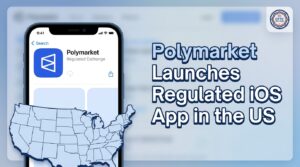
Polymarket, the world’s largest prediction market platform, has rolled out a native iOS application targeting US-based users, marking its formal re-entry into the American market after a regulatory absence stretching back to early 2022. The launch follows the removal of an extensive waitlist and hinges on a critical structural move: the acquisition of a CFTC-registered Designated Contract Market (DCM). American users can now legally trade event contracts through what the company calls “Polymarket US,” a product deliberately separated from its global, crypto-native offshore platform.
What Polymarket’s US Return Signals for Event Contract Markets
The timing here is not accidental. Prediction markets have attracted growing attention from regulators, institutional investors, and media outlets alike, particularly after Polymarket’s high-profile role during the 2024 US presidential election cycle. By securing a DCM registration, Polymarket has positioned itself within the same regulatory perimeter as traditional derivatives exchanges. That distinction matters, both for user trust and for the platform’s ability to scale without the legal ambiguity that shadowed its earlier US operations.
Before diving into the details, here are the strategic takeaways from this development:
- Regulatory legitimacy achieved: Acquiring a CFTC-registered DCM gives Polymarket a compliance foundation that few crypto-adjacent platforms possess in the US market.
- Product bifurcation is deliberate: “Polymarket US” operates as a distinct entity from the offshore platform, likely to satisfy regulatory requirements around segregation of user funds and market oversight.
- The initial focus on sports contracts suggests a calculated entry point, avoiding politically sensitive markets while building regulatory rapport.
- Waitlist removal signals confidence: Opening access broadly, rather than through a phased rollout, indicates the platform believes its compliance infrastructure can handle scale.
- Competitors like Kalshi, which already hold DCM status, now face a rival with substantially larger brand recognition and user engagement data.
How the DCM Acquisition Reshapes the Business Model
Polymarket’s earlier iteration in the US operated in a gray zone. The platform settled a $1.4 million penalty with the CFTC in 2022 for offering unregistered binary options, and subsequently blocked US users from accessing the platform. Its return required more than a rebrand.
Acquiring a Designated Contract Market is no small feat. DCM status subjects the operator to ongoing CFTC oversight, including rules around market surveillance, trade reporting, and participant protections. In practice, this means Polymarket’s regulated US prediction market will function more like a traditional exchange than the freewheeling crypto marketplace its global users are accustomed to.
And while the offshore version of Polymarket allows users to trade on a wide range of political, economic, and cultural outcomes using cryptocurrency, the US app will initially limit its scope to sports-related event contracts. This narrower focus is almost certainly a regulatory concession (a distinction regulators have historically insisted upon when approving new contract types).
Sports First, Then What?
Starting with sports is strategic. The CFTC has shown greater willingness to approve event contracts tied to sporting outcomes than those linked to elections or geopolitical events. Kalshi, the only other major US-based prediction market with DCM registration, fought a protracted legal battle with the CFTC over its proposed election contracts in 2024, eventually winning a federal court ruling that allowed them.
Polymarket likely intends to expand beyond sports. But the sequencing tells us something about its regulatory strategy: build credibility with less contentious contract types, then push for broader approval. Whether the CFTC will grant that latitude remains an open question, particularly as political prediction markets continue to draw scrutiny from lawmakers concerned about market manipulation and public perception.
Competitive Landscape at a Glance
| Platform | DCM Status | US Availability | Initial Contract Focus | Settlement Method |
|---|---|---|---|---|
| Polymarket US | Yes (acquired) | iOS app, nationwide | Sports event contracts | USD-based (regulated) |
| Kalshi | Yes (original registrant) | Web and mobile | Broad (including weather, economics, elections after court ruling) | USD-based |
| Polymarket (Global) | No | Blocked for US users | Politics, culture, crypto, sports | Crypto (USDC) |
Why Regulated Prediction Markets Are Gaining Institutional Attention
Prediction markets are no longer a niche curiosity. Academic research has consistently shown that well-structured prediction markets can aggregate information more efficiently than polls, expert panels, or traditional forecasting models. The underlying mechanism is straightforward: participants with real financial exposure tend to be more honest and more precise in their assessments than those offering opinions without stakes.
For institutional players, the appeal goes further. Regulated prediction markets offer a new class of event-driven derivatives, instruments that can hedge against specific, binary outcomes. A sports franchise evaluating revenue scenarios, an insurer pricing catastrophe risk, or a media company forecasting audience engagement could all, at least on paper, find utility in these contracts. The challenge has always been regulatory clarity. With two DCM-registered platforms now operating in the US, that barrier is materially lower than it was even twelve months ago.
Still, adoption at scale depends on liquidity. Polymarket’s global platform reportedly handled billions in trading volume during 2024’s election season. Replicating that depth in a regulated, USD-denominated environment with a narrower contract menu will test whether the platform’s brand translates into sustained engagement under tighter constraints.
Frequently Asked Questions
Is Polymarket legal in the United States now?
Yes. Through its acquisition of a CFTC-registered Designated Contract Market, Polymarket has established a legally compliant pathway for US users to trade event contracts. The regulated US app operates separately from the offshore platform.
What types of contracts can US users trade on Polymarket?
At launch, the US app focuses on sports-related event contracts. Broader categories, including political and economic outcomes, are not yet available but may follow pending regulatory approval.
How does Polymarket US differ from the global version?
The global platform is crypto-native, settling trades in USDC and offering a wide range of event categories. Polymarket US is regulated under CFTC oversight, uses USD settlement, and currently limits contracts to sports events. They are operationally distinct products.
Who regulates Polymarket in the US?
The Commodity Futures Trading Commission oversees the platform’s US operations through its DCM registration, the same framework governing established derivatives exchanges.



