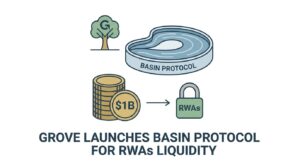
Grove, a decentralized infrastructure provider, has rolled out Basin, a DeFi protocol engineered to deliver instant onchain stablecoin liquidity for tokenized real-world assets. The protocol claims up to $1 billion in daily liquidity capacity, a figure that positions it as one of the more ambitious entrants in the rapidly expanding RWA tokenization space. The launch targets a persistent friction point in decentralized finance: the gap between tokenized assets and readily available, stable settlement liquidity.
What Basin’s Launch Signals for RWA Liquidity Infrastructure
Tokenized real-world assets have attracted significant institutional attention over the past eighteen months, yet liquidity fragmentation remains a stubborn obstacle. Basin attempts to address this by providing a dedicated protocol layer where stablecoin liquidity can be accessed instantly against tokenized collateral. Before unpacking the mechanics, here are the strategic takeaways from this development:
- Scale ambition: A stated $1 billion daily liquidity ceiling suggests Grove is targeting institutional-grade throughput, not retail experimentation
- The protocol focuses specifically on stablecoin pairs, sidestepping the volatility risk that has plagued broader DeFi lending markets
- RWA-native design: Basin appears purpose-built for tokenized assets rather than retrofitted from existing AMM or lending architectures, which could reduce integration friction for asset issuers
- Timing aligns with a broader wave of institutional RWA tokenization pilots, including those from major financial institutions exploring onchain treasury and credit products
- Competitive positioning: By anchoring liquidity provision to real-world asset backing, Basin differentiates from synthetic or algorithmic liquidity pools that carry higher systemic risk
How Basin Fits Into the DeFi-TradFi Convergence
The tokenization of real-world assets (encompassing everything from U.S. Treasuries to private credit and real estate) has moved from conceptual whitepapers to live deployments. Boston Consulting Group has projected the tokenized asset market could reach $16 trillion by 2030. But projections aside, the operational reality is messier. Tokenized assets often sit on fragmented chains with limited secondary market depth, making it difficult for holders to convert positions into liquid stablecoins without significant slippage or delay.
Basin’s architecture reportedly addresses this by creating a protocol-level liquidity layer that connects tokenized RWA issuers directly with stablecoin reserves. That shift matters because it removes the need for intermediary OTC desks or centralized exchange listings, both of which introduce counterparty risk and settlement latency.
Whether the $1 billion daily capacity figure reflects committed capital or theoretical throughput under optimal conditions remains a question Grove’s protocol documentation will need to clarify as adoption scales.
The Liquidity Problem Nobody Solved Cleanly
Existing DeFi protocols have attempted to serve tokenized assets, but most were designed for crypto-native tokens. Adapting automated market makers or overcollateralized lending pools to accommodate assets with fundamentally different risk profiles (a tokenized Treasury bill behaves nothing like ETH) has produced awkward compromises. Capital efficiency suffers. Pricing oracles struggle with assets that don’t trade 24/7 on transparent orderbooks.
Basin’s approach, at least on paper, sidesteps some of these issues by narrowing its scope to stablecoin liquidity provision against verified RWA collateral. The narrower the use case, the fewer edge cases the protocol needs to handle. And fewer edge cases typically means fewer exploit vectors (a distinction that matters enormously after the DeFi security incidents of 2022 and 2023).
Institutional Appetite and What Drives It
Several forces are converging to make protocols like Basin timely rather than premature. Regulatory frameworks in jurisdictions including the EU, Singapore, and the UAE have begun accommodating tokenized securities with clearer legal standing. BlackRock’s BUIDL fund, Franklin Templeton’s onchain money market fund, and similar vehicles have demonstrated that institutional capital will flow onchain when the infrastructure meets compliance and liquidity thresholds.
Still, a protocol offering $1 billion in daily liquidity needs counterparties willing to deploy at that scale. The chicken-and-egg dynamic of DeFi liquidity is well documented: deep pools attract users, but users only arrive when pools are already deep. How Grove plans to bootstrap initial liquidity, whether through incentive programs, institutional partnerships, or treasury-backed reserves, will likely determine Basin’s trajectory in its first six months.
Reframing Liquidity as Infrastructure, Not a Feature
One of the more consequential shifts in DeFi thinking over the past year has been the reframing of liquidity from a market outcome to a designed infrastructure layer. Protocols that treat liquidity as something that emerges organically from incentives have repeatedly encountered boom-bust cycles. Basin’s positioning suggests Grove views liquidity as a utility, something that should be provisioned reliably, like bandwidth or settlement rails.
This framing carries implications beyond DeFi. If tokenized RWAs are to compete with traditional settlement infrastructure, they need liquidity guarantees that institutional treasurers can model against. Sporadic pool depth won’t suffice. The question is whether a decentralized protocol can deliver the kind of reliability that centralized clearinghouses have spent decades engineering.
Frequently Asked Questions
What is Basin?
Basin is a DeFi protocol developed by Grove that provides instant onchain stablecoin liquidity specifically designed for tokenized real-world assets, with a stated capacity of up to $1 billion daily.
Why does RWA tokenization need dedicated liquidity protocols?
Tokenized real-world assets have different risk profiles, pricing mechanisms, and settlement requirements compared to crypto-native tokens. Generic DeFi protocols weren’t built to handle these differences efficiently, leading to poor capital utilization and pricing inaccuracies. Dedicated infrastructure like Basin aims to close that gap.
Who would use Basin?
Likely users include RWA token issuers seeking secondary market liquidity, institutional investors needing to convert tokenized positions into stablecoins, and DeFi protocols looking to integrate RWA collateral into their own lending or yield products.
Is the $1 billion daily capacity guaranteed?
Grove has stated this as the protocol’s capacity ceiling. Whether it reflects committed reserves or maximum theoretical throughput has not been fully detailed, and real-world utilization will depend on adoption and counterparty participation.



