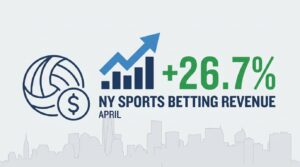
Sports betting operators in New York State posted a collective year-on-year revenue increase of 26.7 per cent in April, underscoring the continued expansion of one of the largest legal wagering markets in the United States. The growth signals that the state’s mobile sports betting framework, launched in January 2022, continues to attract handle volume even as the initial novelty period fades. And while the headline number is strong, the trajectory raises questions about how long double-digit growth rates can persist in a market with a 51 per cent tax rate on gross gaming revenue.
What April’s Numbers Reveal About New York’s Betting Landscape
Before diving into the strategic takeaways, it’s worth grounding the figure in context. New York’s sports betting market operates under one of the heaviest tax burdens in the country, yet operators have continued to scale revenue quarter after quarter. April’s 26.7 per cent jump suggests that consumer adoption is still deepening, promotional spending may be stabilising, and the competitive dynamics among licensed sportsbooks are producing a more efficient market overall.
- Revenue acceleration persists: A 26.7% year-on-year gain in April indicates that New York’s market has not yet plateaued, despite operating for over three years
- Tax revenue implications are significant: With the state collecting 51% of operator GGR, even modest revenue growth translates into tens of millions in additional public funds
- The growth rate outpaces several peer states that launched around the same period, suggesting New York’s population density and urban concentration continue to drive outsized engagement
- Operator margins remain under pressure: High tax rates mean that revenue growth does not necessarily translate into proportional profitability for sportsbooks
- Seasonal factors played a role: April captures the tail end of the NBA and NHL regular seasons, March Madness carryover, and the opening weeks of the MLB season
A Tax Structure That Shapes Everything
New York’s 51 per cent tax on gross gaming revenue remains the defining feature of its sports betting regime. No other major US market imposes a comparable rate (a distinction that has drawn persistent criticism from operators). The structure was designed to maximise state revenue rather than operator profitability, and on that metric, it has delivered.
But the tax rate also constrains how aggressively sportsbooks can invest in promotions, bonuses, and customer acquisition. In states like New Jersey or Pennsylvania, where rates sit between 13 and 36 per cent, operators retain more flexibility to compete on price. New York’s operators, by contrast, must generate volume to offset thinner margins. That they continue to grow revenue at this pace suggests the sheer size of the addressable market compensates for the fiscal squeeze.
Still, the question of sustainability lingers. At what point does the tax burden force consolidation among licensees, or push operators to redirect investment toward friendlier jurisdictions?
How Operators Are Navigating the Market
The state currently licenses a limited number of mobile sportsbook platforms, including major brands such as FanDuel’s sportsbook platform, DraftKings, BetMGM, and Caesars Sportsbook. This controlled-entry model has kept the competitive field narrow, arguably benefiting incumbents by limiting fragmentation.
FanDuel and DraftKings have consistently dominated handle share in New York, a pattern that mirrors their national positioning. Smaller operators face an uphill battle: the combination of high taxes and entrenched brand loyalty makes it difficult to carve out meaningful market share without unsustainable promotional spending.
What’s notable about April’s results is that the revenue growth appears broad-based rather than driven by a single operator or a one-off sporting event. That pattern points to structural market expansion rather than a temporary spike.
Regulatory and Fiscal Context Across US States
| State | Tax Rate on GGR | Launch Year | Market Structure |
|---|---|---|---|
| New York | 51% | 2022 | Limited licenses, mobile only |
| New Jersey | 13% (online) | 2018 | Open market, casino-tied |
| Pennsylvania | 36% | 2019 | Casino-tied licenses |
| Illinois | Up to 40% (graduated) | 2020 | Operator-based, recently restructured |
| Ohio | 20% | 2023 | Universal licensing model with multiple tiers |
New York’s rate sits at the top of this table by a wide margin. Illinois recently moved toward a graduated structure that can reach 40 per cent at the highest revenue tiers, but even that falls short of New York’s flat 51 per cent levy.
The Behavioural Dimension: Why Bettors Keep Engaging
Revenue growth of this magnitude isn’t purely a supply-side story. Understanding what drives continued bettor engagement requires looking at the demand side through a behavioural lens. Several factors rooted in decision-making psychology help explain the pattern.
First, the normalisation effect. As sports betting becomes embedded in mainstream media coverage, advertising, and social conversation, the psychological barrier to participation drops. What was once a niche activity increasingly registers as a standard form of entertainment consumption. This reframing matters: it shifts the mental category from “gambling” to “sports engagement,” which broadens the pool of willing participants.
Second, loss aversion and sunk-cost dynamics play a subtle role in retention. Bettors who have already invested time in learning platforms, building parlays, and tracking results develop a sense of accumulated expertise. Walking away feels like abandoning that investment. Operators understand this well, which is why loyalty programmes and streak-based promotions are calibrated to reinforce continued participation.
Third, the availability heuristic amplifies engagement during high-profile sporting periods. April’s overlap with the NBA playoffs, NHL postseason push, and early MLB action creates a dense calendar of betting opportunities. When events are frequent and visible, the perceived ease and relevance of placing a wager increases. The cognitive shortcut is simple: more games, more reasons to bet.
Finally, social proof operates as a powerful accelerator. In a state with nearly 20 million residents, the visibility of peers who bet normalises the behaviour further. Group chats, office pools, and social media discussions around parlays and props create feedback loops that sustain engagement well beyond the initial adoption phase. Operators who tap into these social dynamics through shareable bet slips and referral incentives are, in effect, leveraging one of the oldest principles in behavioural science.
Frequently Asked Questions
How much tax does New York collect from sports betting?
New York imposes a 51 per cent tax on gross gaming revenue from mobile sports betting, the highest rate among major US markets. This has generated hundreds of millions in annual state revenue since the market launched.
Which sportsbooks operate in New York?
The state licenses a limited number of platforms, including FanDuel, DraftKings, BetMGM, Caesars Sportsbook, and several others. FanDuel and DraftKings hold the largest share of total handle.
Is New York’s sports betting market still growing?
Yes. April’s 26.7 per cent year-on-year revenue increase suggests the market continues to expand, driven by deepening consumer adoption and a dense sports calendar.
Why is New York’s tax rate so high compared to other states?
The state opted for a model that prioritises public revenue over operator profitability. The limited-license structure was designed to attract major operators willing to accept thinner margins in exchange for access to one of the country’s largest consumer bases.



