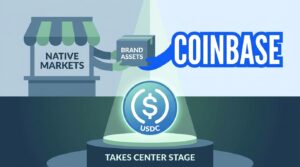
Native Markets, the decentralized trading protocol, is offloading its brand assets to Coinbase in a move that simultaneously cements USDC as the protocol’s canonical quote asset. The transaction signals a deeper alignment between the two entities and raises questions about how branding and infrastructure intertwine in the evolving crypto landscape. While the deal’s financial terms have not been disclosed, the strategic implications are hard to miss.
What the Brand Asset Sale Means for Both Parties
Before unpacking the broader market dynamics, here’s what matters most at a glance:
- USDC becomes the default quote asset across Native Markets’ protocol, anchoring all trading pairs to Circle’s dollar-pegged stablecoin
- Coinbase acquires Native Markets’ brand assets, though the exact scope of what “brand assets” encompasses (trademarks, domain, visual identity, or more) has not been fully detailed
- The deal strengthens Coinbase’s positioning in the decentralized trading layer, a segment where the exchange has been steadily expanding its footprint
- For Native Markets, the arrangement likely provides capital or strategic backing while simplifying its operational focus around a single stablecoin standard
- Competitors relying on multi-asset quoting may face pressure to consolidate around dominant stablecoins
Why USDC as the Canonical Quote Asset?
Choosing a single quote asset is not a trivial decision for any trading protocol. It determines liquidity concentration, user experience, and regulatory exposure all at once. By designating USDC, Native Markets is betting on the stablecoin’s regulatory standing and its deep integration with institutional on-ramps. That bet is arguably well-timed. USDC’s issuer, Circle, has been aggressively pursuing compliance frameworks across multiple jurisdictions, and Coinbase itself holds a significant economic relationship with Circle through the Centre Consortium’s legacy arrangements.
Still, the move narrows optionality. Protocols that quote exclusively in one stablecoin tie their fate to that asset’s peg stability, regulatory treatment, and issuer solvency. In practice, USDC has maintained its peg with only brief exceptions (the March 2023 Silicon Valley Bank episode being the most notable), but the structural dependency is real.
Coinbase’s Quiet Infrastructure Play
This acquisition fits a pattern. Coinbase’s expansion into decentralized infrastructure has accelerated over the past eighteen months, spanning Base (its Layer 2 network), wallet services, and now brand-level acquisitions from DeFi-native protocols. The purchase of Native Markets’ brand assets suggests Coinbase sees value not just in technology but in the identity layer of decentralized finance.
What remains less clear is whether Coinbase intends to operate under the Native Markets brand, absorb it into existing product lines, or simply retire it. Each path carries different competitive implications. A rebrand or integration could give Coinbase a ready-made presence in decentralized spot trading. Retirement, on the other hand, would suggest the acquisition was primarily defensive.
And while Coinbase has not commented publicly on its intentions, the timing coincides with broader industry consolidation. Smaller DeFi protocols are increasingly finding it difficult to sustain independent operations amid thinning liquidity and rising compliance costs.
How This Reshapes Stablecoin Competition
Every protocol that defaults to a specific stablecoin sends a signal to the market. Native Markets’ decision is one more data point in USDC’s favor, at a moment when Tether’s USDT continues to dominate global stablecoin volume but faces persistent questions about reserve transparency. The competitive dynamics here are not static.
| Factor | USDC | USDT |
|---|---|---|
| Regulatory posture | Proactive compliance, U.S.-focused | Offshore-centric, limited disclosure |
| Market cap (approx.) | ~$33 billion | ~$112 billion |
| Institutional adoption | Strong, especially among U.S. entities | Dominant in global retail and offshore venues |
| Peg stability record | Brief depeg in March 2023; otherwise stable | Generally stable, minor historical deviations |
| DeFi protocol integrations | Growing, particularly on Ethereum L2s | Ubiquitous across chains |
The gap in market capitalization is substantial, yet USDC’s share of new protocol integrations (particularly on Ethereum-aligned Layer 2 networks) has been climbing. Native Markets’ choice reinforces that trajectory.
Strategic Framing: What Industry Leaders Should Watch
Deals like this rarely exist in isolation. They reflect underlying shifts in how value, identity, and liquidity are being reorganized across crypto markets. For executives and fund managers evaluating exposure to decentralized trading infrastructure, several threads deserve attention.
First, brand acquisitions in DeFi are still uncommon enough to be noteworthy. The fact that a centralized exchange is purchasing brand assets from a decentralized protocol blurs a line that many in the industry assumed would remain firm. Second, the consolidation of quote assets around a single stablecoin per protocol reduces fragmentation but introduces concentration risk (a distinction regulators have been slow to enforce). Third, the deal’s structure may set a template for how other small-to-mid-size DeFi protocols exit or restructure in the current environment.
Whether this particular transaction becomes a footnote or a turning point depends largely on what Coinbase does next with the assets it has acquired. The protocol-level shift to USDC, however, is already done.
Frequently Asked Questions
What are brand assets in the context of a crypto protocol?
Brand assets typically include trademarks, logos, domain names, and associated intellectual property. In DeFi, this can also extend to community-facing identity elements like social media accounts and documentation portals, though the exact scope varies by deal.
Does this mean Coinbase now controls Native Markets’ protocol?
Not necessarily. The sale covers brand assets specifically. Protocol governance, smart contracts, and operational control may remain with the existing team or community, depending on the protocol’s structure. No public statement has confirmed a full acquisition.
Why would a protocol choose only one stablecoin as its quote asset?
Concentrating on a single quote asset simplifies liquidity, reduces smart contract complexity, and can improve execution quality for traders. The tradeoff is dependency on that stablecoin’s issuer and regulatory standing.
How does this affect users currently trading on Native Markets?
Existing users should expect all trading pairs to be denominated in USDC going forward. Depending on the brand transition, interface changes or migrations may follow, though no timeline has been announced.



