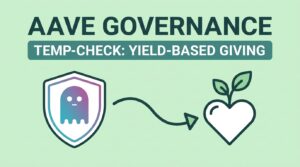
Aave’s governance community has initiated a temperature check on a proposal that would introduce a charitable yield donation feature, enabling depositors to redirect interest earned on their crypto holdings to humanitarian organizations. The mechanism preserves full capital control for the depositor while channeling generated yield toward vetted charitable causes. If approved, this would mark one of the first structured philanthropic primitives embedded directly into a major DeFi lending protocol. The proposal arrives at a moment when decentralized finance protocols are under growing pressure to demonstrate real-world utility beyond speculative trading.
What the Aave Charitable Yield Proposal Actually Entails
At its core, the proposed mechanism allows users who deposit assets into Aave’s lending pools to allocate some or all of the yield generated on those deposits to designated charitable recipients. The depositor’s principal remains untouched and fully withdrawable at any time. Yield, which accrues passively through Aave’s existing interest rate model, would be routed programmatically to approved humanitarian wallets.
This is not a donation in the traditional sense. Users never give up ownership of their capital. They lend it, earn interest, and choose to redirect that interest. The distinction matters, both legally and psychologically, because it lowers the barrier to participation. A user with $10,000 in stablecoins deposited on Aave’s decentralized lending platform could generate yield for a charitable organization without ever reducing their own balance.
Still, the governance discussion remains in its earliest phase. A temp-check is not a binding vote. It gauges community sentiment before a formal Aave Improvement Proposal (AIP) moves to snapshot or on-chain voting.
Strategic Implications for DeFi Protocols and Nonprofits
Before unpacking the broader significance, here are the key strategic takeaways from this governance action:
- Capital-preserving philanthropy enters DeFi infrastructure: Unlike direct donations, this model lets users contribute without depleting holdings, a structure that could attract institutional and high-net-worth participants who want social impact without balance sheet reduction.
- Protocol differentiation through real-world utility: As DeFi protocols compete for deposits and user loyalty, embedding charitable mechanisms could serve as a meaningful retention and brand-building tool.
- Regulatory positioning may benefit. Protocols that demonstrate measurable social good could find themselves in a more favorable light during legislative scrutiny (a distinction regulators have been slow to formalize but increasingly acknowledge in public commentary).
- Operational complexity rises: Vetting charitable recipients, ensuring transparent fund disbursement, and managing cross-jurisdictional compliance for humanitarian transfers introduce governance overhead that Aave’s DAO structure will need to absorb.
- The mechanism could become a template. If Aave ships this successfully, competing protocols like Compound or Spark will face pressure to offer similar features.
Why Yield-Based Giving Resonates Now
Crypto philanthropy is not new. The Giving Block, Endaoment, and similar platforms have facilitated hundreds of millions in digital asset donations. But most of those flows involve outright transfers of tokens, which trigger taxable events and require donors to part with assets they may want to hold.
Yield-based giving sidesteps both problems. And while the concept has existed in traditional finance through vehicles like donor-advised funds and charitable remainder trusts, embedding it natively into a permissionless protocol removes intermediaries and makes the process accessible to anyone with a wallet and a deposit.
What remains less clear is how Aave’s governance will handle the selection and oversight of recipient organizations. On-chain transparency can verify fund flows, but it cannot verify impact. That gap between financial traceability and real-world accountability is one the broader crypto-philanthropy space has yet to close convincingly.
How Behavioral Design Shapes Participation
The architecture of this proposal draws, perhaps unintentionally, on principles rooted in behavioral psychology and neuro-linguistic programming. Framing matters enormously in charitable giving. When a user is told “donate your money,” the cognitive response involves loss aversion. The brain registers a reduction. But when the framing shifts to “redirect yield you’re already earning,” the perceived cost drops to near zero, even if the dollar amount is identical.
This reframing leverages what behavioral economists call the “endowment effect” in reverse. Because the yield was never held as realized gains in the user’s mental accounting, parting with it feels painless. Aave’s mechanism, at least on paper, exploits this asymmetry elegantly. The depositor’s identity as an investor remains intact. They are not “giving away” anything. They are choosing where new value flows.
There is also an anchoring dynamic at play. By defaulting the principal as untouchable and presenting yield allocation as an opt-in layer, the proposal anchors the user’s sense of security first. Only after that anchor is established does the charitable option appear. This sequencing reduces friction and increases the likelihood of participation, a pattern well-documented in nudge theory and charitable giving research. Protocols that understand these psychological levers will likely see higher adoption rates than those that simply add a “donate” button.
Language within the governance proposal itself reinforces this. Terms like “capital control” and “maintained ownership” appear repeatedly, signaling safety before introducing generosity. Whether this framing was deliberate or organic, it aligns with persuasion frameworks that prioritize certainty before asking for action.
Governance and Compliance: The Harder Questions
Routing yield to humanitarian organizations through a decentralized protocol raises questions that Aave’s DAO has not yet fully addressed. Which organizations qualify? Who decides? And how does a permissionless system reconcile with sanctions screening requirements that apply to cross-border financial transfers?
These are not hypothetical concerns. The U.S. Treasury’s Office of Foreign Assets Control (OFAC) has already demonstrated willingness to sanction smart contract addresses, as it did with Tornado Cash in 2022. Any charitable routing mechanism that touches jurisdictions with active sanctions regimes will need robust compliance guardrails.
| Feature | Traditional Crypto Donation | Aave Yield-Based Giving (Proposed) |
|---|---|---|
| Capital impact on donor | Direct reduction of holdings | No reduction; principal preserved |
| Tax event triggered | Typically yes (varies by jurisdiction) | Potentially limited to yield only; legal clarity still pending |
| Intermediary required | Often (platforms like The Giving Block) | Protocol-native, no intermediary |
| Transparency | Varies | On-chain, verifiable in real time |
| Regulatory complexity | Moderate | Higher, due to automated cross-border flows and DAO governance structure |
Frequently Asked Questions
Does this proposal mean Aave will automatically donate user funds?
No. The mechanism is opt-in. Users would actively choose to redirect yield from their deposits. Principal remains fully under the depositor’s control at all times.
Is the temp-check a final decision?
Not at all. A temperature check gauges community interest. If sentiment is favorable, a formal Aave Improvement Proposal would follow, subject to on-chain governance voting before any implementation begins.
Which charitable organizations would receive funds?
That has not been determined yet. The governance process will need to establish vetting criteria, and how those criteria interact with international compliance obligations is arguably the most consequential design decision ahead.
Could other DeFi protocols adopt similar mechanisms?
In principle, yes. The smart contract logic for yield redirection is not unique to Aave. But Aave’s governance infrastructure and liquidity depth give it a structural advantage in deploying this kind of feature at scale.



