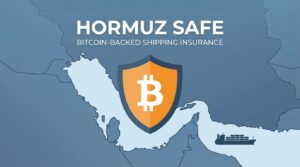
Iran has introduced Hormuz Safe, a Bitcoin-backed insurance product designed specifically for shipping companies navigating the Strait of Hormuz. The service represents a notable convergence of cryptocurrency infrastructure and maritime risk management, targeting one of the world’s most strategically sensitive waterways. Roughly 20% of global oil shipments pass through this narrow corridor daily, making insurance coverage for vessels transiting the strait a persistent concern for operators and underwriters alike. By anchoring the product in Bitcoin rather than fiat currency, Iran appears to be constructing an alternative financial channel that sidesteps the sanctions architecture constraining its access to conventional insurance markets.
What Hormuz Safe Signals for Maritime Insurance and Sanctions Policy
Before examining the specifics, it’s worth framing the strategic implications this development carries for multiple stakeholders across shipping, crypto regulation, and geopolitics.
- Sanctions circumvention via crypto rails: By denominating coverage in Bitcoin, Iran creates a pathway for shipping firms to obtain insurance without relying on Western financial intermediaries or dollar-denominated transactions
- Pressure on traditional P&I clubs: Conventional protection and indemnity insurers have long avoided Iran-linked risk; Hormuz Safe could pull a segment of underserved operators into a parallel market
- The product tests whether existing sanctions enforcement mechanisms can effectively monitor or block Bitcoin-settled insurance contracts
- Geopolitical leverage: Tying a crypto-native financial product to the world’s most critical oil chokepoint gives Iran an asymmetric tool in broader economic negotiations
- Precedent for state-backed crypto insurance: If operationally viable, this model could be replicated by other sanctioned or financially isolated states seeking to underwrite trade risk outside the traditional system
Why the Strait of Hormuz Makes This More Than a Crypto Experiment
The geography matters enormously here. Between 20 and 21 million barrels of crude oil move through the Strait of Hormuz every day, according to the U.S. Energy Information Administration. That volume makes it the single most consequential maritime bottleneck on the planet. Insurance for vessels transiting this corridor has always carried elevated premiums due to geopolitical risk, and coverage gaps have widened in recent years as tensions in the Persian Gulf have periodically escalated.
Shipping companies operating in or near Iranian waters face a particular bind. Western insurers, bound by U.S. and EU sanctions regimes, generally refuse to cover vessels with any Iranian nexus. This leaves operators reliant on a patchwork of state-backed or opaque insurance arrangements. Hormuz Safe, at least on paper, offers a structured alternative.
Still, whether the product can deliver credible claims resolution and adequate reserves remains an open question (a distinction that separates insurance from mere tokenized promises).
How Bitcoin Settlement Reshapes the Risk Equation
Traditional maritime insurance operates through well-established networks: Lloyd’s syndicates, P&I clubs, and reinsurance towers denominated in dollars, euros, or sterling. Hormuz Safe disrupts that chain by settling in Bitcoin, which introduces both advantages and complications.
On one side, Bitcoin settlement removes dependence on correspondent banking relationships that sanctions can sever. Transactions settle on a decentralized ledger, making them harder for any single government to block. For shipping firms already operating in grey-zone trade corridors, this offers a degree of financial continuity that fiat-based systems cannot.
But volatility is the obvious counterweight. Bitcoin’s price swings can be severe within the span of a single voyage. A policy written when Bitcoin trades at $70,000 could face a materially different claims environment weeks later at $58,000. How Hormuz Safe manages this exposure, whether through hedging mechanisms, stablecoin reserves, or overcollateralization, has not been publicly detailed.
And then there’s the enforcement dimension. The U.S. Treasury’s Office of Foreign Assets Control has increasingly targeted crypto-facilitated sanctions evasion. Any shipping company using Hormuz Safe would need to weigh whether the coverage benefit justifies the compliance risk, particularly if their vessels call at ports in jurisdictions aligned with U.S. sanctions policy.
Regulatory and Compliance Implications
| Dimension | Traditional Maritime Insurance | Hormuz Safe (Bitcoin-Backed) |
|---|---|---|
| Settlement Currency | USD / EUR / GBP | Bitcoin |
| Regulatory Oversight | Lloyd’s, national regulators, OFAC compliance | Unclear; likely outside Western regulatory perimeter |
| Sanctions Exposure | High compliance burden, well-documented | Potentially circumvents existing enforcement tools |
| Claims Resolution | Established arbitration and legal frameworks | No publicly known dispute mechanism yet |
| Volatility Risk | Minimal (fiat-denominated) | Significant, tied to Bitcoin price fluctuations |
Arguably, the most consequential unknown is jurisdictional. If a Bitcoin-settled insurance claim is disputed, which court hears the case? Maritime law has centuries of precedent built around fiat-denominated contracts and recognized insurers. Hormuz Safe operates outside that architecture entirely.
The Broader Pattern: Sanctioned States and Crypto-Native Finance
Iran is not improvising here. The country has spent years developing crypto mining infrastructure, partly leveraging subsidized electricity to generate Bitcoin that can be used in international trade. Iran’s central banking framework has explored digital currency applications across multiple sectors, and Hormuz Safe fits within a broader strategy of building parallel financial systems that function independently of SWIFT and dollar clearing.
Russia, Venezuela, and North Korea have each pursued variations of this approach, though with different levels of sophistication. What distinguishes Hormuz Safe is its specificity: rather than a general-purpose crypto payment channel, it targets a defined, high-value use case where the gap in traditional coverage is real and measurable.
That specificity makes it harder to dismiss as mere posturing. Shipping operators who currently self-insure or rely on inadequate state guarantees may find a Bitcoin-backed product genuinely attractive, compliance risks notwithstanding.
Frequently Asked Questions
What is Hormuz Safe?
Hormuz Safe is a Bitcoin-backed insurance service launched by Iran, designed to provide coverage for shipping companies transiting the Strait of Hormuz. It settles policies and claims in Bitcoin rather than traditional fiat currencies.
Why does Iran use Bitcoin for maritime insurance?
International sanctions have largely cut Iran off from conventional insurance markets and dollar-based financial systems. Bitcoin offers a decentralized settlement mechanism that operates outside the reach of sanctions enforcement tools like SWIFT restrictions and OFAC designations. It’s a workaround, not a preference born of ideology.
Is it legal for shipping companies to use Hormuz Safe?
That depends entirely on jurisdiction. Companies domiciled in or trading with countries that enforce U.S. or EU sanctions against Iran would face significant legal and compliance risks. For operators outside those regimes, the legal picture is murkier.
How does Bitcoin volatility affect insurance coverage?
Substantially. A policy’s real value can shift dramatically between issuance and claim, creating uncertainty for both the insurer and the insured. No public details have emerged about how Hormuz Safe manages this exposure.
Could other countries replicate this model?
In principle, yes. Any state facing financial isolation could develop crypto-settled insurance or trade finance products. Whether such products gain market trust is another matter entirely, and trust, in insurance, is the only currency that ultimately counts.



