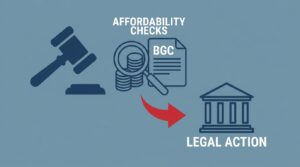
The Betting and Gaming Council (BGC) has signalled it may take legal action against the UK government’s proposed affordability checks for gambling customers, describing the measures as a serious threat to the licensed betting industry. The trade body, which represents major operators across the UK, argues the checks would drive customers toward unregulated black-market platforms. It’s a confrontation that has been building for months, and the language from BGC leadership suggests the organisation is now preparing to escalate.
What the BGC’s Legal Threat Actually Means for the Sector
The prospect of legal action from the UK’s largest gambling trade body carries weight beyond the courtroom. Before unpacking the detail, here are the strategic takeaways that matter most for industry stakeholders:
- Regulatory collision course: BGC’s willingness to litigate signals a fundamental breakdown in dialogue between operators and the government over how affordability should be assessed
- The trade body contends that intrusive financial checks will alienate recreational bettors, pushing an estimated portion of customers toward unlicensed offshore operators
- Revenue exposure: Licensed operators face potential revenue losses if customers migrate to black-market alternatives that face no equivalent compliance burden
- Legal proceedings, if launched, could delay implementation of the checks and create regulatory uncertainty across the sector for the foreseeable future
- Political stakes are rising as the government attempts to balance public health objectives with the economic contribution of a legal gambling industry worth billions in tax revenue
Why BGC Says It Has ‘Little Choice’
The phrase itself is telling. BGC chief executive Michael Dugher has framed the potential legal challenge not as aggression but as a last resort, a position the organisation has been forced into by what it views as disproportionate regulatory proposals. The affordability checks under discussion would require operators to verify customers’ financial circumstances before allowing them to bet above certain thresholds. In practice, this could mean requesting bank statements, payslips, or other sensitive financial documentation from punters.
BGC’s core objection is straightforward: most customers will refuse to hand over that kind of information to a betting company. And when they refuse, they won’t stop gambling. They’ll simply move to platforms operating outside UK jurisdiction, where no such checks exist.
That argument isn’t new. But the willingness to back it with litigation is.
The Black Market Problem No One Has Solved
Central to BGC’s case is the claim that affordability checks would accelerate a migration toward unlicensed gambling sites. The Betting and Gaming Council’s own research has consistently highlighted the scale of the UK’s black market, estimating that hundreds of thousands of consumers already use unregulated platforms. Whether those figures hold up to independent scrutiny is a separate question (and one regulators have been reluctant to address head-on).
Still, the underlying dynamic is real. Unlicensed operators face none of the compliance costs, responsible gambling obligations, or tax liabilities that their licensed counterparts bear. Every additional layer of friction in the regulated market widens that competitive gap. The Gambling Commission has acknowledged the black market risk in broad terms but has not, at least on paper, offered a concrete mechanism for containing it alongside stricter affordability requirements.
A Tension Between Protection and Practicality
The government’s position rests on a public health rationale. Problem gambling causes measurable harm, and affordability checks are designed to prevent vulnerable individuals from wagering money they cannot afford to lose. That objective is difficult to argue against in principle. The friction emerges in execution.
How do you verify someone’s financial capacity without making the process so invasive that it deters the 99% of customers who gamble recreationally and within their means? That question sits at the heart of this dispute, and neither side has produced a satisfying answer.
What Licensed Operators Stand to Lose
| Impact Area | Potential Consequence |
|---|---|
| Customer retention | Significant drop-off among recreational bettors unwilling to submit financial documents |
| Revenue | Decline in gross gambling yield as customers migrate to unlicensed platforms |
| Tax contribution | Reduced tax receipts for HM Treasury from a shrinking licensed market |
| Compliance costs | Substantial investment required to build and operate affordability verification systems |
| Brand trust | Reputational risk if customers perceive checks as intrusive or paternalistic, potentially eroding long-term loyalty |
Reframing the Debate: What Both Sides Miss
Much of the public discourse around affordability checks has been polarised, framed as either a necessary safeguard or an existential threat. The reality, arguably, sits somewhere less dramatic but more complicated. Operators have a commercial incentive to resist checks. Regulators have a political incentive to impose them. Neither incentive, on its own, produces good policy.
What’s been largely absent from the conversation is a credible middle path. Technology-driven solutions, such as open banking integrations that verify affordability passively without requiring customers to upload documents, have been discussed in industry circles but haven’t gained traction in the regulatory framework. The reluctance to explore these alternatives suggests the debate has become more about positioning than problem-solving.
And there’s a psychological dimension worth noting. When customers feel surveilled or distrusted, their relationship with a brand shifts. Behavioural research consistently shows that perceived autonomy influences consumer engagement. Checks that feel like gatekeeping, rather than protection, risk triggering reactance, the well-documented tendency to push back against perceived restrictions on freedom. Operators who understand this dynamic have an opportunity to design compliance processes that feel less like interrogation and more like a service. But that requires investment in user experience design, not just legal infrastructure.
The framing matters too. Language shapes perception. If affordability checks are communicated as “financial health tools” rather than “spending limits imposed by your bookmaker,” customer acceptance could shift materially. This isn’t spin; it’s applied behavioural science, and it’s the kind of nuance that tends to get lost when trade bodies and regulators are locked in adversarial postures.
Frequently Asked Questions
What are gambling affordability checks?
They are proposed measures requiring licensed betting operators to assess whether a customer can financially afford their level of gambling, potentially involving requests for income verification or bank statements before allowing higher-stakes betting.
Why is the BGC opposed?
The BGC argues the checks are disproportionate and will push customers toward unregulated black-market operators that face no equivalent requirements. The trade body believes the measures threaten the commercial viability of the licensed sector without effectively reducing gambling harm.
Could this actually end up in court?
BGC’s language strongly suggests it is preparing for that possibility. Whether proceedings are formally launched will likely depend on the final shape of the government’s proposals and whether any concessions emerge during consultation. Legal challenges of this nature in regulated industries are uncommon but not unprecedented.
What happens to tax revenue if the licensed market shrinks?
The UK’s licensed gambling industry contributes billions in tax annually. A material shift of customers to unlicensed platforms would reduce that contribution, though the precise scale remains contested between industry and government estimates.



