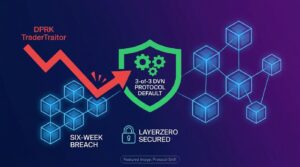
LayerZero has published a detailed post-mortem tracing a security breach that persisted for roughly six weeks to TraderTraitor, a North Korea-linked threat group with a growing track record of targeting crypto infrastructure. The May 18 disclosure outlines how the compromise unfolded, what was exploited, and the protocol-level changes now being enforced to prevent recurrence. Kelp, the liquid restaking protocol affected through its rsETH bridging operations, confirmed that LayerZero approved a new configuration and that rsETH bridging has since migrated to Chainlink. The incident marks one of the more consequential cross-chain security failures of 2025 so far.
What the Breach Revealed About Cross-Chain Verification Gaps
Before unpacking the response, the breach itself deserves scrutiny. According to the post-mortem, TraderTraitor exploited weaknesses in the Decentralized Verifier Network (DVN) configuration that governed message validation between chains. The group, which the FBI and CISA have previously attributed to North Korea’s Lazarus cluster, maintained access for approximately six weeks before detection. That window is significant. It suggests the attackers operated with enough stealth to avoid triggering anomaly detection across multiple verification layers (a distinction that raises uncomfortable questions about monitoring depth in cross-chain protocols).
LayerZero’s response has been to lock in a new default: a 3-of-3 DVN protocol configuration. In practice, this means every cross-chain message must now be independently validated by three separate verifier nodes before execution. The previous setup, which allowed more flexible thresholds, arguably left room for compromise if even one verifier was breached or manipulated.
Strategic Implications of the TraderTraitor Attribution
An introductory note on why the attribution matters beyond the technical fix: TraderTraitor is not a generic label. The group has been tied to multiple high-value crypto thefts, and its operations are assessed by U.S. intelligence agencies as revenue-generating mechanisms for the DPRK regime. Linking this breach to TraderTraitor places it in a geopolitical context that most DeFi security incidents never reach.
- State-level adversaries are now routinely probing cross-chain infrastructure, not just centralized exchanges or custodial wallets
- The six-week dwell time suggests detection capabilities across DVN architectures remain underdeveloped relative to the sophistication of attackers
- LayerZero’s shift to a 3-of-3 DVN default signals that the protocol’s prior trust assumptions were insufficient against nation-state threats
- Kelp’s migration of rsETH bridging to Chainlink reflects a broader trend: protocols seeking oracle and verification redundancy from established providers after a breach
- Regulatory scrutiny of cross-chain bridge security is likely to intensify, particularly as U.S. agencies track DPRK-linked crypto flows more aggressively
Kelp’s Response and the Chainlink Migration
Kelp moved quickly. The liquid restaking protocol confirmed that rsETH bridging operations have been migrated to Chainlink’s infrastructure, a decision made in coordination with LayerZero. This is not merely a vendor swap. Chainlink’s Cross-Chain Interoperability Protocol (CCIP) operates under a different verification model, one that layers decentralized oracle networks with risk management controls that have been battle-tested across traditional DeFi lending and derivatives markets.
Still, migration introduces its own risks. Transitioning bridging infrastructure mid-operation requires careful handling of in-flight messages, liquidity positions, and user-facing interfaces. Whether Kelp experienced any service disruption during the switch has not been publicly detailed.
How the 3-of-3 DVN Default Changes the Security Calculus
The technical shift deserves its own examination. Under LayerZero’s updated DVN protocol, three independent verifiers must each confirm a cross-chain message before it executes. This is a stricter threshold than many protocols currently enforce.
| Configuration | Verifiers Required | Trade-off |
|---|---|---|
| Previous default (flexible) | Variable (often 1-of-2 or 2-of-3) | Higher throughput, lower latency, broader attack surface |
| New 3-of-3 default | All three must agree | Slower finality, significantly reduced single-point-of-failure risk |
| Chainlink CCIP (Kelp migration) | Oracle consensus + risk management layer | Different trust model entirely; relies on Chainlink node operator set |
The trade-off is real. Requiring unanimous verification from three nodes introduces latency and reduces throughput. But after a six-week undetected breach, the calculus tilts heavily toward security over speed.
Reframing Cross-Chain Security Through a Behavioral Lens
Beyond the technical remediation, this incident exposes a pattern worth examining through a behavioral and cognitive lens. Protocol teams, like individuals, tend to anchor on prior assumptions about risk. When a DVN configuration has worked without incident for months, the perceived probability of compromise drops, even as the actual threat landscape evolves. This anchoring bias is well-documented in decision science and applies directly to how security thresholds get set in decentralized systems.
There is also a framing effect at play. Cross-chain bridges have historically been framed as infrastructure problems, engineering challenges to be optimized for speed and cost. TraderTraitor’s involvement reframes them as national security targets. That shift in framing changes who pays attention, how budgets get allocated, and what level of verification is considered acceptable. Protocols that continue to frame bridge security purely as a throughput optimization problem are, arguably, operating with an outdated mental model.
And the social proof dynamic matters too. Kelp’s public migration to Chainlink sends a signal to other protocols built on LayerZero’s messaging layer. When one prominent project moves, others reassess. The question is whether this triggers a broader migration wave or whether the 3-of-3 DVN default proves sufficient to retain confidence. Either way, the reputational cost of inaction after a state-sponsored breach is now quantifiable in a way it was not before.
Frequently Asked Questions
What is TraderTraitor?
TraderTraitor is a threat group attributed by U.S. federal agencies to North Korea. It has been linked to multiple cryptocurrency thefts and is assessed to operate as a revenue-generation arm for the DPRK regime, targeting DeFi protocols and centralized platforms alike.
Why did LayerZero switch to a 3-of-3 DVN default?
The previous configuration allowed more flexible verification thresholds, which the breach exploited. Requiring all three verifiers to independently confirm each message eliminates the risk of a single compromised node enabling unauthorized transactions. It is a direct response to the attack vector TraderTraitor used.
Does the Chainlink migration affect rsETH holders?
Kelp has stated that rsETH bridging now operates through Chainlink’s infrastructure. Users bridging rsETH should experience the same functionality, though the underlying verification mechanism has changed. No reports of lost funds or service interruption have been published as of the post-mortem date.
How long did the breach go undetected?
Approximately six weeks, according to LayerZero’s May 18 disclosure. That duration has raised questions about the adequacy of real-time monitoring across decentralized verification networks.



