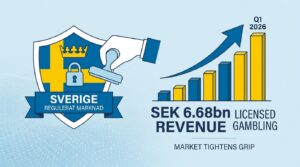
Sweden’s gambling regulator Spelinspektionen reported SEK668bn in licensed gambling revenue for the first quarter of 2026, signalling continued strength in the country’s regulated market. The figure reflects the growing dominance of licensed operators in a jurisdiction that has spent years working to channel consumers away from unauthorised platforms. While the headline number captures market scale, the underlying dynamics reveal shifting patterns across product verticals and operator categories that carry strategic weight for the broader Nordic gambling landscape.
What Q1 2026 Tells Us About Sweden’s Regulated Gambling Trajectory
Before diving into the specifics, the quarterly data from Spelinspektionen deserves framing. Sweden’s licensing regime, introduced in January 2019, has matured into one of Europe’s more closely watched regulatory experiments. The Q1 2026 numbers offer a snapshot of where that experiment stands — and where friction points remain.
- Revenue concentration among licensed operators continues to climb, suggesting that channelisation efforts and enforcement actions against unlicensed sites are producing measurable results.
- The SEK668bn figure represents the combined output of online casino, sports betting, and state-operated lottery segments under licence.
- Product-level shifts hint at evolving consumer preferences, with online verticals likely outpacing retail formats in growth rate.
- Regulatory pressure on bonus restrictions and deposit limits has not, at least on paper, dampened top-line performance for compliant operators.
- The data reinforces Sweden’s position as a bellwether for other European markets considering similar licensing frameworks
How Channelisation Shapes the Revenue Picture
Sweden’s core regulatory challenge has always been channelisation: the percentage of total gambling activity that flows through licensed, taxed, and supervised operators rather than offshore or grey-market alternatives. Early years of the licensing system saw channelisation rates that regulators considered too low, prompting a series of enforcement escalations and marketing restrictions designed to tilt the balance.
The Q1 2026 revenue figure suggests those measures are gaining traction. But whether the gains come from genuine migration of players into the regulated ecosystem or simply from organic market growth among already-compliant consumers is harder to untangle. Spelinspektionen has historically published channelisation estimates alongside revenue data, and the trajectory has been upward (a distinction regulators have been slow to celebrate publicly, given persistent criticism from industry stakeholders about overly restrictive rules).
Still, the Swedish model faces a tension that no quarterly report fully resolves. Tighter player protection rules — deposit caps, mandatory loss limits, restrictions on bonus offers — protect consumers but also risk pushing price-sensitive or high-volume players toward unlicensed alternatives. The revenue data alone cannot answer whether Sweden has found the right calibration.
Product Verticals and Where Growth Concentrates
Online casino and sports betting remain the twin engines of Sweden’s licensed market. Spelinspektionen’s quarterly reporting framework breaks revenue across several categories, including online gambling, land-based operations, and the state-controlled Svenska Spel lottery system.
What stands out in recent quarters is the relative resilience of online formats. Land-based gambling, including casino venues and gaming machines in restaurants, has recovered from pandemic-era disruptions but grows at a notably slower pace. Online operators, by contrast, benefit from mobile penetration rates in Sweden that remain among Europe’s highest — north of 95% smartphone usage among adults under 55.
Sports betting volumes tend to fluctuate with the calendar. Q1 typically captures the tail end of European football leagues’ winter schedules and early knockout rounds of continental competitions, which can inflate or suppress wagering volumes depending on the competitive landscape. Any year-over-year comparison needs that seasonal lens.
Revenue Distribution by Segment
| Segment | Trend (Q1 2026 vs. Prior Year) | Key Driver |
|---|---|---|
| Online Casino | Growth sustained | Mobile adoption, product innovation |
| Sports Betting | Seasonal variation | Football calendar, in-play expansion |
| State Lottery (Svenska Spel) | Stable | Brand trust, retail distribution network |
| Land-Based Gaming | Modest recovery | Post-pandemic normalisation, though structural headwinds persist from digital migration |
Regulatory Pressure and Its Paradox
Sweden has arguably been one of Europe’s most interventionist regulators when it comes to player protection measures within a licensed framework. Temporary COVID-era restrictions on deposit limits were extended, then partially relaxed, then debated again. Bonus caps remain tight. Advertising rules have been progressively narrowed.
And yet revenue keeps climbing.
This creates a paradox that both regulators and operators interpret to suit their positions. For Spelinspektionen, rising revenue under stricter rules validates the approach: consumers can be protected without destroying the market. For operators, the same data sometimes masks margin compression — top-line revenue growth does not always translate into bottom-line profitability when compliance costs, tax obligations, and marketing restrictions eat into operating leverage. The distinction matters more than headline figures suggest.
What This Means for Nordic and European Markets
Sweden’s Q1 performance carries implications well beyond Stockholm. Denmark, Finland, and Norway each operate under different regulatory philosophies, but all watch Swedish outcomes closely. The Finnish market, in particular, is undergoing its own licensing transition after decades of state monopoly, and Swedish channelisation data feeds directly into Helsinki’s policy modelling.
Across the broader European landscape, regulators in Germany, the Netherlands, and Italy face similar questions about how to balance consumer protection with market viability. Sweden’s ability to post strong licensed revenue numbers while maintaining relatively strict player safeguards offers a data point — not a definitive answer, but a reference case that policymakers cite frequently in legislative debates.
Frequently Asked Questions
What does SEK668bn in licensed gambling revenue represent?
This is the total revenue generated by operators holding a Swedish gambling licence during the first quarter of 2026, as reported by the national regulator Spelinspektionen. It covers online casino, sports betting, lottery, and land-based gaming segments combined.
How does Sweden’s channelisation rate affect these figures?
Channelisation measures the share of total gambling activity occurring within the licensed market. Higher channelisation means more revenue flows through regulated, taxed operators. Sweden has been working to increase this rate since its licensing system launched in 2019, and the Q1 2026 revenue figure suggests continued progress — though precise channelisation percentages require separate analysis beyond raw revenue data.
Are Swedish gambling regulations getting stricter?
In several areas, yes. Deposit limits, bonus restrictions, and advertising rules have all been tightened over recent years. Whether further restrictions are forthcoming depends on political dynamics and ongoing evaluations by Spelinspektionen. The regulator has shown willingness to adjust rules based on market data rather than ideology alone, which makes the quarterly revenue reports politically significant as well as commercially relevant.



