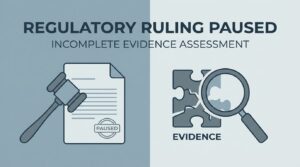
A financial regulator has disclosed that it has “not yet fully completed its assessment” of evidence submitted in an ongoing enforcement matter, signalling a delay in what many market participants had expected to be a decisive ruling. The pause introduces fresh uncertainty for the firms involved and raises questions about the regulator’s internal review capacity. While the specific details of the case remain tightly held, the procedural delay itself carries weight for an industry already navigating a dense regulatory calendar.
What the Delay Signals for Affected Firms
Regulatory pauses of this nature rarely occur in isolation. They tend to reflect either the volume of evidence under review, the complexity of the conduct being examined, or both. For the entities awaiting a determination, the practical consequences are immediate: compliance teams remain in a holding pattern, strategic decisions get deferred, and reputational exposure lingers without resolution.
- The regulator’s acknowledgment that its assessment is incomplete suggests the evidentiary record may be more extensive than initially anticipated
- Firms under review face prolonged uncertainty, which can affect capital allocation, partnerships, and market positioning
- The delay may prompt other regulated entities to re-examine their own compliance documentation, anticipating heightened scrutiny
- Industry observers should watch for whether the regulator requests supplementary submissions or extends formal deadlines
- A drawn-out process could set a precedent for how similar cases are handled in future enforcement cycles
Why Procedural Timelines Matter More Than They Seem
It is tempting to treat a regulatory delay as administrative noise. But in practice, the timing of enforcement actions shapes market behaviour in ways that extend well beyond the parties directly involved. When a regulator signals that it needs more time, the market reads between the lines.
Consider the downstream effects. Competitors adjust their risk appetite. Investors recalibrate exposure. And compliance consultancies (a growing cottage industry in heavily regulated sectors) begin advising clients to tighten internal controls preemptively. The ripple effect of a single procedural update can be surprisingly broad.
Still, not every delay carries the same implications. Some reflect genuine thoroughness. Others hint at resource constraints within the regulatory body itself. What remains less clear in this instance is which dynamic is at play.
The Broader Regulatory Environment
This development lands at a moment when regulators across multiple jurisdictions are grappling with expanding mandates and finite capacity. The volume of enforcement activity has increased markedly over the past two years, driven by evolving market structures, new product categories, and cross-border complexities that earlier frameworks were not designed to address.
Regulators have, at least on paper, committed to faster resolution timelines. Yet the gap between stated ambitions and operational reality continues to widen in several key markets. A regulator publicly acknowledging an incomplete assessment is, arguably, a sign of institutional honesty rather than dysfunction. Whether the market interprets it that way is another matter entirely.
| Factor | Potential Impact | Likelihood |
|---|---|---|
| Extended review period | Prolonged compliance costs for firms under scrutiny | High |
| Request for additional evidence | Broader scope of investigation; possible new parties drawn in | Moderate |
| Precedent-setting outcome | Shifts enforcement expectations across the sector | Moderate to High |
| Resource reallocation within regulator | Delays in unrelated cases or supervisory activities | Uncertain, but worth monitoring closely |
How Firms Should Recalibrate Their Response
For organisations operating in regulated environments, a moment like this calls for more than passive waiting. The instinct to “sit tight until the ruling drops” is understandable but strategically incomplete. Proactive firms tend to use enforcement pauses as windows for internal audit, documentation review, and scenario planning.
One approach gaining traction among compliance leaders involves stress-testing internal evidence trails against the standards regulators have applied in recent comparable cases. That means going beyond checkbox compliance and examining whether the organisation’s records would withstand the kind of granular review this delay implies. It is a subtle but important distinction (and one that separates firms that merely comply from those that are genuinely prepared).
And while no firm wants to be the subject of an enforcement action, the firms that emerge strongest from regulatory scrutiny are typically those that treated the process as an opportunity to strengthen governance rather than simply survive it. That reframing, from threat to diagnostic, is where the Financial Conduct Authority’s published enforcement guidance can serve as a useful reference point for calibrating internal expectations.
Reframing Regulatory Uncertainty as Strategic Input
Uncertainty is often framed as purely negative. In behavioural terms, however, the way organisations process ambiguity determines their strategic agility. Neuro-linguistic programming principles suggest that the language leaders use internally to describe regulatory risk directly shapes organisational response. Describing a delay as a “threat” triggers defensive postures. Describing it as “additional preparation time” opens cognitive space for constructive action.
This is not about spin. It is about the practical reality that teams anchored in threat-based framing tend to freeze, while those operating from a problem-solving frame tend to act. Senior leaders who communicate regulatory developments to their boards and teams using precise, measured language create conditions for better decision-making. Vague reassurances erode trust. Specific, contextualised updates build it.
The same principle applies externally. Firms that issue carefully worded, factual statements about their regulatory status tend to preserve stakeholder confidence more effectively than those that either go silent or overcommunicate. Finding that balance requires discipline, and it requires leaders who understand that the words they choose shape the outcomes they get. In a regulatory pause, the temptation to speculate is strong. Resisting it is a competitive advantage.
Frequently Asked Questions
What does it mean when a regulator says its assessment is not yet complete?
It typically indicates that the body reviewing the case requires additional time to evaluate the evidence before reaching a formal determination. This can result from the complexity of the matter, the volume of submissions, or internal resource constraints.
Should firms under review take any action during the delay?
Yes. Proactive steps such as reviewing internal compliance documentation, conducting scenario analyses, and ensuring legal readiness are advisable. Waiting passively can leave organisations underprepared if the scope of the review expands.
Does a delay suggest the regulator will impose harsher penalties?
Not necessarily. A longer review period does not inherently correlate with a more severe outcome. It may simply reflect due diligence on the part of the regulator, though affected parties should prepare for a range of scenarios.
How might this affect other firms in the same sector?
Competitors and peers often adjust their own compliance posture in response to high-profile enforcement activity. The delay itself may prompt industry-wide reviews of documentation practices and governance frameworks, even among firms not directly involved.



