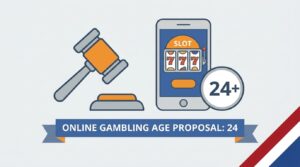
Enschede councillor Meryam Sümer has called on Dutch national lawmakers to raise the minimum legal age for online gambling from 18 to 24, citing mounting concerns over gambling-related harm among young adults. The proposal, which targets what Sümer describes as a vulnerable demographic increasingly exposed to aggressive digital marketing, has reignited debate over the Netherlands’ regulated gambling framework. If adopted at the national level, such a measure would represent one of the strictest age thresholds for online gambling anywhere in Europe.
What the Enschede Proposal Signals for Dutch Gambling Policy
The push from a municipal councillor may seem modest in scope, but it reflects a broader current running through Dutch politics. Since the Netherlands opened its regulated online gambling market in October 2021 under the Remote Gambling Act (Kansspelen op afstand, or KOA), criticism of the regime’s consumer protection provisions has been persistent and, at times, sharp. Before examining the strategic implications, here are the core takeaways from this development:
- Age threshold escalation: Raising the minimum age to 24 would effectively exclude the 18–23 cohort, a demographic that accounts for a disproportionate share of problem gambling cases in the Netherlands
- Regulatory precedent: No EU member state currently enforces a minimum online gambling age above 21, making a 24-year threshold a potential outlier with uncertain enforceability
- The proposal adds political pressure on the Kansspelautoriteit (KSA), the Dutch gambling regulator, which has already faced scrutiny over advertising rules and operator compliance
- Operator impact: Licensed operators in the Dutch market would face a significant reduction in their addressable customer base, with downstream effects on revenue projections and marketing strategies
- Municipal-level advocacy like this often serves as a testing ground for national legislative momentum, even when the proposal itself lacks binding authority
Why 24? The Neuroscience Argument
Sümer’s choice of 24 as the proposed threshold is not arbitrary. It draws on a well-established body of neuroscience research indicating that the prefrontal cortex, the brain region responsible for impulse control, risk assessment, and long-term decision-making, does not fully mature until approximately age 25. This argument has gained traction in public health circles and has already influenced policy in adjacent domains such as alcohol regulation and tobacco sales in several countries.
In the context of gambling, the implications are concrete. Young adults between 18 and 24 are statistically more susceptible to developing problematic gambling behaviours. Data from the Netherlands’ own addiction research institutes has repeatedly flagged this age group as high-risk. And while the current legal framework permits 18-year-olds to gamble online, the question of whether legal capacity should align more closely with neurological maturity is one that Dutch policymakers have so far avoided answering directly.
Still, the neuroscience framing is not without its critics. Some argue it risks infantilising legal adults and creating inconsistencies across regulatory domains (a distinction regulators have been slow to reconcile). If an 18-year-old can vote, serve in the military, and enter binding contracts, the case for restricting their access to a licensed leisure activity demands more than a brain scan to justify.
The Dutch Market Under Pressure
The Netherlands’ online gambling market has been anything but smooth since its 2021 launch. The Kansspelautoriteit has issued multiple enforcement actions against operators for violations ranging from advertising breaches to inadequate responsible gambling measures. A nationwide ban on untargeted gambling advertising took effect in mid-2023, and further restrictions on bonus offers and affiliate marketing have followed.
Operators already navigating this tightening environment would face an additional structural challenge if the minimum age were raised. The 18–23 demographic, while not the highest-spending segment, represents a critical acquisition pipeline for operators building long-term customer relationships. Removing that pipeline doesn’t just shrink the market today. It reshapes it for a decade.
How the Netherlands Compares
| Country | Minimum Online Gambling Age | Notable Restrictions |
|---|---|---|
| Netherlands | 18 (current) | Advertising ban on untargeted channels since 2023 |
| United Kingdom | 18 | Affordability checks under review; credit card ban in effect |
| Germany | 18 | Monthly deposit cap of €1,000 across all operators |
| Italy | 18 | Complete gambling advertising ban since 2019 |
| United States (varies) | 21 (most states) | State-by-state licensing; no federal framework for online gambling |
What stands out is that even the U.S., with its patchwork of state-level regulations, caps the age at 21. A jump to 24 would place the Netherlands in uncharted territory.
Behavioural Framing and the Psychology of Access
Beyond the legislative mechanics, Sümer’s proposal taps into something deeper about how societies frame access to risk. Neuro-linguistic programming principles suggest that the language used to describe gambling, whether as entertainment, risk, or harm, fundamentally shapes public perception and policy appetite. When a councillor frames gambling access as a matter of brain development rather than personal freedom, the entire debate shifts from libertarian ground to a public health register.
That reframing matters. It changes who gets to speak with authority (clinicians rather than industry lobbyists), what evidence counts (neuroimaging over market data), and which analogies dominate (addiction treatment rather than consumer choice). The anchoring effect here is powerful: once “24” enters the discourse as a number tied to science, every lower threshold must justify itself against it. Even if the proposal fails legislatively, it recalibrates the baseline expectation.
And this is precisely how incremental policy shifts work. A proposal that seems radical today becomes the moderate position in three years, especially when it carries the weight of medical research. Operators and regulators alike would do well to recognise that the Overton window on gambling age restrictions is moving, and not in the industry’s favour.
Frequently Asked Questions
Can a local councillor change national gambling law in the Netherlands?
No. Gambling regulation falls under national jurisdiction through the Remote Gambling Act. But municipal councillors can formally petition national lawmakers and generate political momentum that influences legislative priorities.
Has any country set the online gambling age at 24?
Not yet. The highest commonly enforced minimum age for online gambling is 21, applied in most U.S. states with legal online gambling. A threshold of 24 would be unprecedented globally.
What is the current enforcement posture of the Dutch gambling regulator?
The KSA has been increasingly active, issuing fines and sanctions against both licensed and unlicensed operators. Its focus has expanded from market entry compliance to ongoing conduct obligations, particularly around advertising and player protection. Whether it has the appetite or mandate to advocate for age threshold changes remains an open question.