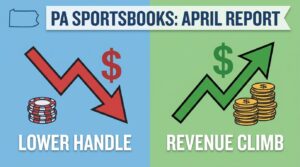
Pennsylvania’s regulated sportsbooks recorded a decline in total wagers during April 2025 compared to the same month last year, yet managed to extract stronger revenue from a smaller pool of bets. The state’s operators collectively posted a higher win rate, translating reduced handle into improved bottom-line performance. It’s a pattern that complicates the simple narrative of growth-at-all-costs that has defined U.S. sports betting expansion since 2018. And it raises a question worth sitting with: does a maturing market reward volume, or margin?
What April’s Numbers Reveal About Pennsylvania’s Betting Market
Before diving into the specifics, the broader contour of April’s data deserves framing. Pennsylvania remains one of the largest legal sports betting states by population and operator count, making its monthly reports a bellwether for the wider U.S. industry. Here’s what stood out from the latest figures:
- Total handle (the amount wagered) fell year-over-year, reflecting a quieter sports calendar between the NFL season and NBA/NHL playoffs ramping up
- Operator revenue climbed thanks to a notably higher hold percentage, suggesting sportsbooks are getting better at managing risk or bettors are shifting toward higher-margin product types
- Tax contributions to the state remained robust, cushioned by the revenue increase despite lower betting volume
- Online channels continued to dominate, accounting for the vast majority of all wagers placed
- The competitive landscape showed familiar names at the top, but market share shifts hinted at evolving consumer preferences
Handle Drops, but the House Wins More
April has historically been a transitional month for sportsbooks. The NFL, which drives roughly half of all U.S. sports betting handle, is months away. March Madness wraps up early in the month, leaving MLB’s early season and the NBA and NHL postseasons to carry the load. That seasonal dip showed up clearly in Pennsylvania’s numbers.
Still, operators didn’t just survive the softer month. They thrived, at least on a revenue basis. The statewide hold rate pushed higher than the year-ago period, a trend visible across several major U.S. jurisdictions in recent months. Whether this reflects sharper odds-setting, the growing popularity of same-game parlays (a product type with structurally higher margins), or simply variance is difficult to isolate from a single month’s data. Probably all three contributed.
What’s harder to dismiss is the strategic implication. Sportsbooks that once competed almost exclusively on promotional generosity and market share acquisition are now visibly prioritizing unit economics. The promotional spending wars of 2021 and 2022 have cooled considerably (a shift investors have welcomed, even if bettors have noticed thinner bonus offers).
Online Betting Remains the Engine
Retail sportsbooks in Pennsylvania, located at the state’s casinos, continue to represent a small fraction of total activity. The convenience gap between walking into a physical location and placing a bet from a phone is, at this point, nearly insurmountable for retail. FanDuel’s Pennsylvania sportsbook platform and its major competitors have built digital experiences that keep bettors within their ecosystems across sports, promotions, and live wagering.
Mobile and online wagers accounted for well over 90% of the state’s handle in April. That ratio has been climbing steadily since Pennsylvania launched online sports betting in 2019, and there’s little reason to expect a reversal.
Operator Performance Snapshot: April 2025
| Metric | April 2025 | April 2024 | Direction |
|---|---|---|---|
| Total Handle | Lower | Higher | ↓ Year-over-year |
| Gross Revenue | Higher | Lower | ↑ Year-over-year |
| Hold Rate | Elevated | Standard range | ↑ Improved margin |
| Online Share of Handle | ~90%+ | ~90% | → Stable dominance |
| Tax Revenue to State | Robust | Solid | ↑ Supported by higher revenue |
How Market Maturity Reshapes Bettor Behavior
Pennsylvania legalized sports betting in late 2018, making it one of the earliest movers after the Supreme Court struck down the federal prohibition. Nearly seven years in, the state’s market exhibits hallmarks of maturity that newer states haven’t yet reached. Promotional churn has slowed. Operator consolidation, while not dramatic, has narrowed the field of serious competitors. And bettors themselves appear to be evolving.
Research into bettor psychology offers useful context here. Neuro-linguistic programming principles suggest that consumer decision-making frameworks shift as familiarity with a product increases. Early-stage bettors tend to be driven by novelty, promotional incentives, and broad exploration of bet types. As they gain experience, their behavior narrows. They develop preferences, routines, and mental models for evaluating odds. This cognitive anchoring means mature bettors often gravitate toward specific sports, bet structures, or even time-of-day patterns.
For operators, understanding these behavioral shifts isn’t academic. It directly informs product design, CRM strategy, and how promotional dollars get allocated. A bettor in their third year of activity responds to different triggers than someone placing their first wager. The language used in push notifications, the framing of odds boosts, even the sequencing of options on a bet slip can influence engagement and spend. Operators investing in behavioral analytics are, arguably, building the most durable competitive advantages in a market where the underlying product is largely commoditized.
This also explains why same-game parlays have become such a focal point. They appeal to experienced bettors seeking complexity and perceived edge, while simultaneously delivering the higher hold rates that operators need to justify their customer acquisition costs. The alignment of bettor psychology and operator economics in this product category is not coincidental.
What Comes Next for Pennsylvania Operators
May and June should bring stronger handle numbers as the NBA and NHL playoffs reach their later rounds and MLB settles into its regular-season rhythm. But the more consequential storyline may be legislative. Pennsylvania’s 36% tax rate on online sports betting revenue remains among the highest in the country, and operators have periodically lobbied for relief. Whether that pressure gains traction in Harrisburg during the current session is uncertain; the state has shown little appetite for reducing a revenue stream that continues to grow.
The tension between tax burden and operator profitability will shape investment decisions. States with lower rates, like neighboring New Jersey, can attract more aggressive promotional spending and product innovation. Pennsylvania’s operators must generate enough margin to absorb the tax hit and still compete for customers who can, in many cases, simply cross a state line.
Frequently Asked Questions
Why did Pennsylvania’s sports betting handle decline in April?
April sits in a seasonal gap between the NFL season and the peak of NBA and NHL playoffs. March Madness ends early in the month, and MLB’s early season doesn’t generate the same wagering volume as football. This pattern is consistent across most U.S. sports betting states.
How did revenue increase if fewer bets were placed?
Sportsbooks held a higher percentage of the money wagered, meaning their win rate improved. This can result from better odds management, a shift toward higher-margin bet types like same-game parlays, or simply natural variance in outcomes.
Is Pennsylvania’s sports betting market still growing?
In terms of revenue and tax generation, yes. Handle growth has moderated compared to the explosive early years, which is typical of a market entering its mature phase. The focus for operators has shifted from raw volume toward sustainable profitability.