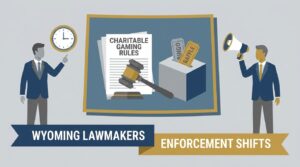
Wyoming’s legislative landscape around charitable gaming is entering a period of active reconsideration. State lawmakers have been asked to revisit the rules governing charitable gaming operations after recent enforcement changes raised questions about compliance, scope, and the future of nonprofit gaming revenue across the state. The push comes at a time when several states are reassessing how charitable organizations interact with gaming frameworks, making Wyoming’s deliberations part of a broader national pattern.
What’s Driving the Push to Revisit Charitable Gaming in Wyoming
Before diving into the strategic implications, it’s worth grounding the discussion in what has actually shifted. Wyoming’s charitable gaming sector operates under a regulatory framework that permits certain nonprofit organizations to conduct limited gaming activities, including raffles, bingo, and pull-tab games, as a means of fundraising. Recent enforcement changes, though not yet fully codified into revised statute, have introduced new compliance expectations that some nonprofits say are difficult to meet without clearer legislative guidance.
- Enforcement recalibration: State regulators have tightened oversight of charitable gaming proceeds, prompting nonprofits to seek legislative clarity on reporting obligations and permissible uses of funds.
- Several charitable organizations have flagged that the current rules create ambiguity around what constitutes a qualifying event versus a commercial gaming operation.
- Revenue at stake: Charitable gaming generates meaningful income for community organizations in Wyoming. Any disruption to the regulatory framework could reduce funding for local programs that depend on these proceeds.
- Legislative timing matters. With the Wyoming Legislature’s interim committee process underway, there is a narrow window for stakeholders to shape proposed amendments before they reach the full chamber.
- Neighboring states have recently modernized their own charitable gaming statutes, creating competitive pressure on Wyoming to update its approach or risk losing organizational activity to jurisdictions with clearer rules.
The Enforcement Gap That Sparked the Debate
At the core of this issue is a disconnect between existing statute and how regulators have begun interpreting it. Wyoming’s charitable gaming laws were last substantively updated years ago, and the operational realities of nonprofit fundraising have shifted considerably since then. Digital ticketing, online raffles, and multi-venue bingo events now occupy space that the original rules never anticipated.
Regulators, facing these new formats, have responded by applying stricter interpretations of existing provisions (a distinction that has caught some organizations off guard). The result: a sector caught between outdated rules and evolving enforcement expectations, with no clear legislative anchor to resolve the tension.
And while no formal penalties have been widely reported, the chilling effect on smaller nonprofits is real. Organizations with limited administrative capacity are, in practice, scaling back gaming events rather than risking noncompliance under uncertain standards.
How Other States Handle Charitable Gaming Oversight
Wyoming is not operating in a vacuum. A look at how peer states manage charitable gaming reveals a range of approaches, from permissive to tightly controlled.
| State | Charitable Gaming Model | Recent Changes |
|---|---|---|
| Montana | Broad authorization with state-level licensing | Updated digital raffle provisions in 2023 |
| South Dakota | Limited to specific game types; strict reporting | No major recent amendments |
| Colorado | Moderate scope; local jurisdiction plays a role | Expanded permissible game categories in 2022 |
| Wyoming | Narrow authorization; enforcement-driven interpretation | Under active legislative review |
Montana’s approach is particularly instructive. By explicitly authorizing digital formats and streamlining licensing, the state reduced compliance friction without sacrificing oversight. Whether Wyoming follows a similar path depends largely on how lawmakers weigh nonprofit flexibility against regulatory control.
Why This Matters Beyond Gaming Revenue
Charitable gaming in Wyoming is not simply a revenue question. It touches on how the state defines the boundary between nonprofit activity and commercial enterprise. Get that line wrong, and the consequences ripple outward. Nonprofits that lose access to gaming revenue must find alternative funding sources, often turning to grants or donor campaigns that are slower and less reliable. Community programs, from youth sports leagues to volunteer fire departments, feel the squeeze first.
There is also a governance dimension. When enforcement shifts without corresponding legislative action, it creates a precedent where regulatory interpretation effectively becomes policy. That dynamic, arguably, undermines the role of the legislature itself.
Reframing the Conversation: Clarity as a Strategic Asset
One dimension that often goes unexamined in regulatory debates is how uncertainty itself shapes behavior. In cognitive and behavioral terms, ambiguity doesn’t just slow decision-making; it distorts it. Organizations facing unclear rules tend to adopt one of two strategies: overcompliance, which drains resources, or avoidance, which eliminates activity altogether. Neither outcome serves the public interest.
For Wyoming’s nonprofits, the current environment triggers what behavioral economists call loss aversion. The perceived risk of running afoul of new enforcement standards outweighs the potential benefit of hosting a gaming event, even when that event would be entirely lawful under a reasonable reading of the statute. This psychological dynamic is not trivial. It means that the real cost of regulatory ambiguity is not measured in fines or penalties but in events that never happen, funds that are never raised, and communities that go without.
Lawmakers who recognize this pattern have an opportunity to reframe the debate. Instead of asking whether charitable gaming rules need to be stricter or looser, the more productive question is whether the rules are clear enough to be followed confidently. Clarity, in this context, functions as infrastructure. It reduces friction, lowers compliance costs, and allows organizations to allocate their limited resources toward mission-driven work rather than legal interpretation.
Still, not all stakeholders agree on what clarity should look like. Some favor prescriptive rules that define every permissible format. Others want broader authorization with post-event reporting requirements. The tension between these approaches will likely define the legislative conversation in the months ahead.
Frequently Asked Questions
What types of gaming are currently permitted under Wyoming’s charitable gaming laws?
Wyoming allows certain nonprofit organizations to conduct raffles, bingo, and pull-tab games under specific conditions. The scope is narrower than in several neighboring states, and digital formats remain a gray area under current statute.
Why are enforcement changes prompting legislative review?
Regulators have begun applying stricter interpretations of existing rules, particularly around reporting and event formats. Because these interpretations were not accompanied by new legislation, nonprofits and lawmakers alike have called for statutory updates to provide clearer guidance.
Could Wyoming expand charitable gaming to include online formats?
That possibility is on the table, though no specific bill has been introduced as of now. Montana’s recent digital raffle provisions offer one model that Wyoming legislators may examine during the interim committee process.
How much revenue does charitable gaming generate for Wyoming nonprofits?
No single consolidated figure has been published by the state. But across the nonprofit sector, gaming events represent a significant and, for some organizations, irreplaceable source of operational funding.



