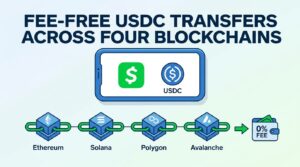
Cash App, the payments platform owned by Block (the fintech company co-founded by Jack Dorsey), has introduced support for sending and receiving USDC stablecoins across four blockchain networks. The integration, announced Wednesday, eliminates transfer fees and removes the need for users to set up a separate crypto wallet. It marks one of the most frictionless on-ramps to stablecoin usage yet offered by a mainstream consumer payments app, and it signals a broader strategic shift in how established fintech players are positioning themselves around digital dollars.
What Cash App’s Stablecoin Move Means for Fintech and Crypto
The decision to embed USDC transfers directly into Cash App’s existing interface carries implications that stretch well beyond a product update. By stripping away the technical barriers that have historically kept casual users away from stablecoins, Block is making a calculated bet on everyday utility over speculative trading. Here’s what stands out:
- Zero fees on USDC transfers position Cash App to compete directly with traditional remittance services and peer-to-peer payment rails that still charge percentage-based fees on cross-border transactions.
- Support across four blockchain networks gives users optionality without requiring them to understand the underlying infrastructure.
- No separate wallet or crypto onboarding required — a deliberate design choice that lowers the activation threshold for Cash App’s tens of millions of existing users.
- The move reinforces Block’s broader pivot toward open financial protocols, consistent with Jack Dorsey’s long-stated interest in decentralized payment systems.
- Competitors like PayPal and Venmo, which have their own stablecoin and crypto strategies, now face pressure to match or exceed this level of integration simplicity.
Why Stablecoins, and Why Now?
Stablecoin transaction volumes have surged past those of several major traditional payment networks in recent quarters. USDC, issued by Circle, has positioned itself as the compliance-friendly alternative in a market where regulatory scrutiny continues to intensify. For a company like Block, which already processes billions in payment volume annually, adding stablecoin rails isn’t a novelty play. It’s infrastructure.
And the timing matters. U.S. lawmakers are actively debating stablecoin legislation, with multiple bills circulating through Congress that would establish clearer regulatory frameworks for dollar-pegged digital assets. By launching now, Cash App’s stablecoin integration arrives at a moment when regulatory clarity appears closer than it has in years (a distinction that arguably makes this a lower-risk bet than it would have been twelve months ago).
Still, what remains less clear is whether mainstream consumers actually want stablecoin functionality embedded in their payment apps, or whether this is a supply-side push waiting for demand to catch up.
The Competitive Landscape Shifts
Block isn’t operating in a vacuum. PayPal launched its own stablecoin, PYUSD, in 2023 and has been steadily expanding its crypto capabilities. Stripe recently acquired Bridge, a stablecoin infrastructure company, for over $1 billion. Visa and Mastercard have both piloted stablecoin settlement layers.
But Cash App’s approach differs in one critical respect: it treats USDC not as a crypto product but as a payment feature. There’s no trading interface, no price charts, no speculative framing. The user experience, at least on paper, mirrors sending dollars to a friend. That design philosophy could prove decisive in driving adoption among users who would never open a crypto exchange.
| Platform | Stablecoin Supported | Transfer Fees | Separate Wallet Required |
|---|---|---|---|
| Cash App | USDC | None | No |
| PayPal / Venmo | PYUSD | Varies | No |
| Coinbase | USDC, USDT, others | Network-dependent | Yes (crypto account) |
| Traditional crypto wallets | Multiple | Gas fees apply | Yes, with key management and onboarding steps |
How Frictionless Finance Reshapes User Behavior
There’s a deeper behavioral dimension to this launch that deserves attention. When financial tools reduce cognitive load, adoption patterns change in ways that aren’t always linear. Behavioral economists have long observed that the removal of even minor friction points — an extra screen, a verification step, a fee disclosure — can dramatically increase usage rates. Cash App’s decision to embed USDC transfers without requiring users to think of themselves as “crypto users” taps directly into this principle.
Consider the framing effect at work here. A user sending USDC through Cash App isn’t “transacting on a blockchain.” They’re sending money. The language, the interface, the absence of jargon — all of it is calibrated to normalize what was, until recently, a niche activity. This kind of reframing has precedent: when Venmo turned peer-to-peer payments into a social feed, usage exploded not because the technology changed, but because the perception of the activity did.
Block appears to be applying the same logic to stablecoins. By anchoring the experience in familiarity rather than novelty, the company sidesteps the skepticism that has historically accompanied crypto products aimed at retail users. Whether that strategy converts into sustained transaction volume is the open question, but the psychological architecture behind it is sound.
The implications extend to financial literacy as well. Users who interact with USDC through Cash App may gradually develop comfort with concepts like blockchain settlement and multi-network transfers without ever needing to study them explicitly. That kind of passive education, embedded in routine behavior, tends to be far more durable than any tutorial or onboarding flow.
Frequently Asked Questions
Which blockchains does Cash App support for USDC transfers?
Cash App supports USDC transfers across four blockchain networks. The specific networks haven’t been fully detailed in initial reporting, but USDC is natively available on Ethereum, Solana, Base, and several other chains supported by Circle.
Do users need a crypto wallet to send USDC on Cash App?
No. The entire point of this integration is that it works within Cash App’s existing interface. No separate wallet setup, no seed phrases, no additional verification beyond what Cash App already requires.
Are there any fees for sending or receiving USDC?
Block has stated that USDC transfers on Cash App are fee-free, which distinguishes the offering from most crypto exchanges and even some traditional payment services that charge for cross-border or instant transfers.
How does this compare to PayPal’s stablecoin offering?
PayPal uses its own proprietary stablecoin, PYUSD, while Cash App has opted for USDC — a third-party stablecoin with broader market acceptance and deeper liquidity across decentralized finance protocols. The strategic trade-offs between owning a stablecoin and distributing someone else’s are significant, and neither approach has proven definitively superior yet.