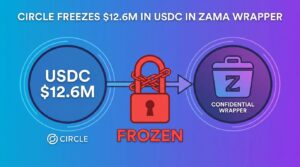
Circle, the issuer behind USDC, blacklisted the smart-contract address powering Zama’s confidential USDC (cUSDC) token on Friday, effectively freezing approximately $12.6 million worth of stablecoins inside a privacy-oriented wrapper protocol. The action targeted an ERC-1967 proxy contract that pools USDC on behalf of users seeking transaction confidentiality. Zama itself faces no known litigation or regulatory enforcement action, which makes the freeze both technically significant and legally ambiguous. The move raises pointed questions about the reach of centralized stablecoin issuers over decentralized infrastructure.
What Circle’s Blacklisting of Zama’s cUSDC Means for Privacy Protocols
Before unpacking the broader implications, here are the core strategic takeaways from this freeze event. Each carries weight for builders, investors, and compliance teams operating at the intersection of stablecoins and on-chain privacy.
- $12.6 million in USDC is now inaccessible inside Zama’s cUSDC wrapper contract, with no public indication of when or whether the freeze will be reversed.
- Circle exercised its contractual blacklisting power against a proxy contract, not an individual wallet, signaling a willingness to target protocol-level infrastructure rather than just end users.
- Zama is not named in any known litigation or enforcement proceeding, raising questions about the legal threshold Circle applies before freezing assets.
- The incident underscores a structural vulnerability in any privacy protocol that relies on centralized stablecoins as its underlying collateral.
- Other confidential token wrappers built on USDC or similar centralized stablecoins now face heightened counterparty risk from their own base asset issuers.
How the Freeze Mechanism Works
USDC’s smart contract includes a blacklist function that allows Circle to freeze any Ethereum address holding the token. Once an address is blacklisted, no USDC can be transferred in or out. The mechanism has been used before, typically in response to law enforcement requests or sanctions compliance obligations.
What distinguishes this case is the target. Zama’s cUSDC wrapper operates as an ERC-1967 proxy, a standard upgradeable contract pattern that pools USDC deposits and issues confidential tokens in return. By blacklisting the proxy address itself, Circle didn’t just freeze one user’s funds. It locked the entire pool.
That’s a blunt instrument. And it affects every depositor who used the wrapper, regardless of whether any individual user engaged in illicit activity.
Zama’s Position: Privacy Without Prosecution
Zama, a company focused on fully homomorphic encryption (FHE) technology, built the cUSDC wrapper as a demonstration of confidential token transfers on Ethereum. The protocol allows users to deposit USDC and receive a privacy-preserving token that obscures transaction details while remaining on-chain. Zama’s fully homomorphic encryption research has attracted attention from both enterprise and crypto-native audiences for its potential to bring programmable privacy to public blockchains.
No regulatory body has publicly accused Zama of facilitating money laundering, sanctions evasion, or any other financial crime. No court order has been disclosed. Circle has not, at the time of this action, issued a public statement explaining the specific rationale behind the blacklisting (a distinction regulators have been slow to demand transparency around).
Whether the freeze was prompted by a government request, an internal compliance review, or something else entirely remains unanswered.
The Structural Risk Stablecoins Pose to Privacy Layers
This incident crystallizes a tension that has simmered for years. Privacy protocols that wrap centralized stablecoins inherit the centralization risk of the underlying asset. In practice, the privacy layer sits on top of an asset whose issuer retains full administrative control, including the ability to freeze funds unilaterally.
For protocol designers, the lesson is architectural. Building confidential transaction systems on top of assets like USDC or USDT means accepting that the base layer can be switched off at any moment. Decentralized alternatives, such as DAI or on-chain collateralized stablecoins, carry their own risks but do not include a blacklist function controlled by a single corporate entity.
Still, the market reality is hard to ignore. USDC and USDT dominate stablecoin liquidity. Designing privacy wrappers around less liquid assets limits adoption. That tradeoff now looks considerably more dangerous.
Comparing Stablecoin Blacklist Capabilities
| Stablecoin | Issuer | Blacklist Function | Governance Model |
|---|---|---|---|
| USDC | Circle | Yes, centralized admin key | Corporate, regulated entity |
| USDT | Tether | Yes, centralized admin key | Corporate, offshore-registered |
| DAI | MakerDAO | No direct blacklist function | Decentralized governance (though collateral includes USDC) |
| LUSD | Liquity | No blacklist function | Immutable smart contract, fully decentralized |
What Builders and Compliance Teams Should Reassess
The freeze forces a recalibration across multiple stakeholder groups. Protocol developers working on privacy-preserving DeFi applications need to stress-test their dependency on centralized stablecoins. Compliance officers at stablecoin issuers, meanwhile, face growing scrutiny over the transparency and proportionality of blacklisting decisions.
Arguably, the most consequential question isn’t whether Circle had the right to freeze the contract. It did, contractually. The harder question is whether freezing an entire pool, affecting all depositors, constitutes a proportionate response when no specific user has been publicly identified as a bad actor. That proportionality debate will likely intensify as privacy tools become more prevalent on public blockchains.
Investors holding positions in privacy-focused protocols should also revisit their risk models. Counterparty risk from the base asset issuer is not theoretical anymore. It just cost depositors access to $12.6 million.
Frequently Asked Questions
Why did Circle freeze the Zama cUSDC contract?
Circle has not publicly disclosed the specific reason. The freeze was executed using USDC’s built-in blacklist function, which the company can invoke for compliance purposes. No litigation or regulatory action against Zama has been made public.
Can affected users recover their USDC?
Not while the blacklist remains active. The proxy contract holding the pooled USDC cannot send or receive tokens until Circle removes the address from its blacklist. There is no decentralized override mechanism.
Does this affect other privacy protocols?
Directly, no. But any protocol that wraps USDC into a privacy-preserving token faces the same structural risk. The freeze serves as a precedent that Circle’s compliance infrastructure can and will reach protocol-level contracts, not just individual wallets.
Are decentralized stablecoins immune to this kind of freeze?
Stablecoins like LUSD, which operate on immutable contracts without admin keys, cannot be frozen in this manner. DAI offers more resistance than USDC but carries indirect exposure because a portion of its collateral includes centralized stablecoins.