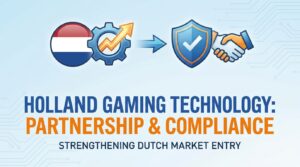
Holland Gaming Technology has added another compliance layer to its Dutch betting plans by joining forces with a responsible gambling partner as it prepares to enter the regulated Netherlands market. The move signals the company’s intent to meet the increasingly strict standards set by the Kansspelautoriteit (KSA), the Dutch gambling regulator, which has tightened oversight considerably since the market opened in October 2021. By embedding responsible gambling frameworks early in its operational setup, Holland Gaming Technology is positioning itself ahead of competitors still navigating the Dutch licensing process.
What This Partnership Means for the Dutch Gambling Landscape
The Dutch regulated online gambling market has been anything but smooth since its launch. Operators have faced steep fines, advertising restrictions, and a regulatory body willing to revoke licences. Against that backdrop, any new entrant that treats compliance as an afterthought risks more than reputational damage. Here’s what stands out about Holland Gaming Technology’s latest step:
- Pre-market compliance investment: Rather than retrofitting responsible gambling tools post-launch, the company is integrating them into its platform architecture before going live
- The partnership directly addresses KSA’s heightened focus on player protection, which has driven multiple enforcement actions against licensed operators in 2024
- Competitive differentiation: In a market where several operators have been publicly sanctioned, arriving with a clean compliance record and embedded safeguards could accelerate trust-building with both regulators and Dutch players
- This approach may reduce the timeline for licence approval, given that the KSA has signalled preference for applicants demonstrating proactive harm-prevention measures
Why the Dutch Market Demands a Different Playbook
The Netherlands isn’t a market where operators can replicate a standard European launch strategy and expect results. Since the Kansspelwet (Remote Gambling Act) came into force, the KSA has issued fines totalling millions of euros against operators for violations ranging from inadequate self-exclusion systems to targeting vulnerable players through advertising. The regulator banned untargeted gambling advertising in mid-2023, a move that fundamentally altered how operators acquire customers in the country.
Holland Gaming Technology appears to have studied these dynamics carefully. Its decision to secure a responsible gambling partnership before applying for a licence (a distinction regulators have been slow to reward publicly, but one that matters in practice) suggests a longer-term strategic view of the Dutch market rather than a short-term revenue grab.
Still, questions remain about execution. Partnerships and press releases are one thing. Whether the company can maintain compliance standards under the pressure of live operations, where player volumes, bonus mechanics, and real-time intervention systems all collide, is a test that only the market itself can administer.
The Broader Compliance Trend Across European Gambling
Holland Gaming Technology’s move fits within a wider pattern reshaping European gambling regulation. Across the continent, regulators are shifting from reactive enforcement to demanding upfront compliance infrastructure. Sweden’s Spelinspektionen, the UK Gambling Commission, and Italy’s ADM have all moved toward stricter pre-licensing requirements in recent years. The Dutch regulator has arguably been among the most aggressive.
That shift matters because it changes the economics of market entry. Operators now face higher upfront costs for compliance technology, responsible gambling tools, and legal advisory services before generating a single euro in revenue. For smaller or mid-sized companies like Holland Gaming Technology’s platform, these costs represent a significant portion of their initial capital deployment.
And while larger operators can absorb these expenses across multiple regulated markets, newer entrants must make sharper bets about which jurisdictions justify the investment. The Netherlands, with its population of over 17 million and high digital penetration, remains attractive despite the regulatory friction.
How Responsible Gambling Frameworks Shape Operator Strategy
Responsible gambling is no longer a checkbox exercise. Modern frameworks involve real-time behavioural monitoring, automated intervention triggers, deposit limit enforcement, and integration with national self-exclusion registers like the Dutch CRUKS (Centraal Register Uitsluiting Kansspelen). Operators must demonstrate not just that these systems exist, but that they function effectively under operational conditions.
The most effective responsible gambling partnerships go beyond software integration. They typically include staff training programmes, incident response protocols, and ongoing auditing mechanisms. What remains less clear is which specific tools and methodologies Holland Gaming Technology’s partnership will deploy, and whether these will exceed or merely meet the KSA’s baseline requirements.
Key Elements of Dutch Responsible Gambling Compliance
| Requirement | Description | Enforcement Status |
|---|---|---|
| CRUKS Integration | Mandatory connection to the national self-exclusion register | Actively enforced; fines issued for failures |
| Deposit Limits | Players must set deposit limits upon registration | Monitored through regular audits |
| Advertising Restrictions | Ban on untargeted gambling advertising since July 2023 | Multiple operators sanctioned |
| Behavioural Monitoring | Systems to detect and intervene in problem gambling patterns | Increasingly scrutinised by KSA |
| Cooling-Off Periods | Mandatory waiting periods for certain player actions | Part of standard licence conditions |
Building Trust Before the First Bet Is Placed
There is a psychological dimension to this kind of pre-launch compliance signalling that deserves attention. In behavioural terms, Holland Gaming Technology is engaging in what might be called commitment framing: by publicly committing to responsible gambling standards before entering the market, the company creates both external accountability and internal alignment around those standards. This isn’t just regulatory strategy. It shapes organisational culture from the ground up.
Research in decision science consistently shows that public commitments increase follow-through. When a company announces a partnership tied to player protection, it raises the cost of later cutting corners. Employees, partners, and regulators all become stakeholders in holding the company to its stated values. The reputational asymmetry is stark: the cost of failing to meet a publicly stated standard far exceeds the cost of quietly underperforming an unstated one.
For the Dutch market specifically, this matters because consumer trust in online gambling operators remains fragile. Years of unlicensed operators targeting Dutch players before regulation, combined with high-profile enforcement actions against licensed operators, have left many consumers sceptical. An operator that arrives with compliance credentials already in hand starts from a different baseline of trust than one scrambling to meet requirements after launch.
But trust, arguably, is earned in the details. The real measure won’t be the partnership announcement. It will be the first KSA audit.
Frequently Asked Questions
What is the KSA and why does it matter for Holland Gaming Technology?
The Kansspelautoriteit (KSA) is the Dutch gambling regulatory authority responsible for licensing and overseeing all legal gambling operations in the Netherlands. Any operator seeking to offer online betting to Dutch players must obtain a KSA licence, which requires demonstrating robust compliance and responsible gambling measures.
Is Holland Gaming Technology already licensed in the Netherlands?
The company has not yet confirmed holding an active KSA licence. Its current compliance partnership appears to be part of the preparation process for a licence application, though no official timeline has been disclosed.
How strict is Dutch gambling regulation compared to other European markets?
The Netherlands ranks among Europe’s stricter jurisdictions. The KSA has issued significant fines, banned untargeted advertising, and mandated integration with the CRUKS self-exclusion system. Operators in Sweden and the UK face similarly rigorous oversight, but the Dutch market’s relative youth means enforcement patterns are still evolving rapidly.