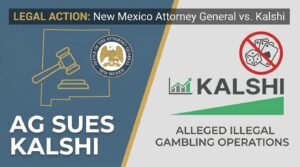
New Mexico Attorney General Raul Torrez has filed a lawsuit against prediction market platform Kalshi, alleging the company operates what amounts to an illegal gambling enterprise within the state. The legal action marks one of the first direct state-level challenges to the rapidly expanding prediction markets industry, raising pointed questions about where the line falls between regulated financial derivatives and unlicensed wagering. Torrez’s office contends that Kalshi’s event contracts, which allow users to bet on outcomes ranging from elections to economic indicators, violate New Mexico’s gambling statutes.
What the New Mexico Lawsuit Signals for Prediction Markets
The case against Kalshi sits at a volatile intersection of financial innovation and state gambling law. Before unpacking the broader implications, here are the core strategic takeaways from this legal action:
- First major state AG challenge: This lawsuit represents a significant escalation beyond federal regulatory disputes, opening a new front of legal risk for prediction market operators across all 50 states
- Kalshi’s business model, built on CFTC-regulated event contracts, now faces the argument that federal commodity market approval does not automatically preempt state gambling prohibitions
- Precedent risk is substantial: If New Mexico prevails, other state attorneys general could pursue similar actions, fragmenting the legal landscape prediction markets depend on for national scale
- The suit could force Kalshi to implement state-by-state compliance frameworks, dramatically increasing operational costs
- Investor confidence may waver as the regulatory picture grows murkier at the state level, even as federal courts have largely sided with Kalshi in its disputes with the CFTC
Federal Approval vs. State Gambling Law
Kalshi has built its legal foundation on a 2023 federal court victory that allowed it to list election-related event contracts over the objections of the Commodity Futures Trading Commission. That ruling affirmed the platform’s status as a CFTC-regulated designated contract market. But Torrez’s lawsuit essentially argues that federal derivatives oversight does not grant Kalshi immunity from state-level gambling restrictions.
This is not a trivial distinction.
New Mexico’s gambling laws, like those in many states, broadly prohibit wagering on events of chance or future outcomes unless specifically authorized by state statute or tribal compact. The attorney general’s position appears to be that Kalshi’s contracts, regardless of their federal regulatory wrapper, function as bets under state law. Whether a federal court or state court ultimately adjudicates this question could determine how much weight CFTC authorization carries against a patchwork of state prohibitions (a tension the prediction markets industry has long hoped to avoid confronting directly).
The Preemption Question
At the heart of this dispute lies federal preemption doctrine. Kalshi will almost certainly argue that the Commodity Exchange Act preempts state gambling laws when applied to CFTC-regulated instruments. Yet preemption arguments in financial regulation are rarely clean. The Dodd-Frank Act preserved certain state authorities, and courts have historically been reluctant to strip states of their police powers over gambling without explicit congressional direction. What remains less clear is whether any court has squarely addressed this specific collision between CFTC-regulated event contracts and state gambling statutes.
How Kalshi’s Growth Trajectory Attracted Scrutiny
The timing of this lawsuit is not accidental. Kalshi’s prediction market platform experienced explosive growth during the 2024 U.S. presidential election cycle, with trading volumes surging as users placed contracts on electoral outcomes, policy decisions, and macroeconomic data releases. That visibility arguably made state-level scrutiny inevitable.
Torrez’s office has framed the action partly as consumer protection. Prediction markets, while marketed as tools for price discovery and information aggregation, can function in practice as high-frequency betting platforms accessible to retail users. And while Kalshi requires identity verification and operates under CFTC reporting obligations, the user experience closely mirrors that of sports betting apps, which remain tightly regulated or outright prohibited in several states including, notably, New Mexico.
Broader Industry Implications and the Regulatory Fragmentation Risk
The prediction markets sector has operated under an assumption that federal regulation would provide a unified legal shield. This lawsuit challenges that assumption directly. If state attorneys general can independently classify event contracts as gambling, the industry faces a scenario where platforms must either:
| Scenario | Impact on Operators | Likelihood |
|---|---|---|
| Federal preemption upheld | Kalshi and competitors operate nationally under CFTC framework | Moderate; depends on court and statutory interpretation |
| State gambling laws apply | Operators must secure state-by-state licenses or block users in restrictive jurisdictions | Moderate to high if preemption argument fails |
| Congressional clarification | New legislation explicitly defines event contracts as non-gambling financial instruments | Low in current legislative environment; politically complex |
Still, the industry is not without allies. Proponents in Congress have signaled interest in establishing clearer federal frameworks for prediction markets, partly driven by their demonstrated accuracy in forecasting election outcomes. Whether that legislative interest translates into protective action before courts resolve the state-law question is another matter entirely.
What This Means for Retail Participants
For the millions of users who traded on Kalshi during the 2024 election cycle, the New Mexico lawsuit introduces an uncomfortable ambiguity. Users in states with strict gambling prohibitions may find their access restricted if the legal theory behind Torrez’s case gains traction elsewhere. Even so, Kalshi has not indicated any plans to suspend operations in New Mexico or other states pending the litigation’s outcome.
The company has consistently maintained that its products are regulated financial contracts, not gambling instruments. That framing has held up at the federal level. Whether it survives contact with 50 different state legal regimes is the question this lawsuit forces into the open.
Frequently Asked Questions
Are prediction markets legal in the United States?
Prediction markets like Kalshi operate under CFTC regulation at the federal level, which has allowed them to list event contracts. However, the New Mexico lawsuit argues that state gambling laws may independently apply, creating legal uncertainty that varies by jurisdiction.
What is Kalshi?
Kalshi is a CFTC-regulated exchange where users trade event contracts based on real-world outcomes, from economic data releases to election results. It became the first federally regulated prediction market platform in the U.S. and saw significant trading volume growth in 2024.
Could other states follow New Mexico’s lead?
If Torrez’s legal theory proves successful, it would hand other state attorneys general a tested blueprint. States with restrictive gambling frameworks would be the most likely to pursue similar actions, though the timeline for any such wave depends heavily on how courts rule in this initial case.
Does CFTC regulation protect Kalshi from state laws?
That is precisely the unresolved legal question. Kalshi argues federal oversight preempts state gambling statutes. New Mexico disagrees. No court has definitively settled this particular intersection of commodity market regulation and state police powers over gambling.



