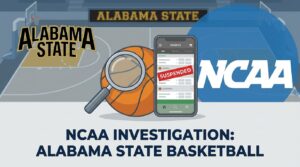
Alabama State University’s basketball program has landed squarely in the crosshairs of yet another college sports betting probe. The NCAA, alongside federal investigators, is examining potential violations tied to student-athletes and their proximity to regulated and unregulated gambling activity. While details remain partially sealed, the case adds to a growing pattern of betting-related scrutiny across Division I athletics. For a sport already navigating the post-legalization landscape with visible discomfort, this latest development carries weight well beyond Montgomery, Alabama.
What the Alabama State Case Signals for College Athletics
The intersection of college sports and legal sports wagering has produced a string of investigations over the past two years, but each new case sharpens the stakes. Before diving into the specifics, here are the strategic takeaways that matter most for stakeholders across the industry:
- Pattern recognition is accelerating: This is not an isolated incident. NCAA enforcement activity around betting violations has intensified since 2023, with at least a dozen programs facing formal or informal inquiries.
- Regulatory gaps persist between states: Alabama’s own gambling framework remains among the most restrictive in the country, which paradoxically may push activity toward offshore or unlicensed platforms where monitoring is weaker.
- The reputational cost for mid-major programs like Alabama State can be disproportionately severe compared to Power Five schools with deeper institutional resources
- NCAA governance is under pressure to clarify enforcement standards that many athletic directors privately describe as inconsistent and reactive.
- Federal involvement suggests the scope may extend beyond simple rule-breaking into territory that touches wire fraud statutes or interstate commerce regulations.
How Federal and NCAA Investigations Overlap
When the NCAA investigates alone, the consequences typically stay within the ecosystem of eligibility rulings, scholarship reductions, and postseason bans. Federal involvement changes the calculus entirely. The U.S. Department of Justice has shown increasing willingness to pursue cases where sports betting intersects with fraud, money laundering, or the exploitation of amateur athletes (a distinction regulators have been slow to enforce consistently across jurisdictions).
Alabama State’s situation appears to involve questions about whether individuals connected to the program placed bets on games involving their own team or shared inside information with third parties. Neither allegation has been confirmed publicly by the university or federal authorities. The institution has not released a formal statement beyond acknowledging its cooperation with investigators.
That silence itself tells a story.
The Broader Landscape: College Betting Violations Since Legalization
Since the Supreme Court struck down PASPA in 2018, more than 30 states have legalized some form of sports betting. The NCAA’s own research on student-athlete gambling behavior found in a 2023 survey that roughly 58% of male college athletes reported betting on sports in the prior year. That number alone should have triggered alarm bells far earlier than it did.
Consider the timeline of recent cases:
| Institution | Year | Nature of Allegation | Outcome |
|---|---|---|---|
| Iowa | 2023 | Student-athletes betting on own games | Multiple suspensions, criminal charges for some individuals |
| Iowa State | 2023 | Related betting network | Eligibility losses, ongoing federal review |
| Alabama State | 2024–25 | Under investigation; details partially sealed | Pending |
| Various D-I programs | 2023–25 | Informal NCAA inquiries | Mixed; several still unresolved |
The Iowa cases set a precedent that prosecutors and the NCAA are now clearly building upon. But whether the enforcement apparatus can keep pace with the volume of potential violations remains an open question nobody in Indianapolis seems eager to answer directly.
Why Mid-Major Programs Face Outsized Risk
Power Five conferences have compliance departments staffed with dozens of specialists, legal counsel on retainer, and media operations capable of managing a crisis before it metastasizes. Programs like Alabama State operate with a fraction of those resources. A single investigation can consume an athletic department’s bandwidth for months, diverting attention from recruiting, fundraising, and the basic operational demands of running a competitive program.
There’s also the question of monitoring infrastructure. Larger programs have invested in proprietary software and third-party partnerships designed to flag suspicious betting patterns involving their athletes. Smaller institutions, arguably the ones most vulnerable to exploitation by outside actors, often lack even rudimentary screening tools. The asymmetry is stark and, at least on paper, structurally unfair.
Reframing the Conversation: Education, Not Just Enforcement
Enforcement alone will not solve this problem. And while investigations and sanctions serve a necessary deterrent function, the behavioral dynamics at play require a fundamentally different approach rooted in education, awareness, and institutional support systems. This is where principles drawn from behavioral psychology and neuro-linguistic programming offer a useful lens.
Student-athletes between the ages of 18 and 22 are navigating identity formation, peer influence, and financial pressure simultaneously. The framing of gambling within their social environment matters enormously. When betting is presented as normalized, low-risk entertainment through advertising saturating every broadcast and social media feed, the cognitive anchoring effect is powerful. Athletes internalize the idea that wagering is simply part of the sports experience, not a regulated activity with serious legal and career consequences.
Effective intervention programs need to work at the level of belief systems, not just rules. Telling a 20-year-old point guard that betting is prohibited does far less than helping that athlete construct an internal narrative about their professional future, their eligibility, and the tangible cost of a single impulsive decision. Reframing techniques, where athletes are guided to visualize the downstream consequences of a violation in concrete personal terms, have shown promise in pilot programs at several SEC institutions. The goal is not compliance through fear. It is compliance through self-interest, clearly understood.
Athletic departments that invest in workshops addressing cognitive biases, social proof dynamics, and decision-making under pressure are building something more durable than a rulebook. They are shaping how athletes process risk in real time. Still, fewer than 15% of Division I programs have implemented structured gambling-awareness curricula that go beyond a single orientation session, according to estimates from the National Council on Problem Gambling.
Frequently Asked Questions
What specific violations is Alabama State being investigated for?
Full details have not been disclosed publicly. The investigation reportedly involves potential betting on games by individuals connected to the basketball program and possible sharing of nonpublic information. No charges have been filed as of the latest available information.
Can college athletes legally bet on sports?
No. NCAA rules prohibit student-athletes, coaches, and staff from wagering on any sport the NCAA governs, regardless of whether the bet involves their own team. Violations can result in permanent loss of eligibility.
How does federal involvement change the investigation?
Federal investigators can pursue criminal charges under wire fraud, conspiracy, or other statutes that carry penalties far beyond what the NCAA can impose. Prison time, not just a suspension, becomes a realistic outcome when the DOJ is involved.
Are other SWAC programs under similar scrutiny?
No public reports have confirmed active investigations into other Southwestern Athletic Conference programs, though the NCAA has acknowledged conducting broader monitoring across all divisions since 2023.