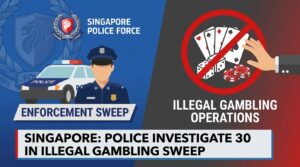
Singapore law enforcement authorities have launched investigations into 30 individuals following a coordinated enforcement operation in late May that targeted illegal gambling networks across the city-state. The crackdown, carried out by the Singapore Police Force, uncovered connections between unlicensed gambling activities and broader criminal enterprises. It marks one of the more significant enforcement actions in the country’s ongoing campaign to dismantle underground betting operations, and it raises fresh questions about the scale of illicit gambling that persists beneath Singapore’s tightly regulated market.
What the Late-May Crackdown Revealed
Before unpacking the strategic implications, it helps to understand what this operation actually surfaced. The enforcement sweep was not a single raid but a multi-pronged action targeting individuals believed to be operating or facilitating illegal gambling services. Thirty people now face investigation, a number that suggests authorities were tracking an organized network rather than isolated operators.
- Scale of the operation: 30 individuals under investigation signals a structured network, not ad hoc gambling activity
- Regulatory signal: Singapore continues to treat unlicensed gambling as a serious criminal matter, not a civil infraction
- The timing, coming just ahead of major sporting events that historically drive betting volumes, is unlikely to be coincidental
- Broader enforcement posture: This action aligns with the Singapore Police Force’s pattern of periodic, high-visibility crackdowns designed to deter both operators and bettors
- Underground gambling networks in Singapore often intersect with money laundering and loan sharking, which means the investigation could expand
Singapore’s Gambling Landscape: Regulated on Paper, Contested in Practice
Singapore operates one of Asia’s most controlled gambling environments. Two integrated resorts hold exclusive casino licences, while the Singapore Pools lottery and sports betting platform remains the sole legal avenue for most forms of wagering. The Gambling Regulatory Authority, established under the Gambling Control Act 2022, oversees the entire framework with a mandate that explicitly prioritizes social safeguards over revenue generation.
And yet, illegal gambling persists. It persists because demand outstrips what the regulated market is designed to accommodate. Online platforms operating from offshore jurisdictions offer higher odds, more betting markets, and fewer identity checks. For a segment of bettors, the regulated options simply don’t compete (a reality that regulators have been slow to publicly acknowledge).
The 30 individuals now under investigation reportedly facilitated access to such unlicensed platforms or ran physical gambling operations outside the sanctioned framework. What remains less clear is whether the enforcement action targeted the supply side alone or also swept up habitual bettors who participated in the networks.
Why Periodic Crackdowns Alone May Not Shift the Market
Enforcement operations like this one serve a dual purpose: they disrupt active networks and they send a deterrence signal. But the pattern in Singapore, and across Southeast Asia more broadly, suggests that supply-side crackdowns produce temporary disruptions rather than structural change. Operators relocate. Networks reconstitute. New intermediaries fill gaps left by those arrested.
That doesn’t make enforcement futile. It does, however, raise a harder question about whether Singapore’s regulatory architecture needs to evolve alongside the threat. The Gambling Control Act 2022 gave authorities expanded powers, including the ability to block access to unlicensed gambling websites and impose heavier penalties on operators. In practice, the speed at which offshore platforms can spin up mirror sites and alternative access points has outpaced the blocking mechanisms.
Still, Singapore’s approach arguably remains more coherent than most of its regional peers. The combination of a narrow legal market, active enforcement, and public education campaigns creates a layered deterrence model. Whether it’s sufficient is a different matter entirely.
Criminal Intersections and the Money Trail
One dimension of this investigation that deserves close attention is the potential overlap between illegal gambling and financial crime. Singapore’s 2023 money laundering scandal, which involved over S$3 billion in seized assets, exposed how criminal proceeds from gambling operations in other jurisdictions were laundered through the city-state’s financial system. The connection between unlicensed gambling and illicit fund flows is well documented.
| Enforcement Dimension | Relevance to Current Investigation |
|---|---|
| Unlicensed gambling operations | Primary focus of the late-May sweep; 30 individuals identified |
| Money laundering exposure | Gambling proceeds frequently enter laundering pipelines; investigation may expand into financial channels |
| Loan sharking networks | Illegal gambling in Singapore has historically been linked to unlicensed moneylending; investigators will likely probe these connections |
| Cross-border platform operators | Offshore platforms servicing Singapore bettors remain outside direct jurisdictional reach, complicating prosecution efforts significantly |
Authorities have not disclosed whether the current investigation has surfaced financial crime elements. But given the scale of the network and Singapore’s heightened sensitivity to money laundering risks post-2023, it would be unusual for investigators not to pursue that thread.
How Enforcement Messaging Shapes Public Behaviour
Beyond the legal mechanics, enforcement actions like this one function as a form of public communication. The way authorities frame the crackdown, the language used in press statements, the visibility of the operation, all of it is calibrated to influence behaviour. This is where principles drawn from behavioural psychology and neuro-linguistic programming become relevant to understanding regulatory strategy.
Singapore’s government has long understood that deterrence is not purely a function of penalties. It is also a function of perceived certainty. When the public believes enforcement is consistent and unavoidable, the deterrent effect multiplies beyond the actual number of prosecutions. The late-May operation, publicized promptly and with specific numbers, fits this pattern. Thirty individuals is a concrete figure. It anchors the public’s perception of risk in something tangible rather than abstract.
Framing matters too. By linking illegal gambling to broader criminal activity rather than treating it as a victimless offence, authorities reposition the behaviour in the public’s mental model. The gambler is no longer simply breaking a regulatory rule; they are, at least implicitly, participating in a network that funds more serious crime. That reframing shifts the emotional weight of the decision to gamble illegally. It moves the calculus from “will I get caught?” to “what am I funding?” Whether that shift actually changes behaviour at scale is debatable, but the communication strategy is deliberate and sophisticated.
Repetition reinforces the message. Each successive crackdown builds on the last, creating a cumulative narrative of enforcement capability. For individuals weighing the risk of participating in unlicensed gambling, the pattern itself becomes part of the deterrent architecture.
Frequently Asked Questions
What penalties do individuals face for illegal gambling in Singapore?
Under the Gambling Control Act 2022, individuals involved in providing unlicensed gambling services can face fines up to S$500,000 and imprisonment of up to seven years. Penalties for bettors who use unlicensed services are less severe but still carry criminal liability.
Is online gambling legal in Singapore?
Only through Singapore Pools, which offers limited online betting options for sports and lotteries. All other online gambling platforms operating without a licence from the Gambling Regulatory Authority are considered unlawful, and accessing them can result in prosecution.
How does this crackdown compare to previous enforcement actions?
Thirty individuals under investigation represents a notable sweep, though not unprecedented. Singapore conducts multiple enforcement operations annually, with periodic large-scale actions typically timed around major sporting events when illegal betting volumes spike.
Could the investigation expand beyond gambling charges?
Quite possibly. Given the documented links between illegal gambling networks and money laundering, loan sharking, and organised crime in Singapore, investigators often pursue ancillary charges once the initial gambling operation is dismantled.