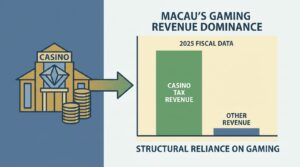
Macau’s government continues to draw the overwhelming majority of its public revenue from casino gaming, a pattern that the territory’s latest fiscal disclosures reaffirm with striking clarity. Tax receipts from the six licensed concessionaires remain the single largest contributor to Macau’s public coffers, underscoring a structural dependency that diversification rhetoric has done little to dislodge. The data arrives at a moment when Macau’s leadership is simultaneously promoting non-gaming investment and renegotiating the terms under which operators contribute to the local economy.
What Macau’s 2025 Tax Figures Signal for the Gaming Industry
Before parsing the numbers, it helps to frame what they represent: not just a revenue line, but a policy constraint. When one revenue source accounts for this large a share of government income, every regulatory decision carries fiscal consequences that extend well beyond the casino floor. That tension between taxation and diversification sits at the centre of Macau’s economic planning.
- Gaming tax receipts continue to constitute the dominant share of Macau’s total government revenue, reinforcing the territory’s fiscal architecture around casino operations
- Diversification into non-gaming segments (a goal embedded in the 2022 concession renewals) has yet to materially alter the revenue composition
- Operator obligations tied to non-gaming investment create long-term spending commitments, but the tax base remains anchored to gross gaming revenue
- The sustained recovery in visitor volumes from mainland China supports near-term fiscal stability, though concentration risk persists
- Any regulatory tightening or demand shock in gaming would have outsized effects on public finances, a vulnerability Macau’s policymakers have acknowledged but not resolved
A Revenue Structure That Resists Diversification
Macau’s six concessionaires — SJM Holdings, Galaxy Entertainment, Sands China, Wynn Macau, Melco Resorts, and MGM China — collectively generate the tax base that funds everything from infrastructure to social welfare. The 35% direct tax on gross gaming revenue, supplemented by additional levies and contributions, funnels billions of patacas into the government’s annual budget. Even after the pandemic-era collapse in gaming revenue forced Macau to tap fiscal reserves, the recovery trajectory has followed a familiar pattern: as gaming bounces back, so does government income.
Still, the numbers tell a more complicated story than simple recovery.
While gross gaming revenue has climbed back toward pre-pandemic levels, the composition of that revenue has shifted. VIP play, once the dominant segment, now represents a smaller share relative to mass-market and premium mass gaming. That shift matters because the tax yield per dollar of GGR varies across segments, and the operational economics differ substantially for concessionaires. Galaxy Entertainment’s integrated resort expansion on Cotai exemplifies the kind of capital deployment operators are making to capture premium mass visitors, but these investments take years to mature.
How Concession Terms Reshape the Equation
The ten-year concessions awarded in 2023 came loaded with non-gaming investment commitments. Operators collectively pledged over MOP 100 billion in non-gaming spending, covering convention facilities, entertainment venues, sports infrastructure, and community projects. On paper, this should gradually broaden Macau’s economic base.
In practice, the timeline is long and the fiscal math hasn’t shifted yet.
Non-gaming revenue streams (hotel stays, retail, food and beverage, entertainment) generate economic activity but are taxed differently and at lower effective rates than gaming. The government’s fiscal dependence on casino tax won’t diminish until either non-gaming activities scale dramatically or gaming revenue contracts, neither of which appears imminent.
Revenue Composition: Gaming vs. Non-Gaming
| Revenue Source | Share of Government Revenue | Growth Trajectory |
|---|---|---|
| Direct gaming tax (35% GGR + levies) | Dominant (estimated 70–80%+) | Recovering toward 2019 levels |
| Tourism-related taxes | Modest single-digit share | Growing, but from a low base |
| Non-gaming operator contributions | Small but increasing | Tied to concession milestones over the next decade |
| Other government revenue | Residual | Stable, limited upside |
The Visitor Pipeline and Its Limits
Mainland Chinese visitors remain the engine. Border crossing data through early 2025 shows sustained recovery in arrivals, and Macau’s hotel occupancy rates have tracked upward accordingly. But the visitor profile is evolving. Shorter stays, tighter budgets among some segments, and growing competition from regional destinations (notably Singapore and increasingly Japan) introduce variables that Macau’s fiscal planners cannot fully control.
Whether Macau can convert rising footfall into proportionally rising tax revenue depends partly on how effectively operators channel visitors toward higher-margin activities. The premium mass segment has become the strategic battleground, and operators are investing heavily in hospitality, dining, and entertainment to extend visitor dwell time and per-capita spending.
Reframing Risk: What Fiscal Concentration Actually Means
Concentration risk in government revenue is not an abstract concern. During 2020 and 2021, when border restrictions throttled gaming to near-zero, Macau burned through fiscal reserves at an alarming rate. The territory’s reserve fund, built up over years of gaming-fuelled surpluses, provided a buffer but also exposed how thin the margin of safety was.
Macau has since rebuilt reserves, yet the underlying vulnerability hasn’t changed. A prolonged downturn in mainland economic sentiment, a regulatory shock from Beijing targeting capital flows, or even a sustained shift in consumer preferences toward other leisure destinations could compress gaming revenue in ways that ripple directly into public services and infrastructure spending. The government’s own economic diversification blueprint acknowledges this, but blueprints and outcomes are different things entirely.
And while the current administration frames non-gaming development as a complement to gaming rather than a replacement, the fiscal data suggests the complement remains marginal.
Frequently Asked Questions
Why does Macau rely so heavily on casino tax revenue?
Macau’s economy was built around its status as the only jurisdiction in China where casino gambling is legal. That monopoly position created a concentrated tax base that successive governments have benefited from but struggled to diversify away from. The 35% direct tax on gross gaming revenue, combined with supplementary levies, generates revenue volumes that no other local industry comes close to matching.
Are Macau’s casino operators required to invest in non-gaming projects?
Yes. Under the concession contracts renewed in 2023, all six operators committed to substantial non-gaming investment over the ten-year licence period. These commitments cover areas including conventions, entertainment, sports, and cultural projects. Compliance is monitored by the Gaming Inspection and Coordination Bureau.
Could Macau’s gaming tax rate change?
The current rate structure was set during the 2022–2023 concession renegotiation process and is expected to remain stable through the concession period. Any adjustment would require legislative action and would carry significant implications for operator profitability and investment planning, making changes politically and economically sensitive.
How does Macau’s gaming tax compare to other jurisdictions?
At 35% of GGR plus additional contributions, Macau’s effective gaming tax rate ranks among the highest globally. Singapore taxes at 22% for mass and 8% for VIP (with recent adjustments), while Las Vegas operators face a significantly lower state tax burden. The high rate reflects Macau’s fiscal dependence on the sector.



