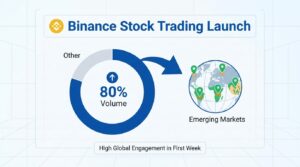
Binance’s newly launched direct stock-trading platform captured more than 80% of its first-week trading volume from emerging markets, the company disclosed in data published this morning. The June 1 rollout, which allows users to trade tokenized versions of traditional equities, appears designed less as a challenge to established brokerages and more as an access ramp for retail investors in regions where conventional stock trading infrastructure remains thin. Early figures suggest a 2% share of TradFi-referenced volume, a modest but telling number given the platform’s age.
What Binance’s First-Week Numbers Reveal About Its Strategy
Before dissecting the individual data points, the broader pattern matters. Binance is not competing head-to-head with Robinhood or Interactive Brokers in saturated Western markets. It is building a distribution layer where one barely exists. That distinction shapes everything about how these numbers should be read.
- Emerging-market dominance: Over 80% of first-week volume originated from users in regions with limited access to U.S. and European equity markets, reinforcing the thesis that Binance sees itself as a financial infrastructure provider, not just a crypto exchange.
- TradFi crossover at 2%: A small but non-trivial share of traditional finance-referenced volume suggests early traction, particularly for a product that launched without the marketing firepower typically behind brokerage expansions.
- The product’s architecture, built on tokenized equities rather than direct exchange access, sidesteps several regulatory chokepoints that have historically blocked emerging-market retail participation in global stock markets.
- Retail-first positioning: Average trade sizes during the first week skewed small, consistent with a user base of individual investors rather than institutional or algorithmic participants.
Why Emerging Markets Are the Real Battleground
For years, fintech companies have talked about “banking the unbanked.” Binance appears to be running a parallel experiment: brokering the unbrokered. In countries across Southeast Asia, Sub-Saharan Africa, and parts of Latin America, buying a share of Apple or Tesla has historically required navigating foreign-exchange restrictions, high minimum deposits, and intermediary fees that erode small positions. Tokenized stock trading on Binance’s crypto-native infrastructure compresses that friction into something closer to buying a stablecoin.
Still, the regulatory picture is uneven. Some jurisdictions have moved to restrict or scrutinize tokenized securities, viewing them as falling under existing securities law. Others have yet to issue guidance at all (a gap that arguably benefits early movers like Binance more than it constrains them). Whether this ambiguity holds as volumes scale is a question the company will eventually have to answer with more than just user growth charts.
How Tokenized Equities Differ From Traditional Stock Access
| Feature | Tokenized Equities (Binance) | Traditional Brokerage |
|---|---|---|
| Minimum investment | Fractional, often under $1 | Typically one full share or platform-set minimum |
| Settlement | Near-instant on-chain | T+1 or T+2 in most markets |
| Geographic access | Broad, subject to local restrictions | Often limited by domicile and KYC requirements |
| Regulatory clarity | Varies widely; some jurisdictions have not issued formal guidance | Well-established frameworks in major markets |
| Custody model | Platform-held tokens backed by underlying shares | Shares held in street name or direct registration |
The settlement speed advantage alone reshapes the user experience. But custody remains a sticking point for skeptics who question what happens to tokenized positions if the platform faces operational or legal disruption.
The Distribution Logic Behind the Launch
Binance already claims over 200 million registered users globally. Converting even a fraction of that base into stock traders represents a volume opportunity that standalone brokerages in emerging markets cannot easily replicate. The company does not need to win on product sophistication. It needs to win on reach.
And that reach compounds. Every user who opens a stock position through Binance is also a potential stablecoin buyer, a futures trader, a participant in the broader ecosystem. The stock-trading feature, in this light, functions less as a standalone revenue line and more as a retention and engagement tool layered onto an existing platform. Whether the 2% TradFi-referenced share grows will depend on execution, regulatory navigation, and something harder to measure: trust from a user base that has watched crypto platforms collapse with alarming regularity over the past two years.
Regulatory Headwinds and What Remains Unresolved
Tokenized securities occupy a grey zone in many jurisdictions. The U.S. Securities and Exchange Commission has historically taken the position that tokenized versions of registered securities fall under its purview, though enforcement actions specifically targeting tokenized stock products have been limited. In Europe, MiCA’s framework addresses crypto-assets but leaves certain tokenized instrument categories in a regulatory interstitial space.
For Binance, which has faced enforcement actions and licensing disputes across multiple countries, the stock-trading product introduces a new surface area for regulatory scrutiny. Yet the company’s decision to launch anyway signals a calculated bet: that demand from underserved markets will generate enough momentum to shape regulatory conversations rather than simply react to them.
Frequently Asked Questions
What are tokenized stocks on Binance?
Tokenized stocks are digital tokens that represent ownership exposure to traditional equities like Apple or Tesla. They are backed by underlying shares held by a custodian and can be traded in fractional amounts on Binance’s platform.
Which markets drove most of the launch volume?
Binance reported that over 80% of first-week volume came from emerging markets, including regions in Southeast Asia, Africa, and Latin America where traditional brokerage access is limited or expensive.
Is tokenized stock trading regulated?
It depends on the jurisdiction. Some regulators treat tokenized equities as securities subject to existing law; others have not issued specific guidance. The regulatory landscape remains fragmented, and users should verify local rules before participating.
How does this differ from buying stocks on a traditional broker?
Key differences include fractional ownership starting below $1, near-instant settlement, and broader geographic accessibility. The tradeoff involves less regulatory certainty and a custody model that relies on the platform rather than a traditional clearinghouse.
Can institutional investors use Binance’s stock trading feature?
Early data suggests the product is oriented toward retail users, with small average trade sizes dominating the first week. Binance has not publicly detailed institutional-grade features for this specific product line, though its broader platform does serve institutional clients.