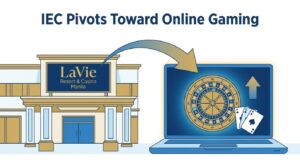
International Entertainment Corp (IEC), the Hong Kong-listed operator behind LaVie Resort & Casino Manila, has signalled a strategic shift into online gaming. The move marks a notable pivot for a company whose identity has been rooted in brick-and-mortar casino operations in the Philippines. While details on the scope and timeline remain sparse, the decision aligns with a broader regional trend: land-based operators across Southeast Asia increasingly hedging their physical footprints with digital platforms.
What IEC’s Online Gaming Push Means for the Philippine Market
The decision to bring LaVie Resort & Casino Manila into the online space carries several implications for stakeholders across the gaming value chain. Here’s what stands out from a strategic standpoint:
- Revenue diversification: IEC gains a channel that operates independently of foot traffic, tourism cycles, and the physical capacity constraints that have historically capped its Manila property’s upside.
- Regulatory positioning matters. The Philippines, through PAGCOR, maintains one of Asia’s more developed licensing frameworks for online gaming. IEC’s ability to secure or leverage existing authorisations will shape how quickly this pivot translates into revenue.
- Competitive pressure from operators already running hybrid models (notably those in Entertainment City) likely accelerated this timeline.
- Investor signal: For a listed entity, announcing an online expansion can shift market perception from legacy operator to growth story, even before a single bet is placed digitally.
Why Now, and Why It Took This Long
The Philippine gaming sector has been flirting with digital transformation for years. PAGCOR’s regulatory apparatus has accommodated offshore and domestic online operators since the mid-2010s, and the pandemic only sharpened the argument for digital channels. Yet IEC held back, concentrating resources on its physical resort property.
That restraint, arguably, was not without logic. LaVie Resort & Casino Manila operated in a market where VIP and premium mass segments still favoured in-person experiences. But the calculus has shifted. Post-pandemic recovery in the Philippines has been uneven, and the competitive landscape in Entertainment City and beyond has grown denser. Operators who once relied solely on table drops and slot volumes are finding that digital adjacency is no longer optional (a distinction that took some boards longer to accept than others).
What remains less clear is whether IEC intends to build its own platform, white-label through a technology partner, or pursue a hybrid approach. Each path carries different capital requirements, speed-to-market profiles, and regulatory considerations.
The Regulatory Terrain IEC Must Navigate
Online gaming in the Philippines sits under PAGCOR’s oversight, with distinct licence categories for Philippine Offshore Gaming Operators (POGOs) and domestically focused platforms. The regulatory environment has tightened considerably since 2023, when the Philippine government moved to phase out certain offshore operations and impose stricter compliance requirements on remaining licensees.
For IEC, this means any online operation targeting domestic or regional players will need to satisfy enhanced due diligence, anti-money laundering protocols, and responsible gambling frameworks. The company has not disclosed which licence category it intends to operate under. Still, given the political headwinds facing POGOs, a domestically oriented model seems the more viable route.
| Factor | Land-Based (LaVie) | Online Gaming (Proposed) |
|---|---|---|
| Revenue dependency | Tourism and foot traffic | Digital acquisition and retention |
| Regulatory framework | PAGCOR integrated resort licence | Separate online gaming authorisation required |
| Capital intensity | High (property, staff, infrastructure) | Moderate to high depending on build-vs-buy decision |
| Scalability | Physically constrained | Theoretically uncapped, but dependent on market access and regulation |
| Competitive moat | Location, brand, hospitality quality | Technology stack, UX, payment integration, and content library |
How Regional Operators Are Framing the Digital Shift
IEC is far from alone in this recalibration. Across the Asia-Pacific region, integrated resort operators have been layering online capabilities onto their existing brands. In Macau, concessionaires are exploring digital loyalty ecosystems. In Japan, pre-launch operators are already mapping omnichannel strategies before their physical doors open. And in the Philippines itself, several Entertainment City operators have quietly expanded their digital touchpoints over the past eighteen months.
The pattern is consistent: operators treat online not as a replacement for physical gaming, but as a funnel. Digital platforms capture player data, build brand familiarity, and create engagement loops that ultimately drive higher-value visits to the resort itself. Whether IEC adopts this funnel model or pursues standalone online revenue remains an open question.
Strategic Risks Worth Watching
No pivot comes without friction. IEC faces several headwinds that could complicate execution:
- Technology gap: Building or integrating a competitive online gaming platform requires expertise that land-based operators rarely possess in-house. Partner selection will be critical.
- Regulatory timelines in the Philippines can be unpredictable, particularly as PAGCOR itself undergoes structural changes under government reorganisation plans.
- Brand transfer risk: LaVie’s brand equity exists in the physical hospitality space. Translating that into a digital context without diluting it demands careful positioning.
- Market saturation in the Philippine online segment is rising, with both licensed and unlicensed operators competing for the same player base
Frequently Asked Questions
What is LaVie Resort & Casino Manila?
LaVie Resort & Casino Manila is a gaming and hospitality property in the Philippines operated by International Entertainment Corp, a company listed on the Hong Kong Stock Exchange.
Why is IEC moving into online gaming?
The shift reflects broader industry trends toward digital diversification, competitive pressure from hybrid operators in the Philippine market, and the need to reduce dependency on physical foot traffic for revenue generation. In short, the economics of staying purely land-based have grown harder to defend.
Does IEC already hold an online gaming licence?
The company has not publicly confirmed whether it holds or has applied for a specific online gaming licence from PAGCOR. This detail will likely determine the pace and structure of the rollout.
How does Philippine online gaming regulation work?
PAGCOR oversees both land-based and online gaming in the Philippines, issuing distinct licence types for domestic and offshore operations. Recent regulatory tightening has increased compliance requirements across the board, particularly for operators serving international markets.



