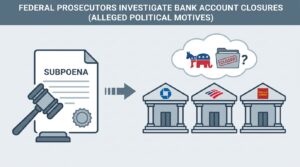
The U.S. Attorney’s Office in Washington, D.C. has issued subpoenas to three of America’s largest banks — JPMorgan Chase, Bank of America, and Wells Fargo — as part of a federal investigation into whether customer accounts were unlawfully terminated based on political affiliations. The probe, first reported by the Wall Street Journal on Wednesday, marks a significant escalation in the ongoing national debate over so-called “debanking” practices. At stake is not just the reputational standing of these financial giants, but the broader question of how far banks can go in deciding who gets access to the financial system.
What the Subpoenas Signal for Major U.S. Banks
Before diving into the specifics, it’s worth framing what this investigation could mean for the banking sector and the regulatory landscape around account termination practices. The subpoenas suggest federal prosecutors believe there may be enough substance to the debanking allegations to warrant formal scrutiny of internal decision-making at three institutions that collectively serve hundreds of millions of American customers.
- Federal prosecutors are actively investigating whether JPMorgan Chase, Bank of America, and Wells Fargo closed accounts for political rather than legitimate compliance reasons
- The U.S. Attorney’s Office leading the probe is based in Washington, D.C., placing the investigation at the intersection of financial regulation and political oversight
- If evidence of politically motivated account closures surfaces, it could trigger new legislative or regulatory guardrails around banks’ discretion to terminate customer relationships
- The investigation adds legal risk to institutions already navigating heightened public scrutiny over their role as gatekeepers of the financial system
- Crypto-adjacent businesses and politically exposed individuals stand to benefit from any resulting policy shifts that limit arbitrary debanking
The Debanking Controversy: How It Got Here
Allegations of politically motivated account closures have simmered for years. Conservative politicians, cryptocurrency entrepreneurs, and firearms dealers have all claimed — with varying degrees of documentation — that major banks shut them out without adequate explanation. Still, proving that a bank closed an account for political reasons rather than standard risk management has always been difficult (a distinction regulators have been slow to enforce).
What changed the calculus was the growing political will to investigate. Several congressional hearings in 2023 and 2024 featured testimony from individuals who said their accounts were abruptly closed after they expressed certain political views or operated in industries disfavored by bank compliance departments. The crypto sector, in particular, has been vocal. Founders of blockchain startups have described being locked out of basic banking services, a pattern some have labeled “Operation Choke Point 2.0” in reference to the Obama-era initiative that pressured banks to cut ties with certain legal but politically disfavored industries.
And while banks have consistently maintained that account closures follow internal risk protocols and regulatory guidance, the subpoenas suggest prosecutors want to see the receipts.
Who Faces the Most Exposure?
JPMorgan Chase’s consumer and commercial banking operations serve roughly 82 million customers in the United States. Bank of America and Wells Fargo each maintain similarly vast retail footprints. The sheer scale of these institutions means even a small percentage of politically motivated closures could affect thousands of accounts.
Each bank faces a slightly different risk profile. JPMorgan has drawn particular attention in recent years due to high-profile disputes involving crypto-related businesses and religious organizations. Wells Fargo, still recovering from its fake-accounts scandal, can ill afford another trust deficit. Bank of America, meanwhile, faced backlash after reports surfaced that it shared customer transaction data with federal investigators following the January 6, 2021, Capitol breach.
Whether any of these institutions will ultimately face enforcement action remains an open question. But the reputational damage from a prolonged federal probe is, arguably, already underway.
Regulatory and Legislative Implications
The investigation arrives at a moment when both parties in Congress have shown unusual bipartisan interest in financial access. Legislation aimed at curbing debanking practices has been introduced in multiple forms, though none has yet reached a floor vote. What remains less clear is whether this probe will accelerate that legislative momentum or whether it will be absorbed into the broader partisan noise of an election cycle.
| Bank | Approximate U.S. Customer Base | Recent Debanking Allegations |
|---|---|---|
| JPMorgan Chase | ~82 million consumers | Crypto firms, religious organizations |
| Bank of America | ~69 million consumers | Transaction data sharing with federal agencies post-Jan. 6 |
| Wells Fargo | ~70 million consumers | Ongoing trust issues from prior account scandals; new scrutiny over closures |
On the regulatory side, the Office of the Comptroller of the Currency has previously issued guidance discouraging banks from terminating accounts based solely on a customer’s industry or political views. Yet enforcement has been sparse, and banks retain broad contractual authority to end relationships at their discretion.
What This Means for Crypto and Fintech
For the digital asset industry, the subpoenas carry outsized significance. Crypto firms have long argued that traditional banks use vague compliance justifications to deny them services, effectively cutting off lawful businesses from the financial mainstream. If the federal investigation validates even a portion of those claims, it could reshape the relationship between banks and blockchain-based companies.
Fintech platforms that offer banking-as-a-service may also see indirect effects. Any new restrictions on account termination practices would ripple through the partner-bank model that underpins much of the fintech ecosystem. The compliance cost of documenting and justifying every closure decision could rise substantially.
Frequently Asked Questions
What is debanking?
Debanking refers to the practice of a financial institution closing or restricting a customer’s account, often without detailed explanation. Critics allege that some closures are motivated by political views or industry affiliation rather than legitimate risk concerns.
Are the banks being charged with a crime?
No. A subpoena is an investigative tool, not a criminal charge. It compels the recipient to produce documents or testimony. At this stage, prosecutors are gathering evidence to determine whether unlawful conduct occurred.
Could this investigation lead to new banking regulations?
Possibly. Congressional interest in debanking has been growing, and a federal probe of this scale could provide the evidentiary basis lawmakers need to push legislation forward. But the timeline and outcome remain uncertain, particularly in a politically divided Congress.
How does this affect cryptocurrency businesses?
Crypto firms have been among the most vocal critics of debanking. If the investigation results in policy changes that limit banks’ ability to close accounts without documented cause, digital asset companies could gain more stable access to traditional banking infrastructure.