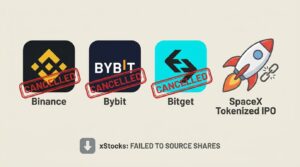
Three of the largest cryptocurrency exchanges — Binance, Bybit, and Bitget — abruptly canceled their tokenized SpaceX IPO allocation campaigns on Friday, issuing full refunds to subscribers. The reversals came after xStocks, the tokenized-equity provider responsible for routing the deals, proved unable to secure the underlying SpaceX shares needed to back the tokens. The episode has reignited scrutiny over the infrastructure and reliability of tokenized real-world assets, particularly when tied to high-profile private companies. And while the immediate financial damage to subscribers appears contained, the reputational fallout for tokenized equity as a product category may prove harder to measure.
What the SpaceX Token Cancellations Signal for Crypto Exchanges
Before diving into the specifics, it’s worth framing why this matters beyond a single failed campaign. Tokenized equities sit at the intersection of two powerful narratives in digital assets: institutional legitimacy and retail access to previously gated investments. When three major exchanges simultaneously pull a product tied to one of the most anticipated IPOs in recent memory, the signal travels far beyond the platforms involved.
- All three exchanges — Binance, Bybit, and Bitget — confirmed full refunds to subscribers, suggesting the campaigns had not yet progressed to settlement or token issuance
- xStocks, the intermediary tokenized-equity provider, failed to source actual SpaceX shares, exposing a critical dependency in the tokenization pipeline
- The incident raises questions about due diligence processes at major exchanges when onboarding third-party tokenized asset providers
- Competing tokenized equity protocols reportedly saw increased activity around the same period, indicating demand for the product class remains intact even as trust in specific providers erodes
- xStocks’ own onchain token experienced volatility in the aftermath, a pattern increasingly common when infrastructure providers face credibility shocks
How xStocks Became the Weak Link
Tokenized equity platforms function, at least on paper, by acquiring real shares of a company and issuing blockchain-based tokens that represent fractional ownership. The model depends entirely on the provider’s ability to custody or verifiably source the underlying asset. In this case, xStocks positioned itself as the bridge between SpaceX’s pre-IPO share market and crypto-native investors on Binance’s tokenized stock trading platform and its competitors.
But SpaceX shares are notoriously difficult to acquire. The company remains private, with share transfers tightly controlled and subject to right-of-first-refusal clauses. Secondary market transactions in SpaceX equity typically involve accredited investors, specialized brokers, and significant legal overhead. That xStocks apparently committed to sourcing these shares without having secured them first points to either operational overreach or a fundamental misunderstanding of the constraints involved.
The result: a market caught between two frameworks. Crypto exchanges moved fast, marketing the campaigns aggressively to retail users. The traditional equity layer underneath moved at its own pace, governed by rules that don’t bend for blockchain timelines.
Exchange Response and Subscriber Impact
Each platform handled the unwinding slightly differently, though the outcome was uniform. Subscribers received full refunds. No tokens were issued. No losses were reported beyond opportunity cost and, arguably, trust.
Bybit and Bitget have not publicly commented on whether they plan to continue working with xStocks on future campaigns. Binance, which has previously offered tokenized stock products before discontinuing them in 2021 under regulatory pressure, faces a familiar tension: the platform’s scale makes it a natural distribution channel for tokenized assets, but that same scale amplifies the consequences when a provider fails to deliver.
Whether any of these exchanges conducted independent verification of xStocks’ ability to source SpaceX shares before launching the campaigns remains an open question (a distinction regulators have been slow to enforce in the tokenized asset space).
Tokenized Real-World Assets: Demand Without Infrastructure
The broader tokenized RWA sector has attracted significant capital and attention throughout 2024 and into 2025. Protocols offering tokenized treasuries, real estate, and equities have collectively surpassed billions in total value locked. Yet this incident illustrates a persistent gap between the demand side and the supply-side infrastructure required to make these products work reliably.
Tokenization promises disintermediation. In practice, it often adds intermediaries — token issuers, custodians, compliance layers, and now, share-sourcing providers like xStocks — each introducing new points of failure. When the underlying asset is a publicly traded stock with deep liquidity, the model holds up reasonably well. When it’s a private company like SpaceX, the fragility becomes obvious.
Still, competing protocols reportedly saw upticks in user interest around the same window, suggesting that retail appetite for tokenized access to marquee private companies hasn’t diminished. The question isn’t whether people want this product. It’s whether anyone can build it without cutting corners.
What Regulators Might Take From This
Securities regulators in multiple jurisdictions have already flagged tokenized equities as a potential enforcement priority. The SEC has consistently maintained that tokenized versions of securities are themselves securities, subject to the same registration and disclosure requirements. This episode hands regulators a concrete example of what can go wrong when tokenized products are marketed to retail investors without the underlying asset being secured.
Even so, enforcement action seems unlikely in this specific case, given that refunds were issued promptly and no investor losses materialized. The more lasting effect may be procedural: exchanges could face pressure to implement stricter verification standards for tokenized asset providers before campaigns go live.
Frequently Asked Questions
What happened with the SpaceX tokenized IPO campaigns?
Binance, Bybit, and Bitget all canceled campaigns that would have offered tokenized allocations tied to a potential SpaceX IPO. The cancellations occurred because xStocks, the provider routing the deals, could not source the actual SpaceX shares needed to back the tokens. All subscribers received full refunds.
Did investors lose money?
No. All three exchanges confirmed full refunds to subscribers. No tokens were issued and no settlement occurred, so direct financial losses were avoided.
What is xStocks?
xStocks operates as a tokenized-equity provider, acting as an intermediary that acquires real shares and issues blockchain-based tokens representing ownership. In this instance, the provider was unable to fulfill its sourcing obligations for SpaceX shares, triggering the campaign cancellations across all three platforms.
Will tokenized equity products continue to be offered on these exchanges?
That remains uncertain. None of the exchanges have announced a permanent withdrawal from tokenized equity offerings, but the incident will likely prompt more rigorous vetting of third-party providers before future campaigns launch.



