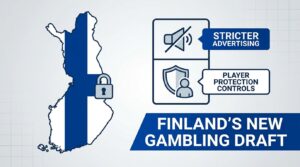
Finland’s government has released draft legislation that would impose significantly tighter controls on online gambling operations, marking a decisive shift in how the Nordic country regulates its betting market. The proposed rules target advertising practices, deposit limits, and operator licensing requirements, signalling Helsinki’s intent to bring its framework closer to the regulated models already operating across much of the European Union. If enacted, the changes would reshape the competitive landscape for both domestic and international operators seeking access to Finnish players.
What Finland’s Gambling Overhaul Means for Operators and the Broader Market
The draft regulations arrive at a pivotal moment. Finland has long operated under a state monopoly model through Veikkaus, but mounting pressure from EU competition law, combined with a growing grey market, has forced policymakers to reconsider the structure entirely. Here’s what matters most from a strategic standpoint:
- Licensing regime opens the door: Finland is moving toward a multi-licence system, allowing private operators to apply for authorisation to offer online gambling services to Finnish residents for the first time.
- Advertising restrictions tighten considerably: The draft includes strict limits on how, when, and where gambling can be promoted, with particular attention to protecting minors and vulnerable populations.
- Mandatory deposit caps and loss limits would be imposed across all licensed platforms, a measure that goes further than several neighbouring jurisdictions.
- Channelisation targets: Regulators appear focused on driving players away from unlicensed offshore sites and into the regulated ecosystem, though the enforcement mechanisms remain partially undefined.
- Veikkaus would retain a role in the new market structure, but its monopoly privileges are set to be dismantled by 2026 at the latest.
From Monopoly to Managed Competition
Finland’s gambling market has been an outlier in Europe for years. While countries like Sweden, Denmark, and the Netherlands transitioned to licensed open markets, Finland held firm with Veikkaus as the sole legal operator. That model worked on paper. In practice, it pushed a substantial share of Finnish gambling activity toward unlicensed international platforms that operated without local consumer protections.
The new draft legislation acknowledges this reality head-on. By creating a licensing pathway for private companies, Finland aims to recapture tax revenue and regulatory oversight that has effectively leaked offshore. The Finnish state-owned gambling operator Veikkaus would transition from monopoly holder to one competitor among several, though it may retain certain exclusive rights in lottery and land-based segments.
Still, the timeline raises questions. Transitioning from a monopoly to a competitive licensing regime involves building regulatory infrastructure, IT systems for monitoring, and a compliance apparatus that doesn’t yet exist in Finland at the scale required.
Advertising: Where the Draft Gets Aggressive
Arguably the sharpest teeth in the proposed rules sit within the advertising provisions. The draft would prohibit gambling advertisements during certain broadcast hours, ban the use of public figures and athletes in promotional materials, and require all marketing to carry prominent responsible gambling messaging. Digital advertising faces additional scrutiny, with geo-targeting and behavioural profiling for gambling promotions subject to new restrictions.
This matters beyond Finland’s borders. Operators who have built acquisition strategies around aggressive digital marketing in Nordic markets will need to recalibrate. And while some of these restrictions mirror what already exists in Italy or Belgium, the combination of deposit limits and advertising curbs creates a regulatory environment that is, at least on paper, among the most protective in Europe.
Player Protection Measures and Responsible Gambling
Beyond advertising, the draft regulations embed responsible gambling principles directly into the licensing conditions. Every licensed operator would be required to implement real-time monitoring tools capable of identifying problematic gambling patterns. Mandatory self-exclusion registers, cooling-off periods, and session time reminders are all specified in the text.
Deposit limits deserve particular attention. The proposed framework would set maximum monthly deposit thresholds that apply across all licensed operators collectively, not per platform. That’s a meaningful distinction (and one that regulators in other jurisdictions have struggled to implement technically). It requires a centralised data-sharing mechanism between competing operators, raising both privacy and competitive sensitivity concerns that the draft does not fully resolve.
How Does Finland Compare to Other Nordic Licensing Models?
The table below offers a snapshot of how Finland’s proposed regime stacks up against its neighbours:
| Feature | Finland (Proposed) | Sweden | Denmark |
|---|---|---|---|
| Licensing model | Multi-licence (from 2026) | Multi-licence (since 2019) | Multi-licence (since 2012) |
| Advertising restrictions | Strict; broadcast bans, no celebrity endorsements | Moderate; tightened in 2023 | Moderate |
| Deposit limits | Cross-operator mandatory caps | Voluntary with operator-set defaults | No universal cap |
| Tax rate on GGR | Not yet confirmed | 18% | 28% (online casino), 20% (betting) |
| State operator role | Veikkaus retains partial exclusivity in lottery | Svenska Spel competes openly | Danske Spil competes openly |
The missing tax rate is notable. Without clarity on gross gaming revenue taxation, operators cannot model the commercial viability of a Finnish licence. Sweden’s 18% rate attracted significant operator interest; a substantially higher Finnish rate could dampen enthusiasm.
What Comes Next in the Legislative Process
The draft is now entering a public consultation phase, during which industry stakeholders, consumer groups, and EU institutions can submit feedback. Finland’s Ministry of the Interior is overseeing the process, with a target of finalising legislation by late 2025 and issuing the first licences in early 2026. But legislative timelines in gambling reform have a habit of slipping, particularly when cross-party consensus proves elusive or when EU state aid considerations complicate the transition from monopoly to open market.
International operators are already positioning themselves. Companies with existing Nordic licences in Sweden or Denmark hold a structural advantage, given their familiarity with regional compliance expectations and player behaviour. Whether Finland’s market size justifies the compliance investment for smaller operators remains an open calculation.
Frequently Asked Questions
When will Finland’s new gambling licences become available?
The government is targeting early 2026 for the first licence issuances, though the timeline depends on the legislative process completing on schedule by late 2025.
Will Veikkaus still operate in Finland?
Yes, but its role changes fundamentally. Veikkaus is expected to compete alongside private operators in most segments while potentially retaining exclusivity in national lottery products. The monopoly as it currently exists would end.
How strict are the proposed advertising rules?
Quite strict by European standards. The draft bans celebrity endorsements, restricts broadcast advertising to specific hours, and imposes new rules on digital targeting. Operators accustomed to lighter-touch regimes will need to adjust their marketing strategies significantly.
Are deposit limits applied per operator or across the market?
Across the market. The proposed cross-operator deposit cap is one of the most ambitious elements of the draft, requiring a centralised tracking system that has not yet been built.



