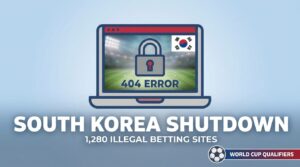
South Korean authorities have moved decisively against unlicensed online gambling, blocking access to 1,280 illegal sports betting websites in the weeks leading up to FIFA World Cup qualifying matches. The crackdown, coordinated by the National Gambling Control Commission (NGCC) alongside telecommunications regulators, targets platforms operating without authorization in a market where sports wagering outside state-sanctioned channels remains prohibited. The timing is deliberate: major football events historically trigger surges in illicit betting activity, and regulators appear intent on cutting off access before demand peaks.
What South Korea’s Betting Crackdown Signals for Enforcement Strategy
This operation reflects a broader pattern across Asia-Pacific jurisdictions, where governments are shifting from reactive prosecution to proactive digital infrastructure blocking. Before examining the specifics, here are the strategic takeaways that matter most for industry stakeholders and compliance professionals.
- Scale of the operation: 1,280 sites blocked in a single enforcement wave represents one of South Korea’s largest coordinated actions against unlicensed gambling platforms
- The enforcement is timed around FIFA World Cup qualifiers, suggesting regulators are building event-driven enforcement calendars rather than relying on periodic sweeps
- Telecommunications cooperation: ISP-level blocking indicates deepening collaboration between gambling regulators and digital infrastructure providers
- Demand-side pressure: South Korea continues to treat illegal gambling as a consumer protection issue, not merely a licensing violation, which shapes the severity of penalties
- Operators targeting Korean-language markets from offshore jurisdictions face increasing technical barriers to reaching customers
How the Blocking Mechanism Works
South Korea’s approach relies on DNS-level filtering and URL blacklisting enforced through domestic internet service providers. When the NGCC identifies an unlicensed platform, it issues blocking orders that ISPs must implement, effectively rendering the sites inaccessible to users connecting through Korean networks. VPN circumvention remains possible (a distinction regulators have been slow to address publicly), but the friction it introduces is enough to deter casual bettors who might otherwise stumble onto illegal platforms through search engines or social media advertising.
The 1,280 figure deserves some context. Many of these sites are mirror domains or cloned versions of the same underlying platforms, spun up rapidly to replace previously blocked URLs. This cat-and-mouse dynamic is familiar to regulators worldwide. Still, the sheer volume suggests the NGCC has invested in automated detection tools capable of identifying new domains faster than operators can deploy them.
Why FIFA Qualifiers Amplify the Risk
Football betting volumes spike predictably around major international competitions. South Korea’s national team generates intense public interest, and qualifying matches for the FIFA World Cup draw millions of viewers domestically. Unlicensed operators exploit this attention, often offering odds on matches that fall outside the scope of Korea’s legal betting monopoly operated by Sports Toto.
The legal framework in South Korea permits only a narrow range of state-authorized gambling products. Sports Toto covers certain sports betting categories, while the Korea Racing Authority handles horse racing. Everything else operates in a grey zone at best. And while the government has periodically discussed modernizing its gambling laws, no significant legislative reform has materialized.
That gap between consumer demand and legal supply is precisely what fuels the offshore market.
Enforcement by the Numbers
| Metric | Detail |
|---|---|
| Sites blocked | 1,280 in the current enforcement wave |
| Lead agency | National Gambling Control Commission (NGCC) |
| Enforcement method | DNS filtering and ISP-level URL blocking |
| Trigger event | FIFA World Cup qualifying matches |
| Legal betting operator | Sports Toto (state-authorized) |
| Estimated annual illegal gambling market in South Korea | Over 80 trillion KRW (~$60 billion USD), per prior NGCC estimates |
The Broader Regulatory Landscape Across Asia-Pacific
South Korea is not operating in isolation. Across the region, jurisdictions from the Philippines to Australia have escalated enforcement against unlicensed online gambling operators over the past 18 months. The Philippines’ PAGCOR has cracked down on offshore gaming operators (POGOs), while Australia’s ACMA has blocked hundreds of illegal sites targeting domestic consumers. What sets South Korea apart is the near-total prohibition on private-sector gambling, which makes any unlicensed operation inherently unauthorized rather than merely non-compliant with licensing conditions.
This absolutist framework simplifies enforcement decisions but complicates market development. Whether South Korea eventually opens a regulated private market for online sports betting remains one of the more consequential unanswered questions in Asian gambling policy. Neighboring Japan’s cautious approach to integrated resorts offers one model, though the political dynamics differ substantially.
Consumer Behavior and the Psychology of Access Restriction
Blocking sites does not eliminate demand. It redirects it. Understanding how bettors respond to access restrictions requires looking beyond enforcement statistics and into behavioral patterns. When familiar platforms disappear, habitual users tend to seek alternatives through peer networks, encrypted messaging groups, and social media channels that sit outside traditional regulatory surveillance.
Research in behavioral economics suggests that friction-based interventions work best when paired with accessible legal alternatives. In South Korea’s case, Sports Toto’s product range is limited compared to what offshore platforms offer, particularly in live betting and accumulator markets. The psychological principle of reactance also applies here: when people perceive their choices being restricted, the prohibited option can become more attractive, not less. Regulators who understand this dynamic tend to pair enforcement with public awareness campaigns that reframe legal betting as a safer, more reliable experience rather than simply the only permitted one.
Framing matters. Messaging that emphasizes consumer protection outcomes, such as guaranteed payouts and dispute resolution mechanisms available through licensed operators, tends to resonate more effectively than punitive warnings. South Korea’s NGCC has historically leaned toward the latter approach, though recent campaigns suggest a gradual shift toward harm-reduction language that acknowledges bettor motivations rather than dismissing them.
Even so, the structural mismatch between what legal channels offer and what consumers seek remains the core tension. No amount of site blocking resolves that.
Frequently Asked Questions
Is all online sports betting illegal in South Korea?
Private-sector online sports betting is not authorized. The only legal option is Sports Toto, a state-sanctioned operator with a limited product range covering select sports and bet types.
How does South Korea block illegal gambling websites?
The NGCC issues blocking orders to domestic internet service providers, which implement DNS-level filtering and URL blacklisting. Users attempting to access blocked sites from Korean networks are redirected to a government notice page.
Can users bypass these blocks with a VPN?
Technically, yes. But using a VPN to access illegal gambling sites does not change the legal status of the activity. South Korean law treats participation in unlicensed gambling as a criminal offense, regardless of how the user connects.
Why are enforcement actions timed around sporting events?
Major competitions drive spikes in betting demand. Regulators time their enforcement waves to coincide with these peaks, aiming to disrupt access precisely when consumer exposure to illegal platforms is highest. It is a resource allocation strategy as much as a legal one.