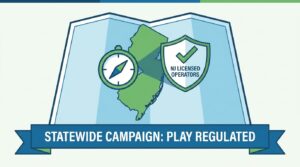
New Jersey’s Division of Gaming Enforcement has rolled out a statewide public awareness campaign aimed at educating residents about the risks of using unlicensed gambling websites. The initiative targets both casual bettors and habitual players, reinforcing that only state-authorized platforms offer the consumer protections mandated under New Jersey law. It arrives at a moment when offshore and grey-market operators continue to attract U.S. players through aggressive digital advertising, often without any of the safeguards that licensed sites are required to maintain.
Why New Jersey Is Drawing a Harder Line on Unlicensed Gambling
The campaign’s core message is deceptively simple: if a site isn’t licensed by the state, players have no recourse when something goes wrong. But beneath that surface lies a more complex regulatory calculation. Here are the strategic takeaways worth watching:
- Consumer protection as competitive lever: By spotlighting the absence of dispute resolution, responsible gambling tools, and data security on unlicensed platforms, New Jersey is reinforcing the value proposition of its own regulated market.
- Revenue preservation: Every dollar wagered on an unauthorized site is a dollar that generates no tax revenue for the state. New Jersey collected over $200 million in internet gaming revenue in recent fiscal periods, and protecting that stream is a clear motivator.
- The campaign also serves as a signal to other states still building out their regulatory frameworks — a template, arguably, for how to communicate the licensed-versus-unlicensed distinction to a public that often doesn’t know the difference.
- Enforcement posture: Public awareness campaigns frequently precede or accompany stepped-up enforcement actions. Whether the DGE follows this initiative with targeted takedowns remains to be seen.
What Unlicensed Platforms Actually Cost Players
The risks aren’t theoretical. Players on unauthorized gambling sites routinely encounter frozen accounts, withheld winnings, and zero avenues for complaint. There is no regulator to call. No audit trail. No requirement that the operator segregate player funds from operating capital (a distinction regulators have been slow to explain clearly to the public).
Licensed operators in New Jersey, by contrast, must comply with strict technical standards, submit to regular audits, and integrate responsible gambling features such as deposit limits, self-exclusion programs, and session time alerts. The New Jersey Division of Gaming Enforcement maintains a public list of approved sites, giving players a straightforward way to verify legitimacy before depositing funds.
Still, verification requires effort. And that’s part of the problem.
The Behavioral Gap Between Awareness and Action
Telling people to “choose licensed sites” assumes they know how to identify one. In practice, many players land on gambling platforms through search engine results, social media ads, or affiliate links — channels where unlicensed operators often outspend their regulated counterparts. The visual difference between a licensed New Jersey casino site and an offshore clone can be negligible to an untrained eye.
This is where the campaign’s effectiveness will ultimately be tested. Public messaging works best when it reduces friction — when it gives people a clear, memorable action to take rather than a principle to internalize. New Jersey’s approach reportedly includes digital ads, social media outreach, and partnerships with licensed operators to amplify the message. Whether those touchpoints reach the demographics most vulnerable to unlicensed sites — younger bettors, first-time sports wagerers, mobile-first users — is the question that doesn’t yet have an answer.
Framing Matters More Than Facts Alone
From a communication standpoint, the campaign reflects principles closely aligned with how people actually process risk. Neurolinguistic research into decision-making suggests that individuals respond more strongly to loss framing than to gain framing. Telling a player “you could lose your entire deposit with no way to recover it” lands harder than “licensed sites offer better protections.” Both statements are true. Only one changes behavior.
Effective public campaigns in regulated industries — tobacco, financial products, even food safety — have historically succeeded when they anchor abstract risks in concrete, personal scenarios. A player who reads about frozen withdrawals on an unlicensed site processes that differently than one who reads a regulatory bulletin about compliance standards. The emotional weight of a specific, relatable loss creates what behavioral researchers call an availability heuristic: the risk feels real because the example is vivid. New Jersey’s campaign, if it leans into this kind of storytelling rather than defaulting to bureaucratic language, stands a better chance of shifting player behavior at the margins. And in a market generating hundreds of millions in annual revenue, even marginal shifts carry outsized fiscal consequences.
The state’s regulators appear to understand that trust isn’t built through mandates alone. It requires repetition, specificity, and a willingness to meet players where they already are — on their phones, mid-scroll, one tap away from a deposit screen.
How New Jersey’s Licensed Market Compares
| Feature | Licensed NJ Operators | Unlicensed / Offshore Sites |
|---|---|---|
| Regulatory oversight | NJ DGE, with regular audits | None in most cases |
| Player fund segregation | Required by law | No obligation; funds may be commingled with operating expenses |
| Dispute resolution | Formal complaint process through the DGE | No recourse |
| Responsible gambling tools | Mandatory: deposit limits, self-exclusion, session alerts | Rarely offered |
| Tax contribution | Generates state revenue | Zero |
Frequently Asked Questions
How can I check if a gambling site is licensed in New Jersey?
The DGE publishes an updated list of authorized internet gaming operators on its official website. Cross-referencing any platform against that list before creating an account takes less than a minute and eliminates the most common risk.
What happens if I’ve already used an unlicensed site?
Players who have deposited funds on unauthorized platforms have limited legal options for recovery. The state’s consumer protection resources may offer guidance, but enforcement against offshore entities remains difficult. Moving to a licensed operator is the most immediate step.
Does this campaign affect existing licensed operators?
Yes, though indirectly. Licensed operators benefit from increased public trust in the regulated ecosystem. Some have reportedly partnered with the state to co-distribute campaign messaging across their own channels.
Are unlicensed gambling sites illegal in New Jersey?
Operating a gambling site without state authorization violates New Jersey gaming law. For players, the legal exposure is less defined — but the financial and personal risks are substantial regardless of how the statute reads.