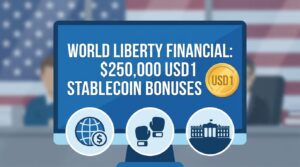
World Liberty Financial, the crypto venture backed by the Trump family, bankrolled a $250,000 fighter bonus pool at UFC Freedom 250 on Sunday, paying out the awards in its USD1 stablecoin. The event took place on the South Lawn of the White House, marking what is believed to be the first time cryptocurrency bonuses have been distributed at a combat sports event hosted on federal grounds. The Ultimate Fighting Championship confirmed the arrangement on June 13, framing it as a milestone in mainstream crypto adoption within professional sports.
What the USD1 Bonus Pool Signals for Crypto-Sports Convergence
Before breaking down the strategic implications, it’s worth recognizing how unusual this arrangement is. A stablecoin issued by a politically connected entity, distributed as prize money at a White House-hosted sporting event, collapses several categories that have traditionally operated at arm’s length: politics, digital assets, and professional athletics.
- Stablecoin legitimacy play: By tying USD1 to a high-visibility payout at a marquee event, World Liberty Financial positions its token not as speculative but transactional. That distinction matters for regulatory positioning.
- White House as venue: Hosting a crypto-linked payout on the South Lawn carries symbolic weight that no exchange listing or partnership announcement can replicate.
- The UFC’s willingness to accept a stablecoin as the bonus mechanism suggests internal confidence that the token’s peg and liquidity can withstand scrutiny from fighters, agents, and media alike.
- Political entanglement risk: For competitors and regulators watching closely, the Trump family’s involvement in both the venue and the issuing entity raises questions about conflicts of interest (a distinction regulators have been slow to enforce in the stablecoin space).
- Precedent for athlete compensation: If fighters accept USD1 without friction, it opens a template for broader crypto-denominated payouts across combat sports and beyond.
How the Payout Worked
The $250,000 pool was distributed among select fighters as performance bonuses, a format the UFC has used for years to reward standout performances on fight night. What changed here was the rail. Instead of traditional wire transfers or checks, recipients received their bonuses denominated in USD1, the dollar-pegged stablecoin issued by World Liberty Financial’s decentralized platform.
USD1 operates as a fiat-backed stablecoin, meaning each token is theoretically redeemable for one U.S. dollar. The practical question, though, is whether fighters and their management teams treat this as equivalent to cash or as an additional step they’d rather skip. Early indications suggest the UFC handled conversion logistics, but the organization has not publicly detailed the redemption process.
Why the White House Setting Changes the Calculus
UFC Freedom 250 was already an unusual event. Staging a full fight card on the South Lawn required coordination between the promotion, the White House, and the Secret Service. Layering a crypto payout on top of that added another dimension entirely.
The optics are deliberate. Distributing a Trump-family-linked stablecoin at the president’s residence blurs the line between policy endorsement and commercial promotion in a way that few prior crypto activations have attempted. And while no official government endorsement of USD1 has been issued, the venue itself functions as an implicit signal to markets and regulators.
Still, the arrangement also invites scrutiny. Congressional critics of the Trump family’s crypto holdings have already flagged potential conflicts, and an event like this gives them fresh material. Whether that translates into legislative action or remains rhetorical is less clear.
The Stablecoin Market Context
USD1 enters a crowded field. Tether’s USDT and Circle’s USDC dominate stablecoin trading volumes, collectively accounting for well over $150 billion in market capitalization. USD1’s current footprint is considerably smaller, and its path to meaningful market share depends on exactly these kinds of high-profile integrations.
| Stablecoin | Issuer | Approximate Market Cap | Primary Use Case |
|---|---|---|---|
| USDT | Tether | ~$140B | Trading pairs, cross-border transfers |
| USDC | Circle | ~$34B | Institutional settlement, DeFi |
| USD1 | World Liberty Financial | Not publicly disclosed at scale | Emerging transactional and promotional use |
The gap is enormous. But World Liberty Financial is arguably betting that political proximity and cultural moments can compress the adoption timeline in ways that pure technology plays cannot.
What Fighters and the Broader Sports Industry Should Watch
For athletes, the immediate question is straightforward: can I spend this? Stablecoins pegged to the dollar should, at least on paper, function identically to fiat for purchasing power. But tax treatment, wallet custody, and conversion friction remain real concerns for individuals who may have limited experience with digital assets.
The UFC’s official event infrastructure handled the distribution, which likely reduced friction for fighters on the receiving end. Yet the broader sports industry will be watching whether this model scales. If a $250,000 bonus pool works cleanly in stablecoin, the next question becomes whether fight purses, sponsorship payments, or even ticket sales follow.
That’s a big if. And not everyone in the combat sports ecosystem is convinced that crypto payouts solve a problem fighters actually have.
Frequently Asked Questions
What is USD1?
USD1 is a dollar-pegged stablecoin issued by World Liberty Financial, a decentralized finance venture associated with the Trump family. Each token is designed to maintain a 1:1 value with the U.S. dollar.
Did fighters have to keep their bonuses in crypto?
The UFC has not publicly confirmed whether fighters could immediately convert USD1 to fiat currency. In practice, most stablecoin recipients can redeem or swap tokens through exchanges, though the specific process here hasn’t been detailed.
Is this the first time crypto has been used for UFC bonuses?
While the UFC has previously partnered with crypto sponsors, this appears to be the first instance where performance bonuses were funded and distributed entirely in a stablecoin, and certainly the first at a White House venue.
Does this mean the U.S. government endorses USD1?
No. The White House served as the event venue, but no official government endorsement of USD1 or World Liberty Financial has been issued. The proximity, however, carries its own weight in market perception.