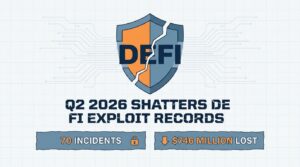
The second quarter of 2026 has earned a grim distinction. With approximately 70 separate exploits logged between April, May, and the first half of June, Q2 2026 now holds the record for the most-hacked quarter in decentralized finance history by incident count, according to data tracked by DefiLlama. The cumulative dollar figure sits at roughly $746 million. What makes this quarter different isn’t just the scale of losses but the sheer frequency of attacks, pointing to something deeper than opportunistic hacking.
What the Exploit Surge Signals for DeFi Security
Before diving into the specifics, it’s worth framing why this data matters beyond the headline number. The pattern emerging in Q2 2026 suggests that DeFi’s security infrastructure hasn’t kept pace with the complexity of protocols being deployed. For executives, investors, and regulators watching this space, the takeaways are pointed:
- Volume over magnitude: Seventy incidents in roughly ten weeks means protocols are being compromised at a rate of nearly one per day, a cadence that overwhelms audit capacity and incident response teams alike
- The $746 million total, while staggering, is distributed across far more events than previous record quarters, suggesting attackers are targeting smaller and mid-tier protocols more aggressively
- Structural vulnerability: This isn’t a story about one or two catastrophic bridge hacks; it reflects systemic weaknesses across smart contract design, access control, and oracle manipulation
- Regulatory pressure will intensify: Quarters like this hand ammunition to policymakers arguing that DeFi protocols should meet minimum security standards before going live
- Insurance and risk-mitigation products in DeFi remain woefully underdeveloped relative to the threat landscape
A Structural Shift, Not a Statistical Blip
The figures tracked by DefiLlama’s DeFi analytics platform reflect something more consequential than a bad quarter. Previous spikes in exploit losses tended to cluster around a handful of large-scale incidents. The Ronin Bridge hack in 2022, for instance, accounted for over $600 million on its own. Q2 2026 looks fundamentally different.
Here, the damage is distributed. Dozens of protocols, many of them launched in the preceding six months, have been hit. And while no single exploit in this quarter approaches the Ronin-scale catastrophe, the aggregate tells a story of systemic fragility. Attackers appear to be running playbooks across categories: flash loan exploits, reentrancy bugs, governance manipulation, and compromised private keys.
That breadth matters. It suggests the attacker ecosystem has matured faster than the defensive one.
How Q2 2026 Compares to Previous Quarters
| Quarter | Approximate Losses | Notable Incidents | Incident Count |
|---|---|---|---|
| Q1 2022 | $1.3 billion | Ronin Bridge ($625M) | ~25 |
| Q3 2023 | $685 million | Multichain, Curve exploits | ~40 |
| Q1 2025 | $520 million | Multiple mid-tier protocol hacks | ~35 |
| Q2 2026 | $746 million | Distributed across ~70 exploits | ~70 |
The contrast is stark. Even quarters with higher absolute losses involved fewer discrete events. Q2 2026’s incident count nearly doubles the previous high watermark, which raises uncomfortable questions about whether the DeFi ecosystem’s rapid expansion has outstripped its capacity for self-governance (a distinction regulators have been slow to enforce).
Why Frequency Matters More Than Total Losses
Dollar figures grab attention. But for protocol builders and institutional allocators, the frequency metric is arguably more alarming. A single massive exploit can be attributed to one team’s failure. Seventy exploits in ten weeks cannot.
When attacks happen this often, the problem shifts from “who made a mistake” to “what’s wrong with how we build.” Smart contract auditing firms, already stretched thin by the pace of new deployments, face a credibility test. Did they audit these protocols? If so, what did they miss? If not, why were unaudited protocols attracting meaningful capital?
Still, not all exploits are created equal. Some involved protocols with total value locked under $1 million. Others hit projects managing tens of millions. The distribution curve of losses within this quarter hasn’t been fully disaggregated yet, and that granularity will matter when assessing whether the problem is concentrated in a particular protocol category or genuinely ecosystem-wide.
Reframing DeFi Risk: What Builders and Allocators Should Consider
Quarters like this force a recalibration. For protocol teams, the lesson is blunt: shipping fast without robust security review is no longer a calculated risk. It’s a near-certainty of exploitation. The attacker tooling available today, including automated vulnerability scanners and MEV-adjacent exploit bots, has lowered the skill threshold for carrying out attacks.
For institutional capital, the calculus shifts too. Allocating to DeFi strategies now requires a security due diligence layer that didn’t exist three years ago. Questions that were once optional are becoming mandatory:
- Has the protocol undergone multiple independent audits?
- Is there a bug bounty program with meaningful payouts?
- What’s the protocol’s incident response plan?
- Are admin keys behind a multisig with time-lock mechanisms?
These aren’t theoretical concerns anymore. They’re underwriting criteria.
Frequently Asked Questions
What made Q2 2026 the worst quarter for DeFi exploits?
It wasn’t the dollar amount alone. The roughly 70 separate incidents in just over ten weeks represent the highest exploit frequency ever recorded in a single quarter, surpassing previous records by a wide margin. The $746 million in losses was spread across dozens of protocols rather than concentrated in one or two catastrophic events.
Are DeFi audits failing?
Not necessarily failing, but clearly insufficient at current scale. Many exploited protocols either skipped audits entirely or relied on a single review. The pace of new protocol launches has outstripped the capacity of established auditing firms, and automated audit tools haven’t closed the gap.
Does this quarter change the regulatory outlook for DeFi?
Almost certainly. Regulators in the EU, UK, and US have already signalled interest in minimum security standards for decentralized protocols. A quarter with 70 exploits strengthens the case for mandatory pre-deployment audits or security certifications, at least on paper.
Which types of exploits were most common?
Flash loan attacks, reentrancy vulnerabilities, oracle manipulation, and compromised access controls all featured prominently. The diversity of attack vectors is itself a key finding: no single exploit type dominated, which points to broad-based weaknesses rather than one systemic flaw.
Whether this quarter becomes a turning point or simply another data point in DeFi’s volatile security history depends on what happens in the next ninety days. The protocols that survive will be the ones that treated security as infrastructure, not overhead.