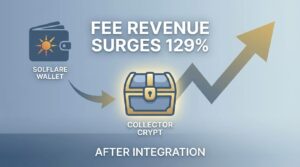
Collector Crypt, the Solana-native platform that tokenizes graded physical trading cards for on-chain trading, recorded a 129% week-over-week spike in fee revenue following Solflare’s decision to embed its card-pack mechanic directly into the wallet interface. The platform pulled in $3.86 million in fees over the period, a figure that underscores how deeply wallet-level distribution can reshape user engagement in niche crypto verticals. What started as a collectibles experiment on Solana now looks increasingly like a case study in infrastructure-driven growth.
What the Solflare Integration Actually Changed
Before the integration, Collector Crypt users had to navigate to the platform’s own interface, connect a wallet, and manually interact with its card-pack purchasing flow. Functional, but friction-heavy. Solflare’s move to embed the mechanic natively inside its wallet collapses that journey into something far more immediate: users encounter the card-pack option where they already manage their assets.
That single UX shift appears to have been the catalyst. A 129% jump in weekly fees is not incremental. It suggests a latent user base that was aware of Collector Crypt but hadn’t been sufficiently motivated to leave the wallet environment. Solflare, by bringing the product to the user rather than the reverse, unlocked demand that the platform’s standalone interface couldn’t reach on its own.
And while $3.86 million in weekly fees is notable for any Solana-based project, the more telling signal may be what it implies about wallet apps evolving into distribution platforms (a distinction the industry has discussed in theory but rarely demonstrated at this scale).
Why This Revenue Milestone Matters for Solana’s Ecosystem
An introductory framing helps here: Collector Crypt sits at the intersection of physical collectibles and DeFi infrastructure, tokenizing graded trading cards so they can be bought, sold, and speculated on without the logistical drag of physical custody. The Solflare integration didn’t change the product. It changed the reach.
- Fee revenue as a proxy for real activity: Unlike token price movements, protocol fees reflect actual usage. A 129% weekly increase signals genuine transactional growth, not speculative froth.
- Wallet-native distribution proves its thesis: Solflare embedding third-party mechanics validates the idea that wallets can function as app stores for crypto-native products.
- The $3.86 million figure positions Collector Crypt among the higher-fee-generating protocols on Solana for that period, competing with projects that have far larger teams and treasuries.
- Physical-digital bridge gaining traction: Tokenized real-world assets remain a persistent narrative in crypto, but few projects have demonstrated consumer-grade adoption. This is one data point suggesting otherwise.
How Wallet-Level Distribution Reshapes User Acquisition
Traditional crypto user acquisition follows a predictable arc: build a dApp, list it on aggregators, run incentive campaigns, hope for organic discovery. It’s expensive and lossy. Solflare’s native embedding of Collector Crypt’s card-pack mechanic sidesteps that funnel entirely.
By meeting users inside their existing workflow, the integration removes the cognitive overhead of context-switching. This matters more than it might seem. In behavioral terms, the gap between “I’ll check that out later” and “I can do this right now” is where most potential users are lost. Solflare closed that gap.
Still, questions linger about sustainability. A 129% spike driven by novelty looks different from a 129% spike driven by retained behavior. Whether Collector Crypt can maintain this trajectory depends on repeat engagement, not just first-time curiosity.
The Broader Implications for Tokenized Collectibles
Tokenizing physical trading cards is not new as a concept. But execution has historically been uneven, plagued by custody concerns, authentication friction, and thin liquidity. Collector Crypt’s approach on Solana benefits from the chain’s low transaction costs and fast finality, which make micro-transactions around card packs economically viable in ways that Ethereum mainnet simply cannot match at current fee levels.
The $3.86 million weekly fee figure also raises a harder question: at what point do tokenized collectible platforms start attracting regulatory attention as de facto trading venues for alternative assets? Graded trading cards already carry significant secondary-market value in traditional channels. Wrapping them in on-chain mechanics doesn’t eliminate the underlying asset classification debate.
Comparative Weekly Fee Performance
| Metric | Previous Week | Integration Week | Change |
|---|---|---|---|
| Weekly Fee Revenue | ~$1.69M (estimated) | $3.86M | +129% |
| Distribution Channel | Standalone dApp | Standalone + Solflare native | Added wallet-native access |
| Blockchain | Solana | Solana | No change |
What Comes Next for Wallet-Embedded Commerce
If Solflare’s integration with Collector Crypt holds as a template, expect other major Solana wallets to explore similar partnerships. Phantom, Backpack, and others have the user bases to replicate this effect across different product categories. The precedent set here gives wallet developers a revenue-sharing model they can point to with hard numbers.
But the real test isn’t whether other wallets copy the playbook. It’s whether embedded mechanics can sustain engagement beyond the initial surge. Arguably, the crypto industry has a pattern of mistaking distribution wins for product-market fit. One strong week does not make a durable business.
What it does make is a signal. And for now, that signal is loud enough to warrant attention from anyone building at the intersection of wallets, collectibles, and on-chain commerce.
Frequently Asked Questions
What is Collector Crypt?
Collector Crypt is a Solana-based platform that tokenizes graded physical trading cards, enabling them to be traded on-chain without requiring physical custody of the cards themselves.
How did the Solflare integration drive revenue growth?
Solflare embedded Collector Crypt’s card-pack purchasing mechanic directly into its wallet interface, removing the need for users to navigate to a separate dApp. This reduced friction and exposed the product to Solflare’s existing user base, contributing to a 129% week-over-week increase in fee revenue.
Is $3.86 million in weekly fees significant for a Solana project?
Yes. That figure places Collector Crypt among the higher-fee-generating protocols on Solana for the period in question, particularly notable given the platform’s relatively narrow focus on tokenized trading cards rather than broader DeFi or NFT activity.
Could other wallets replicate this model?
In principle, yes. Phantom, Backpack, and other Solana wallets have the user bases and technical infrastructure to embed similar third-party mechanics, though the commercial terms and product fit would vary case by case.



