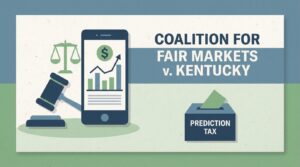
A newly formed industry group calling itself the Coalition for Fair Markets has launched a legal challenge against Kentucky’s pioneering excise tax on electronic prediction platforms. The lawsuit, filed in Franklin Circuit Court, targets a 14.25% levy on prediction market transaction fees enacted by the state legislature. KalshiEX, Crypto.com’s North American Derivatives Exchange (NADEX), and Polymarket’s US exchange (QCX) are driving the coalition’s effort, naming Attorney General Russell Coleman and state revenue officials as defendants. At stake is whether a single state can impose a targeted tax burden on a federally regulated derivatives category without running afoul of constitutional boundaries.
Why This Lawsuit Carries Weight Beyond Kentucky
The prediction market sector has grown rapidly over the past two years, drawing both retail participants and institutional interest. Kentucky’s decision to single out this asset class with a dedicated excise tax represents the first attempt by any US state to carve out prediction platforms for distinct fiscal treatment. That distinction matters. Before examining the legal arguments, here is what industry stakeholders should take away from this filing:
- Constitutional collision course: The coalition argues the tax violates both federal preemption principles and state constitutional provisions, setting up a potential precedent for how derivatives platforms are taxed nationwide.
- Immediate business impact: A 14.25% levy on transaction fees could materially compress margins for exchanges operating in or serving Kentucky residents, potentially forcing platform-level pricing adjustments.
- The coalition’s membership spans centralized and decentralized exchange models, signaling rare alignment across competitors who typically occupy different regulatory postures.
- Regulatory signal risk: If Kentucky’s tax survives legal challenge, other states may view it as a template for taxing novel financial instruments, from event contracts to tokenized assets.
- Injunction timing: The request for an immediate injunction suggests the exchanges believe collection could begin before the courts resolve the underlying constitutional questions.
The Legal Architecture of the Challenge
Central to the coalition’s argument is the claim that Kentucky’s excise tax conflicts with federal regulatory authority over derivatives markets. Prediction contracts traded on platforms like KalshiEX’s event contract exchange are regulated by the Commodity Futures Trading Commission (CFTC), which has exclusive jurisdiction over certain categories of derivatives under the Commodity Exchange Act. The coalition contends that a state-level tax specifically targeting these instruments amounts to an impermissible burden on federally supervised activity.
There is also a dormant Commerce Clause dimension. By imposing a tax that disproportionately affects interstate electronic platforms, Kentucky may be discriminating against out-of-state commerce. Most prediction market participants transact across state lines, and the platforms themselves operate nationally. Whether the tax creates an undue burden on that interstate flow will likely become a central question if the case advances.
And then there’s the equal protection angle. Why prediction markets and not, say, sports betting platforms or traditional futures exchanges? The coalition appears poised to argue that the legislative package lacks a rational basis for singling out one class of financial product (a distinction regulators themselves have been slow to formalize in many jurisdictions).
What a 14.25% Levy Actually Means for Platform Economics
Prediction markets operate on relatively thin fee structures compared to traditional financial exchanges. Transaction fees typically range from a few cents per contract to a small percentage of notional value. Layering a 14.25% excise tax on top of those fees doesn’t just reduce profitability. It fundamentally alters the cost calculus for both the platform and the end user.
Consider the math. If a platform charges a 5% transaction fee on a $100 contract, the fee is $5. A 14.25% excise on that fee adds $0.71 per trade. Across millions of contracts, that figure compounds into a substantial revenue drain or, alternatively, a price increase passed to users. Either outcome risks pushing volume to platforms operating outside Kentucky’s reach.
| Scenario | Transaction Fee | Excise Tax (14.25%) | Total Cost to Platform/User |
|---|---|---|---|
| $100 contract, 5% fee | $5.00 | $0.71 | $5.71 |
| $500 contract, 3% fee | $15.00 | $2.14 | $17.14 |
| $1,000 contract, 2% fee | $20.00 | $2.85 | $22.85 |
| High-volume trader (10,000 contracts/month at $100, 5% fee) | $50,000 | $7,125 | $57,125 |
For high-frequency participants, the annual tax burden could reach six figures. That’s not a rounding error.
Cross-Industry Implications: Who Should Be Watching
This case extends well beyond the prediction market niche. Crypto derivatives platforms, tokenized real-world asset exchanges, and even traditional options venues should be paying attention. Kentucky’s willingness to craft a product-specific excise tax suggests a legislative appetite for treating novel financial instruments as distinct taxable categories rather than folding them into existing frameworks.
Crypto.com’s derivatives arm joining the coalition underscores how broadly the threat is perceived. If a state can tax prediction market fees at 14.25%, what prevents a similar levy on perpetual swap fees, NFT royalty transactions, or decentralized exchange protocol revenues? The legal theory the coalition advances here could become the defensive playbook for the entire digital asset industry.
How Regulatory Framing Shapes Market Perception
Beyond the courtroom, this dispute carries a psychological dimension that shapes how market participants perceive risk. When a state government targets a specific financial product with punitive-seeming taxation, it sends a signal. Investors, platform operators, and institutional allocators all recalibrate their assumptions about regulatory stability. In behavioral terms, this is anchoring at work: the 14.25% figure becomes a reference point, regardless of whether it survives legal scrutiny. Future legislative proposals in other states will be measured against it.
Still, perception cuts both ways. The coalition’s aggressive legal response also sends a message: that the industry is organized enough to fight back, and willing to spend the resources to do so. For platforms evaluating US market entry, the existence of a coordinated legal defense mechanism may actually reduce perceived risk over time, provided the challenge succeeds. What remains less clear is whether the coalition’s unity will hold if the litigation stretches across multiple years and appeals.
Frequently Asked Questions
What is the Coalition for Fair Markets?
It is a newly formed industry association comprising major prediction market and derivatives exchanges, including KalshiEX, NADEX, and QCX. The coalition was created specifically to challenge Kentucky’s excise tax on prediction platform transaction fees.
Why is Kentucky’s tax considered unprecedented?
No other US state has enacted a dedicated excise tax targeting electronic prediction platforms. Kentucky’s 14.25% levy on transaction fees is the first legislative attempt to treat prediction markets as a distinct taxable category.
Could this case affect other states’ tax policies?
Arguably, yes. If the tax is upheld, it could serve as a model for other states seeking to generate revenue from novel financial instruments. A ruling striking it down, on the other hand, would constrain state-level taxation of federally regulated derivatives.
What happens if the injunction is granted?
Kentucky would be temporarily barred from collecting the tax while the constitutional questions are litigated. The exchanges would continue operating under pre-tax conditions until a final ruling is issued, though the timeline for resolution remains uncertain.



