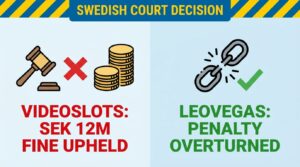
A Swedish administrative court has delivered a split ruling on two gambling enforcement actions, confirming a SEK12 million (US$1.28m) fine against Videoslots while quashing an SEK8 million ($852,138) penalty previously imposed on LeoVegas. The decisions, which stem from separate compliance proceedings brought by Sweden’s gambling regulator Spelinspektionen, underscore the uneven terrain operators face when contesting regulatory sanctions. Both cases involved alleged breaches of Swedish gambling law, yet the court reached opposite conclusions on the merits.
What the Split Ruling Signals for Swedish Gambling Enforcement
These two outcomes, handed down in parallel, reveal more than routine regulatory housekeeping. They expose how fact-specific Sweden’s enforcement framework has become, and how operators with seemingly similar profiles can land on opposite sides of a judicial decision. Before diving into the details, here are the strategic takeaways that matter most for the industry.
- Videoslots faces a confirmed SEK12m penalty, reinforcing that Spelinspektionen’s enforcement actions can survive judicial scrutiny when the evidentiary record is strong enough
- LeoVegas’ SEK8m fine was overturned, suggesting the regulator’s case rested on weaker factual or procedural ground in that instance
- The divergence between the two rulings creates interpretive complexity for operators trying to calibrate their compliance posture in Sweden
- Spelinspektionen’s credibility as an enforcer remains intact on one front but takes a hit on another, which may influence how aggressively it pursues future cases
- For operators licensed in Sweden, the message is nuanced: contest where the facts support it, but do not assume courts will reflexively side with the industry
Videoslots: Why the Fine Stood
The court’s decision to uphold the SEK12 million sanction against Videoslots suggests the regulator presented a sufficiently documented case. Spelinspektionen had alleged that the operator, which holds a Swedish licence and runs a well-known online casino platform, failed to meet obligations under Sweden’s Gambling Act. While the precise nature of the breach has been the subject of regulatory proceedings for some time, the court evidently found the operator’s defence insufficient to overturn the penalty.
That is not a trivial amount for an operator navigating an already competitive Nordic market. SEK12 million sits in a range designed to sting without being existential (a distinction regulators have been slow to calibrate in other jurisdictions). Still, the reputational cost may weigh heavier than the financial one. Operators watching this case will note that Swedish courts are willing to back the regulator when the paperwork holds up.
How LeoVegas Escaped Its Penalty
The LeoVegas outcome tells a different story. The SEK8 million fine, originally imposed by Spelinspektionen, did not survive the court’s review. What remains less clear is whether the reversal turned on procedural deficiencies in the regulator’s case, a substantive disagreement over the interpretation of the law, or gaps in the evidence presented.
LeoVegas, now owned by MGM Resorts International following a 2022 acquisition, operates across multiple European markets and maintains a Swedish licence. The company’s mobile-first gambling operation has been a fixture of the Nordic market for over a decade. Overturning a regulatory fine is never routine; it requires the court to find that the regulator either overstepped its authority or failed to substantiate its claims. That the court reached this conclusion here raises a question the regulator will need to answer internally: was the case brought prematurely?
Regulatory Credibility in the Balance
Spelinspektionen has spent the past several years building a reputation as one of Europe’s more active gambling regulators. Licence revocations, financial penalties, and public warnings have all featured in its enforcement toolkit since Sweden re-regulated its gambling market in 2019.
But a 50% success rate in court, at least across these two cases, complicates the narrative. Regulators depend on the deterrent effect of their sanctions. When courts overturn penalties, it emboldens operators to challenge rather than settle. And while the Videoslots confirmation provides some validation, the LeoVegas reversal hands the industry a precedent it will cite in future disputes.
One case confirmed. One overturned. The pattern, if it becomes one, could reshape how Swedish operators approach regulatory risk.
Comparative Overview of the Two Rulings
| Operator | Fine Imposed | Court Outcome | Parent Company |
|---|---|---|---|
| Videoslots | SEK12m (US$1.28m) | Upheld | Independent |
| LeoVegas | SEK8m (US$852,138) | Overturned | MGM Resorts International |
What Operators Should Recalibrate Now
For compliance teams across Sweden’s licensed gambling sector, these rulings demand a recalibration of internal risk assessments. The instinct to treat all Spelinspektionen sanctions as final and non-negotiable has been challenged. Yet the instinct to dismiss them has also been checked. The practical reality sits somewhere in between, and that ambiguity is arguably harder to manage than a clear-cut enforcement regime.
Operators should be auditing their own compliance frameworks against the specific obligations cited in these cases. Where documentation is thin, the Videoslots outcome serves as a warning. Where the regulator’s reasoning appears stretched, the LeoVegas reversal offers a roadmap for challenge. Neither posture works in isolation.
Swedish gambling law places affirmative obligations on licensees across areas including responsible gambling, anti-money laundering, marketing restrictions, and bonus limitations. Each of these carries its own evidentiary threshold when contested in court. Operators who invest in granular record-keeping and proactive compliance monitoring will find themselves better positioned regardless of which way a particular ruling falls. The cost of robust compliance infrastructure is measurable; the cost of a confirmed fine, both financial and reputational, is harder to contain.
Frequently Asked Questions
Why was the Videoslots fine upheld but the LeoVegas fine overturned?
The court evaluated each case on its own facts and evidence. Videoslots’ penalty was supported by a sufficiently strong regulatory record, while the LeoVegas case apparently fell short of the evidentiary or legal threshold required to sustain the sanction.
Does the LeoVegas ruling mean Spelinspektionen’s enforcement is weakening?
Not necessarily. A single reversal does not invalidate the regulator’s broader enforcement programme. It does, however, signal that Swedish courts will scrutinise the factual basis of penalties rather than defer automatically to the regulator’s judgment.
Can operators use the LeoVegas decision as precedent?
In practice, yes. While each case turns on its specific circumstances, the reversal gives operators a reference point when evaluating whether to contest future sanctions. The strength of that precedent depends on the legal reasoning the court applied, which other operators will study closely.



