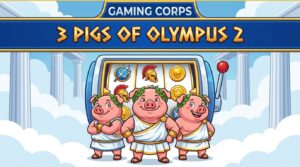
Swedish game developer Gaming Corps has rolled out 3 Pigs of Olympus 2: Rise of the DemiHog, a sequel to one of its strongest-performing mythology-comedy crossover titles. The release builds on the original’s blend of Greek mythological themes with fairy-tale characters, targeting operators and players who responded well to the first instalment’s mechanics. It arrives as the studio continues to deepen its catalogue of high-volatility, narrative-driven slot games across regulated markets.
What the Sequel Brings to Operators and Players
Before diving into the specifics, here’s a distilled look at what this launch signals for the broader iGaming supply chain and Gaming Corps’ strategic direction:
- The sequel leverages proven IP recognition from the original 3 Pigs of Olympus, reducing player acquisition costs for operators deploying the title
- Gaming Corps continues to invest in hybrid-theme game design, combining mythology with familiar storytelling tropes to widen demographic appeal
- High-volatility mechanics and feature-rich gameplay suggest the studio is doubling down on engagement-heavy slot formats favoured in European and LatAm markets
- Sequel releases signal a maturing content strategy: building franchises rather than one-off titles, a model that larger suppliers like Pragmatic Play and NetEnt have used to sustain catalogue momentum
Mechanics and Game Design: What’s Under the Hood
Rise of the DemiHog retains the comedic mythological framing of its predecessor but introduces expanded bonus features and what the studio describes as enhanced win potential. The game sits in the high-volatility bracket, a category that continues to dominate player preference data across multiple European jurisdictions.
Players encounter the three pigs reimagined as demigod figures navigating Olympus, with free spins, multipliers, and a tiered bonus round forming the core feature set. That layered structure matters. It’s the kind of design that keeps session lengths up and gives affiliates something tangible to market beyond a theme skin.
Still, the real test for any sequel is whether it retains the original’s player base while pulling in new users. Gaming Corps appears to be betting that brand familiarity, paired with mechanical upgrades, will do exactly that.
Gaming Corps’ Franchise-Building Approach
This release fits a broader pattern. Rather than flooding the market with unrelated titles (a strategy that has diluted several mid-tier suppliers over the past two years), Gaming Corps has been building recognisable game franchises that operators can slot into existing lobbies with lower integration friction.
Franchise sequels carry a quiet advantage that raw title counts don’t capture: they compress the marketing cycle. Operators already familiar with the original’s performance data can make faster deployment decisions. Players who enjoyed the first game need less convincing. And affiliates can reference an existing review ecosystem rather than starting from scratch.
Whether this approach scales depends on how many of Gaming Corps’ titles generate the kind of retention metrics that justify a sequel. Not every game earns one.
Market Context: Mythology Themes and Competitive Positioning
Mythology-themed slots remain among the most saturated categories in the iGaming content market. Greek gods, Norse legends, and Egyptian iconography dominate supplier catalogues from studios of every size. What separates titles in this space is rarely the theme itself but the execution: mechanical innovation, visual distinctiveness, and narrative hooks that give players a reason to choose one Olympus over another.
Gaming Corps’ decision to hybridise mythology with fairy-tale humour is, arguably, a sharper positioning move than it first appears. It sidesteps direct comparison with the Zeus-and-lightning aesthetic that dozens of competitors occupy, carving out a tonal niche that’s harder to replicate without looking derivative.
| Feature | 3 Pigs of Olympus (Original) | Rise of the DemiHog (Sequel) |
|---|---|---|
| Theme | Mythology-comedy crossover | Expanded mythology-comedy with demigod narrative arc |
| Volatility | High | High |
| Bonus Features | Free spins, multipliers | Enhanced free spins, tiered bonus rounds, increased multiplier potential |
| Target Markets | Europe | Europe, LatAm expansion |
How Narrative-Driven Design Shapes Player Behaviour
There’s a dimension to this release worth examining through the lens of player psychology. Slot games that embed recognisable characters into a progression-style narrative tap into several cognitive patterns that influence engagement. The three pigs as demigods isn’t just whimsy; it creates what behavioural designers call a “familiarity anchor” that lowers the cognitive load required for a new player to understand and invest in the game’s world.
When players encounter characters they already know, even in an absurd new context, their brains process the experience as partially understood before a single spin occurs. This pre-loaded comprehension shortens the gap between game launch and emotional investment. It’s the same principle that makes sequel films easier to market than original IP: the audience arrives with expectations already formed, and the product only needs to exceed them by a small margin to feel satisfying.
Layered bonus mechanics reinforce this further. Each tier of a bonus round functions as a micro-goal, triggering the same reward-anticipation loops that keep players engaged across longer sessions. Gaming Corps’ decision to expand the tiered structure in Rise of the DemiHog suggests the studio’s data from the original indicated that players responded strongly to progressive feature unlocks. And in a market where average session duration directly correlates with gross gaming revenue per user, that’s not a cosmetic choice.
The comedic tone adds another layer. Humour in game design reduces what psychologists term “loss aversion friction,” the negative emotional weight players attach to losing spins. A game that makes you smile between losses keeps you playing longer than one that simply looks impressive. It’s a subtle edge, but across millions of sessions, subtle edges compound.
Frequently Asked Questions
What is 3 Pigs of Olympus 2: Rise of the DemiHog?
It’s a high-volatility online slot game developed by Gaming Corps, serving as the sequel to the original 3 Pigs of Olympus. The title blends Greek mythology themes with fairy-tale characters and features expanded bonus mechanics including tiered bonus rounds and enhanced multipliers.
Where is the game available?
Gaming Corps distributes its titles across multiple regulated markets, with a primary focus on European jurisdictions and growing presence in Latin American markets. Availability depends on individual operator agreements and local licensing requirements.
Why does Gaming Corps focus on sequel releases?
Sequels allow the studio to capitalise on existing brand recognition, reduce player acquisition costs for operators, and compress marketing cycles. The approach mirrors franchise strategies used by larger suppliers in the iGaming space.
How does the game differ from other mythology-themed slots?
Rather than competing directly in the crowded serious-mythology category, Gaming Corps uses a comedy-hybrid approach that pairs mythological settings with familiar fairy-tale characters. That tonal distinction makes the title harder for competitors to replicate without appearing derivative.



