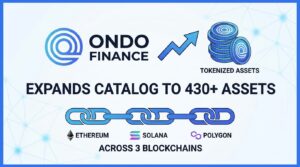
Ondo Finance rolled out 173 tokenized stocks and ETFs on its Ondo Global Markets platform on Tuesday, lifting the total number of available assets past 430. The expansion, announced via the protocol’s official X account on June 17, covers Ethereum, Solana, and BNB Chain. These aren’t fringe tokens or speculative micro-caps. The batch targets some of the most capital-intensive segments of traditional finance, signaling a deliberate push to bridge institutional-grade equities with on-chain infrastructure.
What This Expansion Means for Tokenized Finance
Adding 173 assets in a single batch is not a routine catalog update. It reflects an operational scaling decision that carries implications for liquidity provisioning, regulatory positioning, and competitive dynamics in the real-world asset (RWA) tokenization space. Before unpacking the details, here are the strategic takeaways worth noting:
- Ondo Global Markets now lists over 430 tokenized securities, making it one of the largest on-chain equity platforms by asset count
- Multi-chain deployment across Ethereum, Solana, and BNB Chain broadens accessibility for different DeFi ecosystems and user bases
- The focus on stocks and ETFs, rather than exotic instruments, suggests Ondo is targeting mainstream capital flows
- Rapid catalog growth could pressure competing RWA protocols to accelerate their own listings or risk falling behind in network effects
- Whether this breadth translates into meaningful trading volume remains the open question that will define the platform’s next chapter
Why the Asset Mix Matters
Tokenized real-world assets have been a recurring theme in crypto since at least 2021, but most early efforts concentrated on stablecoins, treasuries, or real estate. Ondo’s decision to go deep on equities and ETFs marks a different bet. Stocks carry regulatory complexity that treasuries do not (a distinction regulators have been slow to harmonize across jurisdictions), and ETFs introduce additional layers around fund structure compliance.
By listing assets that span capital-intensive sectors, Ondo Finance’s tokenized securities platform positions itself closer to the workflows that institutional allocators already use. That alignment is deliberate. It reduces the cognitive gap between traditional portfolio construction and on-chain execution.
Still, catalog size alone doesn’t guarantee adoption. The harder question is whether sufficient demand exists on-chain for tokenized versions of assets that are already liquid and accessible through conventional brokerages.
Multi-Chain Strategy: Ethereum, Solana, and BNB Chain
Deploying across three blockchains is more than a technical checkbox. Each chain carries a distinct user profile and liquidity environment.
| Blockchain | Primary User Base | Key Advantage for Tokenized Assets |
|---|---|---|
| Ethereum | Institutional DeFi, large-scale protocols | Deepest liquidity pools and composability with existing DeFi infrastructure |
| Solana | Retail traders, high-frequency applications | Low transaction costs and fast settlement, suited for frequent trading of tokenized equities |
| BNB Chain | Emerging market users, Binance ecosystem participants | Broad geographic reach, particularly in Asia and regions with limited brokerage access |
This three-chain approach hedges against ecosystem concentration risk. And while Ethereum remains the gravitational center for institutional DeFi activity, Solana’s throughput advantages and BNB Chain’s retail penetration give Ondo access to user segments that a single-chain deployment would miss entirely.
The Competitive Landscape Shifts
Ondo is not operating in a vacuum. Protocols like Backed Finance, Securitize, and Maple Finance have each carved out positions in the RWA tokenization market. BlackRock’s BUIDL fund, tokenized through Securitize, crossed $500 million in assets under management earlier this year. Franklin Templeton has been active on-chain with its money market fund tokens.
But Ondo’s approach differs in scope. Rather than tokenizing a single fund or a narrow asset class, the protocol is building what amounts to an on-chain brokerage catalog. Whether that breadth creates a moat or simply spreads resources thin depends on execution in the coming quarters.
One thing is clear: the pace of listings has accelerated. Going from roughly 260 assets to over 430 in a single update suggests the underlying infrastructure for onboarding new securities has matured considerably.
How Tokenized Equities Reshape Investor Access
At its core, tokenization of traditional securities addresses a structural inefficiency. Global equity markets operate on fragmented rails, with settlement times, custody requirements, and geographic restrictions creating friction that blockchain infrastructure can, at least on paper, reduce. For investors in regions where access to U.S.-listed stocks or ETFs is limited by regulatory barriers or brokerage availability, tokenized versions offer a potential workaround.
The psychological dimension here deserves attention. When investors interact with familiar asset names on platforms they already use for DeFi, the perceived barrier to entry drops sharply. This is not merely a technical convenience. It reframes how users categorize risk. A tokenized S&P 500 ETF sitting alongside yield-bearing DeFi positions normalizes the coexistence of traditional and decentralized finance in a single portfolio view. That normalization, arguably, does more for adoption than any whitepaper ever could.
Framing also plays a role in institutional decision-making. Portfolio managers evaluating on-chain allocation are more likely to engage with a platform that mirrors the asset taxonomy they already understand. Ondo’s catalog expansion, by echoing the structure of a traditional brokerage, reduces the translation cost between legacy systems and blockchain-native workflows.
Frequently Asked Questions
What types of assets did Ondo Finance add?
The 173 new additions consist of tokenized stocks and ETFs, bringing the total catalog on Ondo Global Markets to more than 430 securities.
Which blockchains support these tokenized assets?
All listed assets are available across Ethereum, Solana, and BNB Chain, giving users flexibility depending on their preferred ecosystem and transaction cost tolerance.
How does tokenized stock trading differ from traditional brokerage trading?
Tokenized stocks represent on-chain versions of traditional equities. They can be traded and held within blockchain wallets, potentially enabling 24/7 settlement and composability with DeFi protocols. However, the regulatory treatment varies by jurisdiction, and not all tokenized securities carry the same investor protections as their traditional counterparts.
Is Ondo Finance regulated?
Ondo operates within the evolving regulatory framework for tokenized securities. Specific licensing and compliance details depend on the jurisdiction and the nature of the assets being offered. The company has not publicly disclosed a comprehensive regulatory status across all markets it serves.