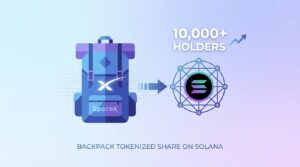
Backpack’s tokenized SpaceX share token has crossed 10,000 onchain holders on Solana, reaching the milestone just six days after listing alongside SpaceX’s Nasdaq debut. The achievement widens the holder gap against rival xStocks’ competing SpaceX product and signals growing retail appetite for tokenized equity exposure to private-market giants. Backpack CEO Armani Ferrante has positioned the product as a structural bridge between traditional equity markets and decentralized finance, a framing that appears to be resonating with crypto-native investors seeking exposure to companies like SpaceX that remain largely inaccessible through conventional brokerage channels.
What the 10,000-Holder Milestone Reveals About Tokenized Equity Demand
Before diving into the strategic implications, it’s worth grounding what this number actually represents. Ten thousand distinct onchain wallets holding a single tokenized asset within less than a week is not just a vanity metric. It reflects genuine distribution across Solana’s user base and, arguably, a faster adoption curve than most tokenized real-world asset (RWA) products have achieved in comparable timeframes.
- Backpack’s SpaceX token reached 10,000 holders in six days, outpacing rival xStocks’ equivalent product by a significant margin in holder count
- The listing was timed to coincide with SpaceX’s Nasdaq debut, leveraging public market momentum to drive onchain demand
- Solana’s low transaction costs and high throughput likely contributed to rapid holder accumulation, reducing friction for smaller retail participants
- CEO Armani Ferrante has framed the product as a structural innovation rather than a speculative instrument, positioning Backpack in the broader RWA tokenization narrative
- The holder gap with xStocks suggests early-mover advantage and brand trust are decisive factors in tokenized equity adoption
Backpack vs. xStocks: A Widening Competitive Gap
The rivalry between Backpack and xStocks over tokenized SpaceX exposure is one of the more telling competitive dynamics in the RWA space right now. Both platforms offer synthetic or tokenized representations of SpaceX shares, but the holder disparity tells a sharper story than any marketing deck could.
Backpack’s edge appears rooted in several factors. Its integration with Solana’s ecosystem gives it access to a large, active user base already comfortable with onchain transactions. And while xStocks has its own distribution channels, Backpack’s timing and execution around the Nasdaq listing created a natural demand catalyst that proved difficult to replicate.
What remains less clear is whether holder count alone translates into sustained liquidity and trading volume. A token held in 10,000 wallets but rarely traded carries different implications than one with deep, active order books. That distinction will matter more in the weeks ahead than it does today.
Why Tokenized Private Equity Access Matters Now
SpaceX has long been one of the most sought-after private companies for retail investors. Traditional access routes are limited: secondary market platforms like Forge Global or EquityZen typically require accredited investor status and minimum investments that exclude most individuals. Tokenization changes that calculus entirely.
By representing fractional SpaceX exposure as an onchain token, Backpack’s exchange platform effectively democratizes access to a company valued at over $200 billion. The product sits at the intersection of two powerful trends: the growing institutional legitimacy of tokenized real-world assets and persistent retail demand for pre-IPO or newly public tech exposure.
| Factor | Backpack SpaceX Token | Traditional Secondary Market Access |
|---|---|---|
| Minimum Investment | Fractional, no stated minimum | Typically $10,000–$50,000+ |
| Investor Requirements | Onchain wallet on Solana | Accredited investor status often required |
| Settlement Speed | Near-instant onchain | Days to weeks |
| Transparency | Holder count and transfers visible onchain | Limited visibility into secondary pricing and volume |
| Regulatory Clarity | Evolving; jurisdiction-dependent | More established but still fragmented across platforms |
The Structural Bet Ferrante Is Making
Armani Ferrante’s public commentary around the SpaceX token launch has been deliberately structural rather than promotional. He has framed Backpack not as a speculative trading venue but as infrastructure for a financial system where equity, debt, and other traditional instruments live natively onchain. That’s a bigger claim than one product can prove, but the SpaceX token serves as a compelling proof of concept.
Still, the regulatory terrain here is anything but settled. Tokenized equity products occupy a grey zone in most jurisdictions (a distinction regulators have been slow to enforce). Whether these tokens constitute securities under U.S. law depends on their exact structure, the rights they confer, and how they’re marketed. Backpack has not publicly detailed the full legal architecture underpinning the product, and that silence will eventually need to be addressed as the holder base grows.
Solana’s Role as the RWA Rails
This milestone also reinforces Solana’s positioning as the preferred blockchain for tokenized real-world assets. The network’s sub-second finality and negligible fees make it particularly suited for high-frequency, low-value transactions, exactly the profile of retail investors buying fractional SpaceX exposure. Competing chains like Ethereum and Avalanche have their own RWA ecosystems, but Solana’s throughput advantage is proving decisive for consumer-facing products.
How Tokenized Equities Reshape Investor Psychology
Beyond the mechanics of blockchain settlement and holder counts, there’s a subtler shift happening in how investors relate to assets like tokenized SpaceX shares. Traditional equity ownership carries psychological weight: brokerage statements, quarterly reports, shareholder votes. Tokenized equivalents compress that experience into a wallet balance and a blockchain explorer link. For some investors, that compression feels liberating. For others, it strips away the anchoring rituals that make ownership feel real.
This psychological dimension matters because it shapes behavior. Onchain holders tend to check balances more frequently, react faster to price movements, and engage with community narratives around the asset in ways that traditional shareholders rarely do. The result: a market caught between two frameworks of ownership, one rooted in regulatory infrastructure and the other in cryptographic proof.
Neuro-linguistic programming principles suggest that the language platforms use to describe these products directly influences adoption. Backpack’s choice to frame its offering around “access” and “structure” rather than “speculation” or “trading” is deliberate. Words like “democratize” and “fractional” activate a sense of inclusion and possibility, lowering psychological barriers to entry. Conversely, platforms that lean into trading jargon or volatility-focused messaging tend to attract a narrower, more risk-tolerant audience. The framing isn’t incidental. It shapes who shows up, how long they stay, and whether they perceive the product as an investment or a bet. As tokenized equity products mature, the platforms that master this linguistic calibration will likely capture disproportionate market share, not because their products are structurally superior, but because they make participation feel intuitive and legitimate to a broader audience.
Frequently Asked Questions
What is Backpack’s tokenized SpaceX share token?
It is a blockchain-based token on Solana that represents exposure to SpaceX equity, allowing investors to gain fractional access to the company without going through traditional secondary market platforms that often require accredited investor status.
How does it compare to xStocks’ SpaceX product?
Both offer tokenized SpaceX exposure, but Backpack has pulled ahead significantly in holder count, crossing 10,000 onchain holders within six days of listing. The competitive gap suggests differences in distribution strategy, timing, and ecosystem integration rather than fundamental product design.
Is this token a security?
That depends on jurisdiction and the specific legal structure of the token. Regulatory frameworks for tokenized equities remain unsettled in most markets, and Backpack has not publicly disclosed the full legal architecture of the product.
Why Solana?
Low fees and fast settlement. Solana’s infrastructure reduces friction for retail-sized transactions, making it practical for thousands of small holders to acquire and transfer tokens without prohibitive costs.



