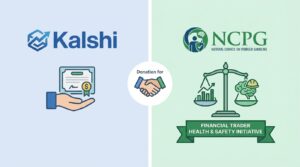
Prediction market platform Kalshi has made a financial contribution to the National Council on Problem Gambling (NCPG), earmarking the donation for a new initiative focused on the wellbeing of financial traders. The NCPG confirmed the funds will support the buildout of its Financial Trader Health and Safety Initiative, a program designed to address gambling-related harm in trading environments. The move arrives at a moment when the boundaries between prediction markets, sports betting, and speculative trading continue to blur in the eyes of both regulators and the public.
What Kalshi’s Donation Signals for Prediction Markets and Responsible Gambling
Prediction markets have spent the last two years fighting for regulatory legitimacy, and Kalshi has been at the center of that battle. By directing funds toward problem gambling infrastructure, the company is making a calculated move that acknowledges a tension most platforms in the space prefer to avoid: the behavioral overlap between trading event contracts and placing wagers. Before unpacking the initiative itself, here are the strategic takeaways worth noting.
- Industry self-regulation as a positioning tool: Kalshi’s donation positions the platform ahead of potential regulatory mandates around trader welfare, a domain where few prediction market operators have invested voluntarily.
- NCPG expands its mandate beyond traditional gambling: The Financial Trader Health and Safety Initiative represents a formal acknowledgment that trading activity can produce gambling-adjacent harms, broadening the council’s scope.
- The timing matters. With the CFTC still navigating how to classify and oversee event contracts, voluntary harm-reduction spending could influence how regulators frame future oversight.
- Precedent for the sector: If other prediction market platforms follow suit, responsible gambling frameworks could become a de facto industry standard rather than a regulatory imposition.
The Financial Trader Health and Safety Initiative
The NCPG’s new program targets a population that has historically fallen outside traditional problem gambling support structures. Financial traders, particularly those engaged in high-frequency or event-based speculation, exhibit behavioral patterns that mirror those seen in gambling disorders: compulsive engagement, loss-chasing, and difficulty disengaging during volatile periods. Yet most employer assistance programs and mental health frameworks treat trading stress as a workplace wellness issue, not a gambling-related one.
That gap is precisely what the initiative aims to close.
While the NCPG has not disclosed the exact size of Kalshi’s donation, the council indicated the funds will be directed toward research, educational resources, and outreach programs tailored to traders operating on prediction markets and adjacent platforms. The initiative also plans to develop screening tools that can help identify at-risk trading behaviors before they escalate into clinical-level problems. Whether these tools gain adoption among platforms beyond Kalshi remains an open question (and arguably the more consequential one).
Why the Line Between Trading and Gambling Keeps Getting Thinner
Kalshi operates as a CFTC-regulated exchange, offering event contracts on outcomes ranging from economic data releases to weather events. The platform has fought legal battles to distinguish its products from sports betting, most notably winning a court ruling in 2023 that allowed it to list contracts on congressional elections. But the user experience of placing a yes-or-no bet on whether GDP will exceed a certain threshold and wagering on a football game share more psychological architecture than either industry typically admits.
Behavioral research published in the Journal of Behavioral Addictions has documented how short-duration, binary-outcome financial products activate the same reward pathways as traditional gambling. The dopamine cycle triggered by a 24-hour event contract settling in your favor is, neurologically speaking, difficult to distinguish from a winning sports bet. And while Kalshi’s regulatory framework provides structural safeguards like position limits and margin requirements, those mechanisms were designed for market integrity rather than individual psychological protection.
Still, the company’s decision to fund the NCPG initiative suggests an awareness that platform design carries responsibility beyond compliance. The prediction market exchange’s approach to event-based contracts places it in a unique position to shape how the broader industry thinks about user welfare.
How Behavioral Patterns in Trading Mirror Problem Gambling
Understanding why this initiative matters requires looking at the cognitive mechanics involved. Neuro-linguistic programming research and behavioral finance studies have identified several overlapping patterns between compulsive trading and gambling disorders. Traders who engage in rapid-fire event contracts often develop anchoring biases, where previous wins or losses disproportionately shape subsequent decisions. This cognitive distortion compounds over time, creating feedback loops that are remarkably similar to those observed in slot machine users.
Loss aversion plays a particularly corrosive role. A trader who loses on three consecutive event contracts doesn’t simply absorb the financial hit; the brain reframes the next trade as a recovery opportunity rather than an independent decision. This reframing, well-documented in behavioral economics literature, is the mechanism behind loss-chasing. It operates below conscious awareness for most participants, which is exactly why screening tools and early intervention programs carry outsized importance.
Environmental cues also matter. Platform interfaces that display real-time P&L, use color-coded gain/loss indicators, and push notifications about expiring contracts create a sensory environment optimized for engagement. These design choices aren’t inherently harmful, but for individuals with predispositions toward compulsive behavior, they can accelerate problematic patterns. The NCPG’s initiative could, at least on paper, produce guidelines that influence how platforms present information to users without undermining the trading experience itself.
Metacognitive awareness training, a technique rooted in behavioral intervention research, has shown promise in helping individuals recognize when their decision-making shifts from analytical to emotional. Integrating such frameworks into trader education programs could represent a practical output of the NCPG’s work.
Regulatory Implications and What Comes Next
The CFTC has not issued formal guidance on responsible gambling obligations for prediction market operators. That absence creates both risk and opportunity. Platforms that invest proactively in harm reduction build goodwill with regulators while also establishing frameworks that could become the baseline if mandatory requirements eventually materialize.
The National Council on Problem Gambling’s expanding focus into financial trading environments also raises questions about jurisdictional boundaries. State gambling commissions, federal financial regulators, and public health agencies all have plausible claims to oversight in this space. Which entity ultimately takes the lead will shape whether trader welfare is treated as a consumer protection issue, a market integrity concern, or a public health priority.
Kalshi’s donation doesn’t resolve that ambiguity. But it does force a conversation that the prediction market industry has, until now, been content to defer.
Frequently Asked Questions
What is the NCPG’s Financial Trader Health and Safety Initiative?
It is a new program launched by the National Council on Problem Gambling to address gambling-related harms among financial traders, particularly those using prediction markets and event-based trading platforms. The initiative will fund research, develop screening tools, and create educational resources.
Why did Kalshi donate to a problem gambling organization?
Kalshi’s event contracts share behavioral characteristics with traditional gambling products. The donation signals the company’s recognition that platform operators bear some responsibility for user welfare beyond regulatory compliance, and it positions Kalshi favorably ahead of any future regulatory mandates in this area.
Are prediction markets considered gambling?
Legally, no. Kalshi operates as a CFTC-regulated exchange, and its products are classified as event contracts rather than wagers. But the psychological and behavioral dynamics involved in trading binary-outcome contracts closely parallel those found in gambling, a distinction regulators have been slow to fully address.