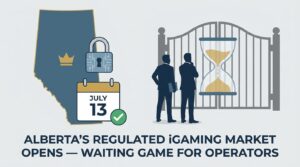
Alberta is set to launch its regulated iGaming market on July 13, making it the latest Canadian province to bring online sports betting and casino operations under a formal licensing framework. Yet private sportsbook and casino operators hoping to participate won’t be taking bets on day one. The province’s phased approach means that initially, only the government-run platform will go live, with private operators expected to follow later once licensing processes are completed. For an industry that has watched Ontario’s model closely, Alberta’s entry raises fresh questions about market design, operator access, and the pace of provincial regulation across Canada.
What Alberta’s Launch Signals for Canada’s iGaming Landscape
The decision to regulate rather than prohibit private iGaming activity places Alberta alongside Ontario as a province willing to build a competitive, multi-operator marketplace. That distinction matters. Most Canadian provinces still funnel online gambling exclusively through government-owned platforms, leaving little room for private-sector participation. Alberta’s framework, at least on paper, charts a different course.
Here are the strategic takeaways from the announcement:
- Alberta’s regulated iGaming market will officially open on July 13, initially through a government-operated platform before private operators gain access.
- Private sportsbook and casino operators must complete a licensing process before entering the market, with no confirmed timeline for when the first private licenses will be granted.
- The phased rollout mirrors elements of Ontario’s approach but introduces its own regulatory nuances that operators will need to navigate.
- Alberta’s move intensifies pressure on other provinces — British Columbia, Quebec, and others — to reconsider their own frameworks for private-sector involvement in iGaming.
- Operators already active in Ontario’s regulated market are arguably best positioned to apply early, given their existing compliance infrastructure in Canada
A Phased Rollout: Government First, Private Operators Later
The structure Alberta has chosen is deliberate. By launching with a government-run platform, the province retains control over the initial consumer experience while building the regulatory scaffolding needed to onboard private operators. This isn’t unusual in Canadian gambling regulation, but it does create a gap — one where unregulated offshore operators continue to serve Alberta residents without consequence.
How long that gap persists will determine whether the province’s model succeeds in channeling players toward licensed platforms. Ontario’s experience offers a useful, if imperfect, benchmark. When Ontario opened its market in April 2022, dozens of operators launched within weeks. Alberta appears to be taking a more cautious path, though the province has not published a detailed timeline for private-operator licensing.
Whether caution translates into credibility or simply delays market capture remains an open question.
How Alberta Compares to Ontario’s iGaming Framework
| Feature | Ontario | Alberta |
|---|---|---|
| Launch year | 2022 | 2025 | Initial operator access | Private operators from day one | Government platform first; private operators phased in |
| Regulatory body | Alcohol and Gaming Commission of Ontario (AGCO) | Alberta Gaming, Liquor & Cannabis (AGLC) |
| Market model | Open, multi-operator | Multi-operator (planned), with phased entry |
| Grey market enforcement | Ongoing challenges | Approach not yet fully detailed |
Ontario’s three-year head start gives it a data advantage that Alberta regulators would be wise to study. Still, Alberta’s smaller population base (roughly 4.8 million versus Ontario’s 15 million) means the economics look different. Operators will need to weigh market size against licensing costs and compliance overhead before committing resources.
The Operator Perspective: Opportunity Meets Uncertainty
For major international operators — and the Canadian brands already operating in Ontario — Alberta represents both opportunity and friction. The opportunity is straightforward: a new regulated market in a province with a strong sports culture and disposable income levels above the national average. The friction lies in regulatory ambiguity.
No confirmed licensing fees. No published operator requirements beyond broad regulatory principles. And no clear enforcement strategy against the grey market operators who currently serve Alberta bettors through Alberta Gaming, Liquor & Cannabis oversight gaps (a distinction regulators have been slow to address publicly).
Operators with experience navigating Ontario’s AGCO framework will recognize the pattern: regulators building the plane while flying it. But Alberta’s willingness to open the door to private participation at all puts it ahead of provinces that have shown no such inclination.
What Remains Less Clear
Several critical details have yet to surface. Will Alberta impose revenue-share models similar to Ontario’s? How will responsible gambling requirements compare? And perhaps most consequentially, will the province mandate data-sharing between operators and the regulator in ways that go beyond Ontario’s current requirements?
These aren’t peripheral questions. They shape unit economics, product design, and ultimately whether operators view Alberta as a priority market or a secondary one.
Broader Implications for Canadian Provincial Regulation
Alberta’s entry into regulated iGaming doesn’t exist in isolation. It adds momentum to a slow-moving but unmistakable trend: Canadian provinces individually deciding how — and whether — to accommodate private online gambling operators. The absence of a federal framework means each province essentially builds its own regime, creating a patchwork that operators must navigate market by market.
British Columbia, which runs its online gambling through the provincial lottery corporation, has shown little appetite for opening to private operators. Quebec’s model similarly keeps things in-house. Alberta’s decision to go multi-operator, even with a cautious rollout, could shift the political calculus in those provinces — particularly if Alberta demonstrates meaningful tax revenue gains and improved channelization rates.
And while the federal government has shown no interest in harmonizing provincial approaches, the growing divergence between provinces may eventually force that conversation.
Frequently Asked Questions
When does Alberta’s iGaming market officially launch?
The regulated market opens on July 13, 2025, initially through a government-operated platform run under the Alberta Gaming, Liquor & Cannabis (AGLC) framework.
Can private operators offer sports betting or online casino games in Alberta right away?
No. Private sportsbook and casino operators will need to complete a licensing process before they can enter the market. The province has not yet confirmed a specific date for when private-operator licenses will be issued, so the timeline remains uncertain.
How does Alberta’s approach differ from Ontario’s?
Ontario allowed private operators to launch alongside its regulated market from day one in April 2022. Alberta is taking a phased approach, starting with a government platform and adding private operators later. The regulatory bodies also differ — AGCO oversees Ontario, while AGLC manages Alberta’s framework. Beyond structure, the two provinces face very different market-size dynamics that will influence operator strategy.
Will this affect other Canadian provinces?
Potentially. Alberta joining Ontario as a multi-operator market increases pressure on provinces like British Columbia and Quebec to reconsider their government-only models, especially if Alberta shows strong revenue performance and player channelization from grey-market sites to regulated ones.



