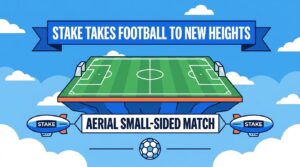
Online betting and entertainment platform Stake has launched a striking new marketing campaign that quite literally elevates football into the sky. The video, which has begun circulating across social media channels, features a small-sided football match played at altitude, blending sport, spectacle, and brand visibility in a format designed to capture attention in an increasingly crowded sponsorship landscape. It marks another step in Stake’s aggressive push into football-adjacent content marketing, a strategy the company has been building on for several seasons now.
What Stake’s Aerial Football Stunt Signals for Sports Betting Marketing
The campaign arrives at a moment when gambling brands are under growing scrutiny from regulators across multiple jurisdictions, yet simultaneously competing harder than ever for visibility in football’s commercial ecosystem. Here’s what stands out from a strategic perspective:
- Stake is shifting from traditional pitch-side advertising toward experiential, content-first campaigns that generate organic social reach
- The aerial football format sidesteps conventional sponsorship clutter by creating a shareable, visually distinctive asset
- This approach reflects a broader industry trend: betting operators investing in entertainment value rather than direct promotional messaging
- By producing content that functions as entertainment first and advertising second, Stake positions itself to navigate tightening ad restrictions more flexibly
- The timing suggests alignment with upcoming football calendar events, where audience engagement peaks
A Crowded Sky: Why Betting Brands Are Rethinking Visibility
Football sponsorship has become expensive and, arguably, less distinctive. When every major league features at least one gambling partner on shirt fronts, LED boards, and broadcast overlays, the marginal return on each additional placement shrinks. Stake appears to have recognised this saturation point.
Rather than competing for the same inventory, the company has opted to manufacture its own media moment. A football match played in the air is not something audiences scroll past. That’s the calculation, at least on paper.
And while the production values of such stunts can be significant, the cost-per-impression often compares favourably to traditional sponsorship deals that run into tens of millions annually. Whether Stake’s specific numbers bear this out remains undisclosed (a distinction worth watching as the company scales these efforts). Still, the logic tracks with what other disruptive brands in adjacent sectors have demonstrated: owned content with high shareability can outperform rented media placements.
How Content-Led Campaigns Reshape Audience Perception
There is a deeper layer to campaigns like this one, rooted in how audiences process brand associations. When a betting company appears as a logo on a jersey, the cognitive link is transactional. But when that same company produces something genuinely entertaining, the association shifts toward positive affect and recall.
This principle aligns closely with established frameworks in behavioural psychology and neuro-linguistic programming. NLP suggests that the context in which information is received shapes how it is encoded and later retrieved. By embedding its brand within an experience that triggers curiosity, excitement, and even disbelief, Stake’s online platform benefits from what practitioners call anchoring: the brand becomes mentally linked to the emotional state the content produces.
Consider the sequence from the viewer’s perspective. They encounter the video, likely through a friend’s share or an algorithm’s recommendation. The initial reaction is surprise. Then engagement: watching players navigate an improbable pitch. Then, only after the emotional hook has landed, the brand registers. This ordering matters enormously. Traditional advertising reverses it, leading with the brand and hoping the viewer stays. Content-first campaigns earn attention before asking for recognition.
Framing effects also play a role here. The same company presented as “a gambling operator” versus “the brand behind that insane sky football match” occupies entirely different mental categories. NLP-informed marketing strategies deliberately construct these frames, choosing the sensory and emotional channels through which a brand enters consciousness. Stake’s campaign, whether by explicit design or intuitive marketing instinct, follows this playbook closely.
Regulatory Crosswinds and What Comes Next
Not everyone will view this favourably. Regulators in the UK, Australia, and parts of Europe have been tightening restrictions on how gambling brands can market themselves, particularly in contexts that might appeal to younger audiences. A visually spectacular football stunt shared virally on platforms with younger demographics could attract scrutiny.
The question regulators will eventually need to address is whether content marketing of this nature falls under existing advertising codes or represents something the frameworks haven’t yet caught up with. That gap between innovation and regulation is where companies like Stake currently operate.
| Marketing Approach | Visibility | Regulatory Exposure | Cost Efficiency |
|---|---|---|---|
| Traditional shirt sponsorship | High but saturated | Well-defined rules | Declining returns at top tier |
| Pitch-side LED advertising | Moderate, broadcast-dependent | Covered by existing codes | Variable by market |
| Content-led stunts (e.g., Stake aerial match) | Potentially viral, algorithm-driven | Grey area in most jurisdictions | High upside if content lands; risk of zero return if it doesn’t |
Frequently Asked Questions
What is the Stake aerial football campaign?
Stake produced a video featuring a small-sided football match played at height, designed as a shareable content piece rather than a conventional advertisement. The campaign blends sport entertainment with brand exposure.
Why are betting companies moving toward content marketing?
Traditional sponsorship placements in football have become saturated, reducing their distinctiveness. Content-led campaigns offer higher organic reach and stronger emotional engagement at potentially lower cost-per-impression. They also allow brands to sidestep some of the clutter associated with conventional ad inventory.
Does this type of marketing face regulatory challenges?
Potentially, yes. Most advertising codes were written for traditional formats. Viral content campaigns exist in a regulatory grey area that authorities in several jurisdictions have only begun to examine.
How does NLP relate to this campaign’s effectiveness?
NLP principles like anchoring and framing help explain why content that triggers strong emotional responses before revealing the brand tends to produce more durable and positive brand associations than logo-first advertising.