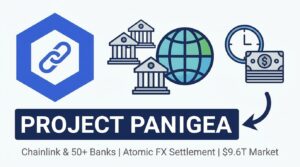
Chainlink, alongside a multinational banking consortium spanning more than 50 institutions across 16 countries, unveiled Project Pangea at the Point Zero Forum in Zurich on Tuesday. The initiative targets T+0 atomic settlement for the global foreign exchange market, which processes roughly $9.6 trillion in daily volume. By combining Chainlink’s oracle infrastructure with institutional-grade blockchain rails, the project aims to compress what currently takes one or two business days into near-instantaneous finality. It is, at least on paper, one of the most ambitious attempts to rewire the plumbing beneath global currency trading.
Why Project Pangea Signals a Structural Shift in FX Settlement
The foreign exchange market has operated on delayed settlement cycles for decades, with T+1 or T+2 windows that introduce counterparty risk, tie up capital, and create reconciliation headaches across time zones. Project Pangea doesn’t merely propose incremental improvement. It proposes elimination of the settlement gap entirely through atomic settlement, where both legs of a trade either complete simultaneously or not at all.
Before diving into the mechanics, here’s what matters for decision-makers watching this space:
- Scale of participation: More than 50 financial institutions across 16 countries have joined the consortium, giving the project a geographic and institutional breadth that most blockchain pilots lack
- Market size at stake: The global FX market moves $9.6 trillion daily; even marginal efficiency gains at this scale translate into billions in freed capital and reduced operational cost
- T+0 atomic settlement would effectively remove Herstatt risk, the decades-old problem of one party delivering currency while the other defaults before completing their side
- Chainlink’s oracle layer serves as the connective tissue between on-chain settlement logic and off-chain market data, pricing feeds, and institutional systems
- The announcement’s timing at Point Zero Forum in Zurich places it squarely in front of central bankers and regulators already debating tokenized finance frameworks
How Atomic Settlement Reshapes Counterparty Risk
Settlement risk in FX isn’t theoretical. The Bank for International Settlements has repeatedly flagged it as a systemic vulnerability, with a 2022 survey estimating that $2.2 trillion in daily FX turnover remained exposed to settlement failure. CLS Bank, the dominant settlement utility, handles a significant share of global FX volume but still operates within conventional settlement windows.
Project Pangea’s approach bypasses that constraint. Atomic settlement means both currencies in a trade are exchanged in a single, indivisible transaction on-chain. No waiting. No window of exposure where one counterparty has paid and the other hasn’t. The mechanism relies on Chainlink’s cross-chain interoperability and oracle infrastructure to bridge real-world pricing data with on-chain execution logic, ensuring that settlement conditions reflect live market reality rather than stale reference rates.
Whether this architecture can absorb the throughput demands of a market that processes trillions daily remains the open engineering question.
The Consortium’s Geographic Reach Matters More Than Its Size
Fifty institutions is a notable number. But the 16-country spread is arguably more significant. FX settlement complexity scales with jurisdictional diversity: different regulatory regimes, different central bank operating hours, different payment system architectures. A consortium concentrated in one region would face a narrower set of problems. Pangea, by design, confronts the full spectrum.
That geographic ambition also introduces friction. Regulatory alignment across 16 jurisdictions is not something that resolves quickly (a distinction regulators have been slow to enforce in tokenized asset discussions more broadly). Still, the consortium’s willingness to launch with this breadth suggests that participating banks see enough strategic value to absorb the coordination cost upfront.
What Sets This Apart from Previous Blockchain-FX Pilots
The blockchain-in-banking narrative has produced no shortage of pilot projects over the past decade, many of which quietly faded after the press release. Three features distinguish Pangea from earlier efforts:
| Feature | Previous Pilots | Project Pangea |
|---|---|---|
| Settlement target | T+1 improvement | T+0 atomic finality |
| Consortium scale | Typically 5–15 banks, single region | 50+ institutions, 16 countries |
| Oracle integration | Limited or absent | Chainlink oracle layer for real-time pricing and cross-chain data |
| Regulatory engagement | Often post-hoc | Launched at a forum attended by central bankers and financial regulators |
Institutional Blockchain Adoption: Reading the Momentum
Project Pangea arrives during a period of accelerating institutional engagement with blockchain infrastructure. Swift has been running tokenized asset settlement experiments. JPMorgan’s Onyx platform processes billions in repo transactions. The European Central Bank is deep into its digital euro exploration. And central banks in Singapore, Switzerland, and the UAE have each run cross-border CBDC pilots that touch on the same settlement problems Pangea targets.
What’s different here is the directness of the value proposition. FX settlement isn’t a speculative use case. It’s a measurable, quantifiable inefficiency that costs the global banking system real money every day. The $9.6 trillion daily volume figure isn’t aspirational; it’s the existing market that Pangea aims to serve more efficiently.
Yet the gap between a consortium announcement and production-grade infrastructure remains wide. Integration with existing treasury management systems, compliance with anti-money laundering frameworks across jurisdictions, and the sheer latency requirements of high-frequency FX trading all present hurdles that no whitepaper can resolve.
Frequently Asked Questions
What is T+0 atomic settlement?
It refers to the simultaneous exchange of both sides of a trade in a single transaction, with no time delay between execution and final settlement. Both parties either receive their respective currencies instantly, or the transaction doesn’t execute at all.
Why does FX settlement still take one to two days?
Legacy infrastructure, time zone mismatches, and the involvement of multiple intermediaries (correspondent banks, settlement utilities, clearinghouses) all contribute to the delay. These systems were built decades ago and have been patched rather than replaced.
How does Chainlink fit into this?
Chainlink provides the oracle layer that feeds real-time market data into the on-chain settlement process, along with cross-chain interoperability tools that allow different blockchain networks and institutional systems to communicate. Without reliable external data, atomic settlement logic can’t function accurately.
Is Project Pangea live?
The project was announced at Point Zero Forum in Zurich. Details on timeline, phased rollout, or production deployment have not been fully disclosed. The consortium structure suggests an extended development and testing period ahead.
What Comes After the Announcement
The real test for Project Pangea won’t be measured in press coverage or consortium headcount. It will be measured in whether a single live FX trade settles atomically between two banks in different countries under real regulatory conditions. That milestone, whenever it arrives, would represent something the industry has discussed for years but never delivered at scale. The infrastructure is being assembled. The institutions are at the table. And the $9.6 trillion question is whether the architecture holds when the volume hits.