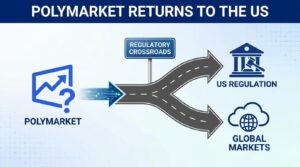
Polymarket, the blockchain-based prediction market platform, has re-entered the United States after years of operating under a cloud of regulatory restriction. The move comes amid shifting political sentiment toward prediction markets and decentralized finance, but it also raises pointed questions about federal oversight, consumer protection, and the legal boundaries of event-based wagering. What looked like a triumphant homecoming is quickly becoming a test case for how Washington intends to regulate an asset class that sits uncomfortably between financial derivatives and online gambling.
What Polymarket’s US Return Signals for the Industry
The platform’s decision to re-engage with US users carries weight beyond its own business trajectory. It reflects a broader recalibration happening across prediction markets, crypto-native platforms, and the agencies tasked with policing them. Here are the strategic takeaways worth tracking:
- Regulatory ambiguity persists: No single federal agency has claimed definitive jurisdiction over prediction markets, leaving platforms to navigate overlapping frameworks from the CFTC, SEC, and state-level regulators
- Polymarket previously settled with the CFTC in 2022 for $1.4 million over operating an unregistered trading facility, making its return a calculated bet on a friendlier enforcement climate
- Political tailwinds may be temporary. The current administration’s warmer posture toward crypto and decentralized platforms does not guarantee long-term regulatory clarity
- Competitors like Kalshi have pursued a compliance-first strategy through CFTC-approved designation as a regulated exchange, creating a visible contrast in approach
- User demand is real: Polymarket saw record trading volumes during the 2024 US presidential election cycle, proving that appetite for political event contracts extends well beyond niche crypto audiences
The CFTC Settlement and What Changed
In January 2022, the Commodity Futures Trading Commission reached a consent order with Polymarket, citing the platform’s failure to register as a designated contract market or swap execution facility. The $1.4 million penalty was modest by enforcement standards, but the message was clear: operating prediction markets tied to real-world events without proper registration violated the Commodity Exchange Act.
Polymarket subsequently restricted access for US-based users. Yet the platform continued to grow internationally, particularly around high-profile political and geopolitical events. Trading volumes surged during the 2024 election season, with some individual markets attracting hundreds of millions of dollars in open interest. That growth, arguably, gave Polymarket the leverage and visibility to revisit the US question from a position of strength rather than desperation.
Still, the legal landscape hasn’t fundamentally shifted. The CFTC has not issued new guidance specifically accommodating blockchain-based prediction markets, and the agency’s own internal debates about event contracts (a distinction regulators have been slow to codify) remain unresolved.
How Prediction Markets Sit Between Two Regulatory Worlds
The core tension is structural. Prediction markets function like financial derivatives in some respects: users take positions on binary outcomes, prices reflect implied probabilities, and contracts settle based on verifiable events. But they also resemble gambling, particularly when the events in question are elections, celebrity behavior, or weather patterns. That dual identity creates jurisdictional friction.
The CFTC has historically treated event contracts with caution. Under the Dodd-Frank Act, the agency can review and potentially prohibit contracts involving “activity unlawful under any Federal or State law,” terrorism, or gaming. Political event contracts occupy a gray zone. Kalshi won a federal court ruling in 2023 allowing it to list congressional control contracts after the CFTC initially blocked them, but that decision applied narrowly and is still being tested through subsequent regulatory actions.
Polymarket’s model adds another layer. Built on the Polygon blockchain, its contracts settle in USDC, a stablecoin. Whether these instruments qualify as commodities, securities, or something else entirely depends on which regulator you ask. And while Polymarket’s prediction trading platform has attracted institutional-grade volume, its decentralized architecture complicates traditional compliance frameworks around KYC and AML obligations.
Why the Timing Matters
Polymarket’s return coincides with a broader deregulatory posture from the current US administration toward digital assets. The SEC has pulled back on several crypto enforcement actions, and legislative proposals around stablecoin regulation and market structure are advancing through Congress with bipartisan support. That environment creates a window, but windows close.
What remains less clear is whether Polymarket intends to pursue formal registration or operate under an assumption that enforcement priorities have shifted. The difference matters enormously. A registered prediction market gains legal certainty and institutional credibility. An unregistered one operates on borrowed time, regardless of how favorable the political winds seem.
Competitive Dynamics and Market Structure
| Platform | Regulatory Status | Settlement Layer | Key Differentiator |
|---|---|---|---|
| Polymarket | Previously settled with CFTC; current US status under review | Polygon (USDC) | Largest volume in political event markets globally |
| Kalshi | CFTC-designated contract market | Traditional (USD) | Compliance-first approach; won federal court ruling on election contracts |
| PredictIt | Operated under CFTC no-action letter (now revoked) | Traditional (USD) | Academic origins; winding down operations |
The competitive picture is shifting fast. PredictIt, once the dominant US prediction market under a CFTC no-action letter, has been forced to wind down after the agency revoked its exemption. Kalshi has positioned itself as the regulated alternative. And Polymarket, with its crypto-native infrastructure and massive user base, occupies a third lane entirely.
What This Means for Traders and Institutions
For retail participants, Polymarket’s US availability opens access to a platform with deep liquidity and a proven track record on event pricing accuracy. But the absence of formal regulatory approval means user protections remain thin, at least on paper. There is no FDIC-equivalent backstop, no regulated clearinghouse, and limited recourse if contracts settle incorrectly or the platform faces enforcement action.
Institutional players face a different calculus. Some hedge funds and proprietary trading firms have already engaged with Polymarket’s markets for informational value and hedging purposes. A clearer regulatory framework would likely accelerate institutional adoption, but few compliance departments will approve direct participation on an unregistered platform, regardless of volume or market depth.
Frequently Asked Questions
Is Polymarket legal in the United States?
Polymarket previously restricted US access following its 2022 CFTC settlement. Its current re-entry into the US market has not been accompanied by a public announcement of new regulatory approval, and the platform’s legal status for US users remains a subject of active debate among legal scholars and market participants.
How does Polymarket differ from Kalshi?
Kalshi operates as a CFTC-designated contract market with full regulatory approval. Polymarket runs on blockchain infrastructure, settles in stablecoins, and has historically operated outside the traditional regulatory perimeter. The two platforms target overlapping markets but from fundamentally different compliance postures.
Can prediction markets predict elections accurately?
Prediction markets have demonstrated strong calibration on binary political outcomes, often outperforming polling averages in the final days before elections. They are not infallible. But the aggregation of real-money positions tends to surface information that surveys miss, particularly around turnout dynamics and late-breaking sentiment shifts.
What risks do users face on unregistered prediction platforms?
Users on unregistered platforms lack the protections afforded by regulated exchanges, including segregated customer funds, dispute resolution mechanisms, and regulatory oversight of market integrity. Enforcement action against the platform itself could also disrupt access to funds or open positions without warning.



