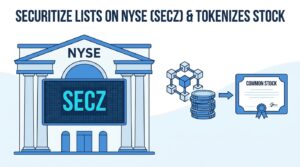
Securitize made its public market debut on the New York Stock Exchange Thursday, trading under the ticker SECZ. But the firm didn’t stop at a conventional listing. In a move that blurs the boundary between traditional capital markets and blockchain infrastructure, the tokenization company simultaneously placed its own newly listed common stock onchain. Eligible U.S. investors can now access tokenized SECZ shares, a step that positions Securitize as both issuer and proof-of-concept for the technology it sells.
What Securitize’s Dual-Track Listing Signals for Tokenization
The decision to tokenize its own equity at the moment of listing carries strategic weight that goes beyond symbolism. Here’s a short framing before the key points: when a company whose entire business model rests on digitizing real-world assets chooses to eat its own cooking on day one of public trading, the signal to institutional buyers, regulators, and competitors is hard to miss.
- Market credibility through self-reference: By tokenizing SECZ shares, Securitize demonstrates live, production-grade functionality of its platform under the scrutiny that comes with a public listing on the NYSE.
- Regulatory positioning: Listing on a major U.S. exchange while simultaneously offering onchain access suggests the company has navigated, or at least engaged with, the compliance architecture required for dual-format equity distribution.
- The move arguably pressures rival tokenization platforms to accelerate their own public market strategies or risk ceding first-mover perception.
- Investor access expansion: Tokenized shares could eventually lower friction for certain investor classes, particularly those operating in digital-asset-native custody environments.
- Whether this translates into meaningful secondary market liquidity for the tokenized version remains an open question that trading data over the coming weeks will begin to answer.
How the Onchain Listing Works
According to the press release distributed via PR Newswire, eligible U.S. investors can access tokenized SECZ through Securitize’s own infrastructure. The mechanics involve representing NYSE-listed common stock as digital tokens on a blockchain, with each token corresponding to a share of the underlying equity. This isn’t a synthetic derivative or a wrapped asset. It’s the same security, expressed in a different format.
That distinction matters. Tokenized equities that mirror registered securities carry different regulatory implications than utility tokens or stablecoins. And while the concept has been discussed in boardrooms and pilot programs for years, a company tokenizing its own stock at the point of IPO on a venue like the NYSE is a tangible escalation.
Why This Matters Beyond Securitize
The broader tokenization market has been gaining institutional traction. BlackRock’s BUIDL fund, which Securitize helped bring to market as a tokenized money market vehicle, crossed significant asset thresholds in 2024. Franklin Templeton, JPMorgan, and others have run tokenization pilots across treasuries, bonds, and private credit. Still, most of these efforts have involved tokenizing someone else’s assets.
Securitize tokenizing its own publicly traded equity is a different proposition. It collapses the distance between platform provider and asset issuer, creating a feedback loop where the company’s stock performance and its technology’s credibility become intertwined in a way that’s unusually direct (a dynamic that could cut both ways if technical issues surface post-listing).
A Competitive Landscape in Flux
Several firms occupy adjacent territory. tZERO has operated a regulated alternative trading system for digital securities. Polymath pivoted toward infrastructure. Ondo Finance has focused on tokenized yield products. Yet none of these competitors have simultaneously listed on a top-tier U.S. exchange and tokenized their own shares in a single event.
That gap won’t last forever. But for now, Securitize holds a narrative advantage that institutional allocators tend to reward, at least in early innings.
Reframing Investor Psychology Around Tokenized Equities
One underexplored dimension of this development involves how investors mentally categorize tokenized stocks. Behavioral finance research consistently shows that format and framing influence decision-making, even when the underlying economics are identical. A tokenized share of SECZ and a traditionally settled share of SECZ represent the same ownership claim. Yet the investor who holds the tokenized version may perceive different attributes: faster settlement, 24/7 transferability, programmable compliance.
These perceived attributes can shape portfolio construction choices in subtle but measurable ways. Institutional investors evaluating digital-asset custody solutions may view tokenized SECZ as a low-risk entry point for testing blockchain-based settlement workflows. Retail participants already comfortable with crypto wallets might find tokenized equities more intuitive than brokerage accounts. Neither group is irrational. They’re responding to interface design and operational familiarity, forces that traditional finance has historically underweighted.
What Securitize has done, in effect, is create a live A/B test between two distribution formats for the same security. The behavioral data generated by this experiment could prove as valuable as the capital raised.
Regulatory Implications Worth Watching
The SEC has not issued comprehensive guidance on tokenized registered securities trading in parallel with their traditional counterparts on a national exchange. Securitize’s approach appears to operate within existing frameworks, but the absence of explicit rulemaking leaves interpretive room. Whether the Commission views this as innovation within bounds or a precedent requiring new guardrails will likely depend on how the tokenized shares behave in practice: settlement times, custody chains, and investor protection mechanisms will all face scrutiny.
State-level regulators may also take interest, particularly around custody requirements for tokenized securities held in self-hosted wallets versus qualified custodians.
Frequently Asked Questions
What is Securitize?
Securitize is a digital asset securities firm that provides technology for issuing, managing, and trading tokenized real-world assets. The company has worked with major financial institutions including BlackRock on tokenized fund products.
What does it mean to tokenize a stock?
Tokenizing a stock means representing traditional equity shares as digital tokens on a blockchain. The tokens correspond to the same legal ownership rights as conventionally held shares, but they can be transferred and settled using blockchain infrastructure.
Can anyone buy tokenized SECZ shares?
Access to tokenized SECZ is currently limited to eligible U.S. investors through Securitize’s platform. Specific eligibility criteria have not been fully detailed in the initial announcement, so prospective buyers should verify requirements directly.
Is this the first NYSE-listed company to tokenize its own stock at IPO?
Based on available information, Securitize’s simultaneous NYSE listing and onchain tokenization of its own common stock appears to be a first for a major U.S. exchange. Previous tokenization efforts have typically involved assets issued by third parties or operated on alternative trading systems.